
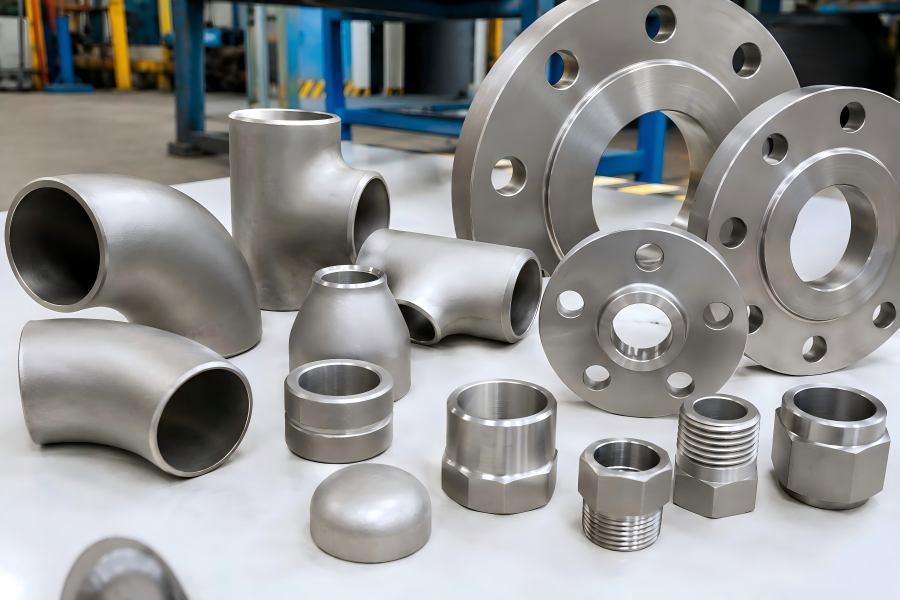
You encounter ASME, ASTM, ANSI, and DIN as the most common pipe fitting standards in the industry. These standards shape the safety, compatibility, and quality of piping systems. Engineers, contractors, and project managers rely on them for dependable performance.
- ASME delivers robust guidelines for pressure and temperature-critical applications, such as steam piping and refineries.
- ASTM sets material property and testing requirements, ensuring you use reliable components.
- ANSI coordinates standards, promoting compatibility and harmonization across systems.
- DIN supports engineering quality and compatibility, especially in European projects.
Pipe Fitting Standards Overview
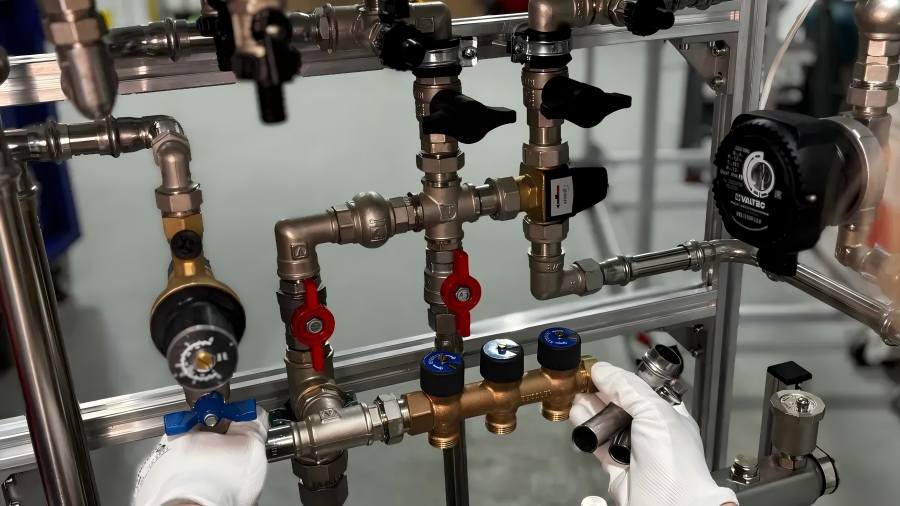
You need to understand the organizations behind pipe fitting standards to make informed decisions in your projects. Each group shapes the industry in unique ways, setting requirements for materials, dimensions, and performance.
ASME and ANSI
ASME and ANSI play central roles in American pipe fitting regulation. ASME creates standards and guidelines for applications that depend on temperature and pressure. ANSI coordinates voluntary standardization and assigns schedule numbers for wall thickness classifications. You often see their standards in the B16 series, which covers cast iron, malleable iron, steel, and flanges.
Here’s a quick comparison of their roles:
| Organization | Role in Pipe Fitting Standards |
| ANSI | Coordinates U.S. standards, assigns schedule numbers |
| ASME | Develops codes and standards, including B16 classifications |
Common ASME/ANSI standards include:
- B16.1: Flanges and flanged fittings made from cast iron
- B16.3: Malleable Iron Threaded Fittings
- B16.5: Pipe Flanges and Flanged Fittings
- B16.9: Factory-Made Wrought Steel Butt-welding Fittings
ASTM
ASTM focuses on material properties and testing. You rely on ASTM standards to ensure quality and compatibility in oil and gas, construction, manufacturing, and power generation.
| Aspect | ASME | ASTM |
| Material Designation | SA | A |
| Inspection Requirements | More inspection items | Fewer inspection items |
The following ASTM standards are commonly referenced:
- A106: Seamless carbon steel piping for operation at elevated temperatures
- A182: Forged pipe flanges produced from alloy steel and stainless steel
- A234: Wrought pipe fittings manufactured from carbon steel and alloy steel
- A403: Austenitic Stainless Steel Fittings
DIN
DIN sets industrial standards in Germany and Europe. You use DIN Pipe Fitting Standards for projects requiring metric measurements and nominal diameter (DN) conventions. DIN covers pipes, tubes, and fittings made from steel, cast iron, and bronze.
| Standard | Measurement System | Naming Convention | Description |
| DIN | Metric | DN | Close to actual OD in mm |
| ANSI | Imperial | NPS | Nominal size, varies by schedule |
You select the right standard based on project location, material requirements, and compatibility needs. Understanding these organizations helps you navigate Pipe Fitting Standards confidently.
ASME and ANSI Standards
ASME B16 Series
You rely on the ASME B16 series when you need consistent Pipe Fitting Standards for demanding environments. This series covers a wide range of fittings and materials, ensuring you meet safety and compatibility requirements.
- ASME/ANSI B16.1 covers cast iron pipe flanges and flanged fittings, specifying pressure-temperature ratings, material requirements, and testing methods.
- ASME/ANSI B16.3 specifies malleable iron threaded fittings, with clear guidelines for dimensions, tolerances, and coatings.
- ASME/ANSI B16.4 details gray iron threaded fittings, focusing on size designation and threading.
- ASME/ANSI B16.5 includes pipe flanges and flanged fittings, covering materials, dimensions, and marking.
- ASME/ANSI B16.9 focuses on factory-made wrought steel butt-welding fittings, ensuring precise tolerances and testing.
- ASME/ANSI B16.11 applies to forged steel socket-weld and threaded fittings, with strict requirements for pressure ratings and materials.
These standards define the essential features for each fitting, so you can trust their performance in critical applications.
ANSI Flanges and Dimensions
You must pay attention to dimensional standards when selecting ANSI flanges. The ASME B16 standards specify exact measurements, tolerances, and material specifications. This ensures compatibility across manufacturers and projects.
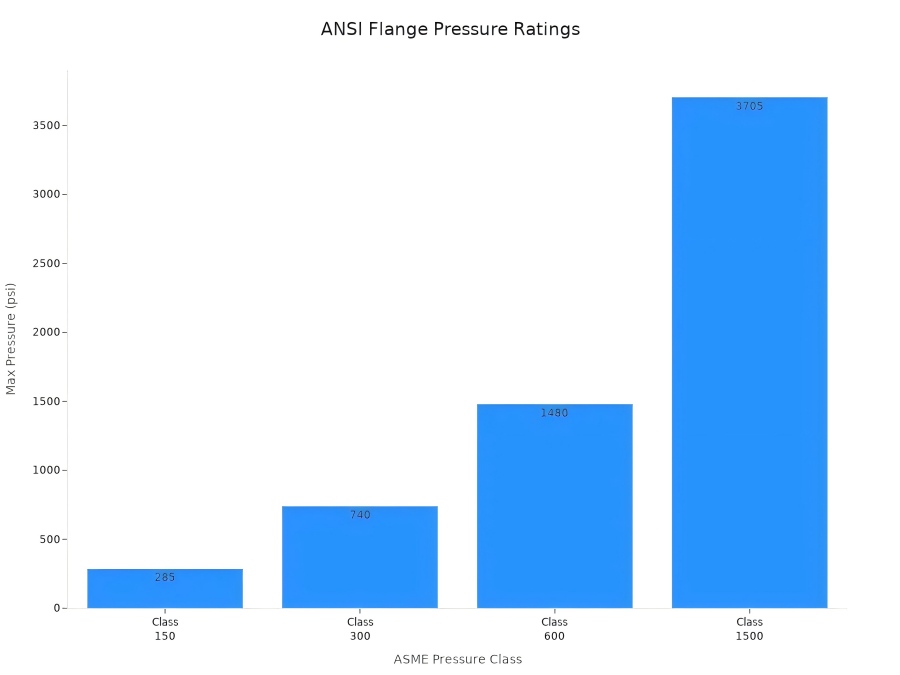
| ASME Pressure Class | Typical Pressure Capacity | Common Applications |
| Class 150 | Up to approximately 285 psi | Water systems, HVAC systems, low-pressure steam lines, fire protection systems |
| Class 300 | Up to approximately 740 psi | Process piping, compressed air systems, hydrocarbon service |
| Class 600 | Up to approximately 1,480 psi | Oil and gas processing, steam systems, chemical plants |
| Class 1500 | Up to approximately 3,705 psi | High-pressure reactors, critical steam systems |
Application Areas
You encounter ASME and ANSI pipe fitting standards in many industries. These standards support safe and reliable operation in the following areas:
| Application Area | Description |
| Oil & Gas Pipelines | Transporting petroleum products under extreme pressures. |
| Chemical Processing | Resistant to chemical exposure and corrosion. |
| Power Generation | Steam, cooling water, pressure vessels. |
| Water & Wastewater | Municipal piping networks and treatment plants. |
| Manufacturing & Industrial Facilities | Process lines, compressed air systems, mechanical equipment. |
| HVAC Mechanical Systems | Chilled water, steam, hydronic heating loops. |
You select these standards to ensure your piping systems meet industry requirements for safety, durability, and performance.
ASTM Pipe Fitting Standards
ASTM sets the benchmark for material quality and testing in the world of pipe fittings. You depend on these standards to guarantee that every fitting meets strict requirements for strength, durability, and compatibility. When you select fittings for demanding environments, ASTM standards give you the confidence that your system will perform as expected.
ASTM A234 and A403
You often encounter ASTM A234 and ASTM A403 when specifying fittings for industrial projects. ASTM A234 applies to carbon and alloy steel fittings for high-temperature and high-pressure service, while ASTM A403 covers stainless steel fittings with strong corrosion resistance and high-temperature strength.
| Standard | Material Type | Application Focus |
| ASTM A234 | Carbon steel and alloy steel | High-temperature and high-pressure uses |
| ASTM A403 | Stainless steel | High-temperature strength and resistance to corrosion |
You choose between these standards based on the environment and the specific performance needs of your piping system.
Material Specifications
ASTM material specifications define the essential qualities of pipe fittings. You rely on these specifications to ensure that each fitting will perform reliably under pressure, temperature, and chemical exposure. The standards detail everything from material composition to mechanical properties and testing protocols.
| Aspect | Contribution to Quality |
| Material composition | Ensures predictable properties of metals, alloys, or plastics. |
| Mechanical properties | Cover tensile strength, hardness, and ductility characteristics. |
| Testing protocols | Include pressure, impact, and corrosion resistance tests. |
- ASTM A234: A standard covering piping fittings made from wrought carbon steel and alloy steel for use in moderate to high-temperature applications.
- ASTM A403: Standard specification for wrought austenitic stainless steel pipe fittings used in piping systems.
Testing and Quality
You need assurance that every fitting will withstand the demands of your system. ASTM standards require rigorous testing to verify pressure ratings, mechanical strength, and long-term durability. For example, you will see procedures for establishing pressure ratings by testing water-filled assemblies and evaluating failure data over time. Standards also require hydrostatic pressure testing and consider temperature and chemical compatibility for each fitting.
| Section | Description |
| 1.1 | Evaluates water-filled pipe and fitting assemblies to determine the pressure rating. |
| 4.1 | Determines long-term pressure rating based on failure data over time. |
| 4.2 | Evaluates hydrostatic pressure strength at specified durations. |
| 1.7 | Considers temperature and chemical compatibility for pressurized liquids. |
By following ASTM Pipe Fitting Standards, you ensure that your piping systems meet the highest levels of quality and reliability.
DIN Pipe Fitting Standards
DIN Material Types
You encounter DIN standards most often in European and international projects. These standards set strict requirements for pipe fittings, focusing on precision and reliability. Steel, cast iron, and bronze are only a few of the many materials covered by DIN. You will notice that DIN 2615, for example, specifies both dimensional requirements and material properties. This standard helps you achieve better fit-up and welding performance by controlling wall thickness and surface finish.
When you compare DIN to ASME and ASTM, you see that DIN often demands higher impact toughness and better low-temperature performance. You also find that DIN and EN standards require more non-destructive testing and thorough material checks. This approach ensures that your fittings perform well under tough conditions.
DIN emphasizes:
- Tight tolerances for manufacturing
- Rigorous quality control
- Enhanced material performance for demanding environments
Dimensional Standards
You need to pay close attention to dimensional tolerances when working with DIN Pipe Fitting Standards. DIN sets clear limits for every measurement, which helps you achieve consistent results across different suppliers.
Common DIN tolerances include:
- Outer diameter tolerance: ±0.3 mm for pipes with a diameter up to 110 mm
- Wall thickness tolerance: ±10%
- Socket and spigot fit: ±0.2 mm clearance for solvent welding applications
- Straightness requirement: Maximum deviation of 0.5% of pipe length
These precise tolerances help you avoid leaks and ensure a snug fit, especially when you work with metric sizing and DN (nominal diameter) conventions.
Regional Use
You will find DIN Pipe Fitting Standards used widely in Europe, the Middle East, and many international projects. These standards support metric measurements and DN sizing, making them ideal for regions that do not use imperial units. If you work on projects that cross borders, you must check compatibility between DIN and other standards like ANSI or ASME.
DIN standards give you confidence in the quality and consistency of your piping systems, especially when you need to meet strict European regulations.
Comparing Pipe Fitting Standards
Key Differences
You need to understand the main differences between ASME, ASTM, ANSI, and DIN to make informed decisions for your piping projects. Each standard serves a unique purpose and covers different aspects of pipe fittings. ASME focuses on design, construction, and safety codes for pressure systems. ASTM sets the rules for material properties and testing methods. ANSI coordinates and approves standards throughout the United States, ensuring uniformity and harmonization.DIN, widely used in Europe, emphasizes precision, metric sizing, and strict quality control.
The main areas of emphasis for each standard are shown in the following table:
| Standard | Focus Area | Example |
| ASTM | Material properties, testing methods, and specifications | ASTM A106 – Standard specification for seamless carbon steel pipes |
| ASME | Design, construction, and safety codes | ASME Section VIII – Pressure Vessel Code |
| ANSI | Coordination and approval of U.S. standards | ANSI oversees and harmonizes standards for U.S. industries |
| DIN | Metric-based dimensional and quality standards | DIN 2615 – Tees for steel pipes |
You will notice that ASME and ASTM often work together in American projects, while DIN dominates in European and some international markets. ANSI acts as the umbrella organization, ensuring that standards like ASME and ASTM align with national requirements.
Overlaps and Compatibility
You may encounter situations where different standards overlap or need to work together. For example, ASME and ASTM often reference each other. ASME may specify the design and dimensions, while ASTM defines the material properties. This overlap helps you achieve both safety and quality in your piping systems.
However, compatibility issues can arise when you mix standards from different regions. Here are some common challenges:
- Dimensional mismatch: A 2-inch ASME tube does not match a DN50 DIN tube in outer diameter or wall thickness. This difference can cause leaks or fitting failures if you do not use proper adapters.
- Compatibility: Certain ASME BPE specifications are compatible with DIN 11866 Series C because they share the same dimensional standards. Series A and Series B, however, require special adapters to connect with ASME fittings.
You should use each standard based on your project’s location, regulatory requirements, and the need for dimensional compatibility. For international projects, you may need to source special transition fittings or adapters to bridge the gap between standards.
Regional Preferences
Regional preferences play a significant role in the selection of Pipe Fitting Standards. In North America, you will find a strong preference for ASME, ASTM, and ANSI standards. This region emphasizes infrastructure development and strict regulations, which drive the demand for durable and reliable fittings. North America holds about 40% of the global market share, supported by investments in sustainable practices.
In Europe, DIN standards dominate. The focus here is on energy efficiency and sustainability, with regulatory frameworks guiding the selection of materials and designs. .
In the Middle East, you will see a demand for fittings that meet international standards due to harsh climates and large-scale projects. Oil and gas, as well as construction, drive the need for robust and certified fittings.
Asia-Pacific, especially Southeast Asia and East Asia, is experiencing rapid urbanization. This growth increases the demand for quality fittings, particularly for fire safety and infrastructure. .
By understanding these differences, overlaps, and regional preferences, you can select the right standards for your piping systems and avoid costly mistakes.
Selecting the Right Standard
Project Requirements
You must evaluate several factors before choosing a pipe fitting standard for your project. Material composition determines durability and corrosion resistance. Environmental conditions influence your choice of protective coatings or materials. Fitting design must match the intended application to ensure proper flow and pressure management. Pressure ratings play a critical role in preventing failures. Material grade and temperature conditions affect these ratings.
- Material composition impacts long-term performance.
- Environmental conditions require specific coatings or alloys.
- Fitting design ensures proper flow and pressure control.
- Pressure ratings must align with system demands.
- Material grade and temperature influence pressure capacity.
You should also consider the location and regulatory requirements. North American projects often require ASME, ASTM, or ANSI standards. European and international projects typically use DIN or ISO standards. These fittings offer reliable performance for systems operating up to 285 psi. You select 150LB fittings when you need cost-effective solutions for municipal piping, fire protection, and chilled water loops.
Tip: Always match the standard to your project’s technical needs and local regulations. This step ensures compatibility and safety.
Compliance and Certification
| Standard | Main Purpose | Example |
| ASTM | Defines material requirements and testing methods | ASTM A106 for carbon steel |
| ASME | includes design, construction, and safety regulations. | ASME B31 and BPVC piping codes |
| ANSI | Approves and coordinates standards | ANSI/ASME B16.5 for flanges |
| ISO | Provides international industrial standards | ISO 3183 for oil and gas pipeline transport |
| DN | Indicates metric nominal pipe size | DN50 equals NPS 2″ |
You must partner with reputable suppliers who meet international quality standards. Certification ensures that fittings comply with industry regulations and perform as expected.
Best Practices
Industry organizations like ASME and ANSI set essential standards for dimensions and materials. Correct installation procedures minimize risks of failures. Adhering to standards reduces risks associated with leaks and failures in piping systems.
Standards allow for compatibility between fittings from different manufacturers, facilitating maintenance and repairs. Standardized specifications ensure consistent performance under defined conditions. Compliance with standards is often mandated by industrial regulations. Standard dimensions simplify ordering and inventory management.
- Proper alignment prevents stress at joints.
- Regular inspections help detect leaks and wear early.
- Use quality materials suitable for the service environment.
Safety, reliability, and efficiency depend on your commitment to best practices. You protect your project and ensure long-term performance by following these guidelines.
You must understand your project requirements, verify compliance, and apply best practices. This approach helps you select the right Pipe Fitting Standards and achieve successful outcomes.
You gain confidence and reliability when you understand ASME, ASTM, ANSI, and DIN standards. These standards protect your piping systems and ensure safe operation. The table below shows how standards support safety and effectiveness:
| Aspect | Description |
| Safety and Compliance | Following industry standards maintains quality and legal compliance. |
| Prevention of Hazards | Regular inspections and proper fittings prevent leaks and explosions. |
| Reliability and Efficiency | Well-designed systems deliver long-term performance and efficiency. |
You should always consult the latest codes and standards for your project. Explore these resources to stay informed:
- ASTM International
- ASME
- ASSE
- NSF
FAQ
What is the difference between ASME standards and ASTM standards?
ASME establishes codes and standards related to system design, fabrication, and operational safety. You rely on ASTM standards for material properties and testing methods. Both work together to ensure your piping system meets performance and safety requirements.
Can you mix DIN and ANSI fittings in one system?
You should avoid mixing DIN and ANSI fittings directly. Dimensional differences can cause leaks or failures. Use special adapters or transition fittings if you must connect components from both standards.
Why do you need to check pressure ratings on pipe fittings?
You must check pressure ratings to prevent system failures. Every fitting has a maximum pressure capacity. Exceeding this limit can lead to leaks, bursts, or safety hazards.
How can you determine the right pipe fitting standard for your project?
You review project specifications, location, and regulatory requirements. You consult with engineers or suppliers. You match the standard to your system’s pressure, temperature, and material needs.
What does “150LB” mean for pipe fittings?
You see “150LB” as a pressure class. It indicates that at normal temperature, the fitting can withstand up to 285 psi. 150LB fittings are used in low-pressure steam lines, HVAC systems, and water systems.