
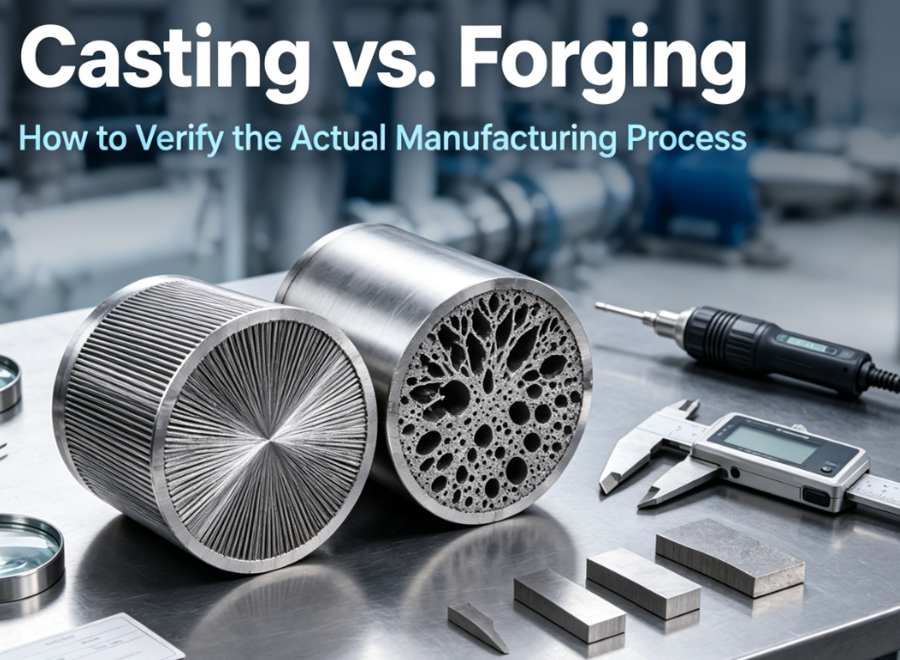
Forged and cast parts can look nearly identical after machining, but their manufacturing processes create significant performance differences. Knowing how to recognize them helps prevent costly sourcing mistakes.
Why Does This Happen?
Forging generally requires higher tooling investment, larger presses, stricter temperature control, and more process management than casting. For relatively simple geometries, a casting may even resemble a forging after machining.
Some suppliers quote forged parts but supply castings instead. Without verifying the manufacturing process, buyers may not discover the substitution until performance issues appear in operation.
The Differences That Matter
Despite the visual resemblance of cast and forged workpieces following machining operations, their manufacturing routes produce fundamentally unique material traits.
| Comparison | Forging | Casting |
| Manufacturing Method | Deformed from a solid billet | Formed by pouring molten metal into a mold |
| Grain Structure | Continuous grain flow | Solidified grain structure |
| Strength & Toughness | Higher | Depends on casting quality |
| Fatigue Performance | Better for repeated loading | Generally lower |
| Defect Risk | Lower | Higher risk of porosity and shrinkage |
| Best Suited For | High-load structural parts | Complex-shaped components |
Optimal manufacturing route selection is determined by practical working conditions. Rather than debating whether to adopt casting or forging, engineers should prioritize verifying that finished parts conform to the forming process defined in product designs.
Attention Point 1: Surface Appearance Is Not Reliable
One common misconception is that forged parts always have rough surfaces while castings always show obvious casting marks.
In reality, both assumptions are unreliable.
A casting can be shot blasted, CNC machined, polished, or coated until almost every visible casting feature disappears.
Likewise, a precision die forging may leave the press with a relatively smooth finish that looks far better than many people expect.
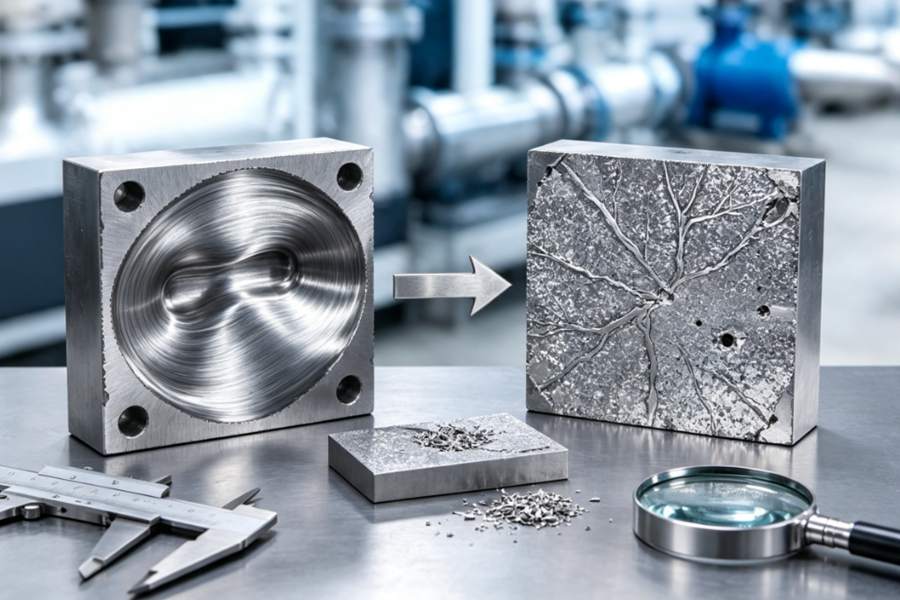
Attention Point 2: Ask How the Material Flows
| Check Point | Forging | Casting |
| Material Formation | Metal is deformed under pressure | Molten metal solidifies in a mold |
| Grain Structure | Continuous grain flow | Random solidification structure |
| Internal Performance | Better strength and fatigue resistance | More dependent on defect control |
| Supplier Verification | Can explain die design and material flow | Focuses mainly on mold and pouring process |
During forging, plastic deformation continuously redirects the grain flow around the geometry of the component. Areas subjected to high loading generally benefit from uninterrupted material continuity.
Casting follows a completely different route. Molten metal fills a mold cavity and solidifies from liquid to solid. Even with excellent process control, the internal structure develops through solidification rather than deformation.
Attention Point 3: Compare the Quotation With the Manufacturing Route
Many inconsistencies become visible long before production starts.
For example, a quotation may mention:
- Forged steel
- Heat treatment
- CNC machining
Yet it never references forging dies, billet preparation, trimming, or forging operations.
Instead, the manufacturing description includes mold production, pouring, risers, or solidification terminology.
These inconsistencies often reveal far more than photographs ever can.
Attention Point 4: Review Material Certification Carefully
Material certificates confirm chemical composition, but they do not automatically prove how a component was manufactured. A steel grade such as 42CrMo, 4140, or 1045 can be used for both forging and casting.
Receiving a certificate with the correct material designation therefore answers only one question.
It fails to distinguish between forged plastic deformation and mold pouring manufacturing methods.
Instead of treating certificates as final evidence, compare them with the actual manufacturing records.
Questions worth asking include:
- Was the raw material supplied as billet or molten metal?
- What heat treatment followed forming?
- Are forging process records available?
- Can the supplier identify the forging equipment used?
Attention Point 5: Mechanical Property Consistency
| Verification Point | What to Check |
| Strength Requirements | Confirm whether the part meets required strength and toughness levels |
| Fatigue Performance | Evaluate suitability for repeated loading, vibration, and impact conditions |
| Internal Structure | Check whether the manufacturing process supports consistent material properties |
| Batch Stability | Review whether performance remains consistent across production runs |
| Test Reports | Compare test data with actual manufacturing process and application needs |
Forged parts usually achieve more predictable mechanical performance through controlled deformation, while cast parts depend more on solidification quality and defect management.
Attention Point 6: Visit the Factory
For high-value programs, nothing replaces seeing the manufacturing process in person.
A genuine forging facility typically includes equipment such as:
- Billet cutting lines
- Heating furnaces
- Forging presses or hammers
- Trimming presses
- Heat treatment facilities
- Inspection and machining departments
The production flow is generally continuous. By comparison, a foundry follows an entirely different workflow involving mold preparation, melting, pouring, cooling, shakeout, and cleaning operations.
For critical forged components, buyers may consider:
- Ultrasonic Testing (UT)
- Magnetic Particle Testing (MT)
- Metallographic Analysis
- Hardness Testing
Attention Point 7: Investigate Price Gaps
Competitive pricing is normal. Pricing that is dramatically below every other quotation deserves investigation.
Forging costs are influenced by material utilization, tooling, forming force, heat treatment, machining allowance, and production volume. These costs cannot simply disappear.
When one quotation is substantially lower without a clear technical explanation, buyers should understand exactly where those savings come from.
Attention Point 8: Evaluate Supplier Capability
Experienced manufacturers rarely begin technical discussions with unit price.
They usually ask about:
- Working load
- Fatigue requirements
- Safety factors
- Material selection
- Heat treatment
- Production quantity
- Machining allowance
- Inspection standards
A set of evaluation questions can identify if forging technology is a viable manufacturing route for specific components. Many engineering scenarios benefit more from casting instead.
When the design goals fit casting’s process features, this manufacturing method possesses no intrinsic drawbacks compared to other forming techniques.
Warning Signs
| Warning Sign | Possible Risk |
| No forging process records available | Actual forming process may be unclear |
| Supplier only provides material certificates | Material grade is confirmed, but process is not |
| Extremely short production lead time | Forging steps may have been skipped |
| Unusually low quotation | Manufacturing route may have changed |
| Unable to explain grain flow | Supplier may lack forging capability |
Time to Choose Casting
Not every application requires forging.
Casting can be an effective solution when:
- Complex geometries are required
- Internal cavities are difficult to form by forging
- Production volume requires flexible shape options
- Mechanical loads remain within design limits
Selecting either casting or forging is not the primary matter at stake. The real concern is whether the selected process matches the engineering requirements.
Key Inquiry Points
Before starting production, buyers should ask:
- What exact forming procedure is used to fabricate the part?
- Where are the base raw materials sourced from?
- Can you provide forging process documentation?
- What heat treatment method is applied?
- How is grain flow controlled?
- What inspections are performed before shipment?