
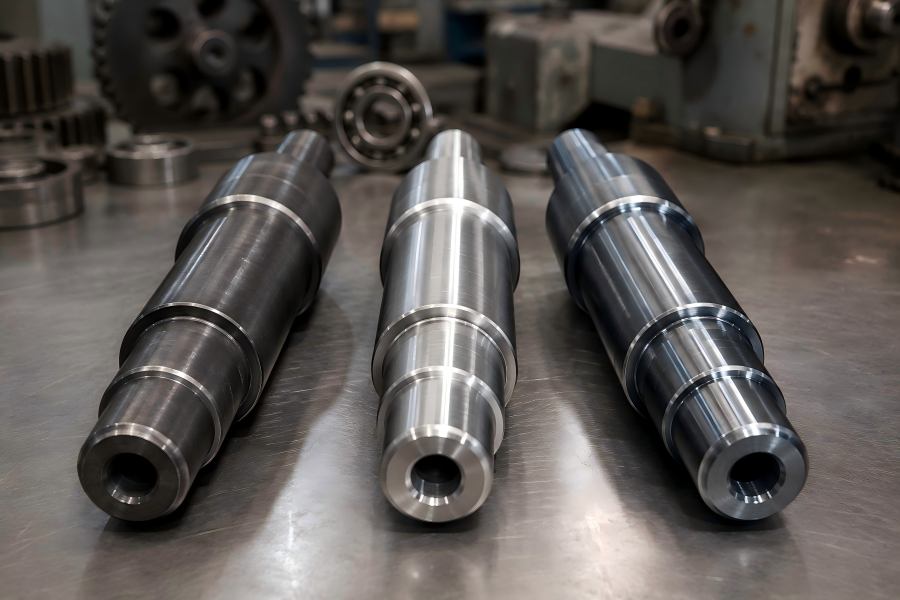
Shafts are key components in mechanical systems used for power transmission and load support. Typical materials include carbon steel, stainless steel, and alloy steel, each with different strength, durability, wear resistance, and cost, making material selection vital for performance and reliability.
Understanding Shaft Materials
Before comparing performance, it is important to understand what these materials are and how they differ at a basic level.
Carbon Steel Shafts
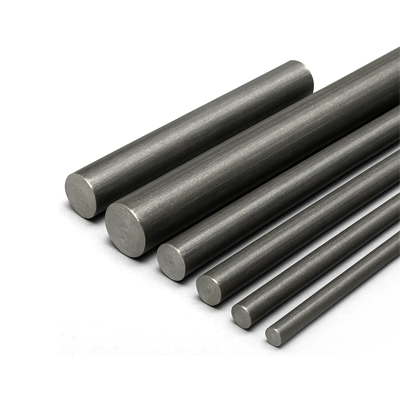
Carbon steels are iron-carbon alloys with relatively low amounts of other alloying elements. They are categorised based on carbon content:
- Low-carbon steel(up to ~0.3% C): Easy to form and weld, lower strength
- Medium-carbon steel(~0.3–0.6% C): Balanced strength and toughness
- High-carbon steel(~0.6–1.0% C): Very high strength and hardness
No significant additions of corrosion-resistant elements (like chromium) are present. Most common carbon steels used for shafts include AISI 1040, 1045, 1050, etc.
Key Characteristics
- Affordable
- Good machinability
- Adequate strength for many general applications
- Poor corrosion resistance
Stainless Steel Shafts
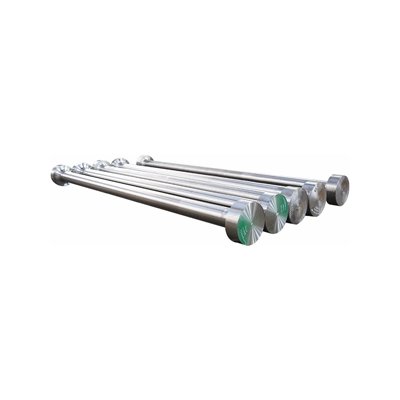
Stainless steels are iron-based alloys containing at least 10.5% chromium, which forms a protective oxide layer that provides corrosion resistance.
Stainless steels commonly used for shafts typically include:
- Austenitic grades(e.g., 304, 316): Excellent corrosion resistance
- Martensitic grades(e.g., 410, 420): Higher strength, moderate corrosion resistance
Key Characteristics
- Excellent corrosion resistance
- Lower strength than some alloy steels (except martensitic stainless grades)
- More expensive
- Often used where environments are corrosive or hygiene is necessary
Alloy Steel Shafts
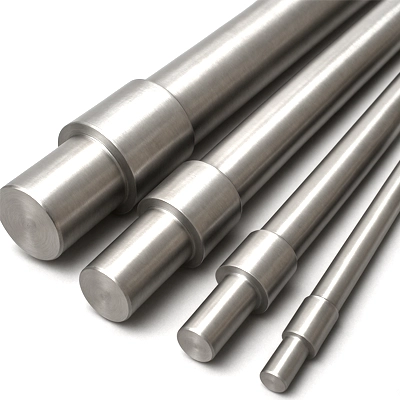
Alloy steels include significant alloying elements such as chromium, molybdenum, nickel, vanadium, silicon, and others to improve specific properties.
Common shaft grades:
- 4140and 4340 (chromium-molybdenum, nickel-chromium)
- 8620(nickel-chromium-molybdenum, good case hardening)
- Many other custom alloys
Key Characteristics
- Higher strength and toughness
- Better fatigue and wear resistance
- Customizable properties through heat treatment
- Cost higher than carbon steel, lower than some specialty stainless steels
Comparative Analysis
To determine which material performs better, we examine three materials based on key engineering requirements:
| Performance Factor | Carbon Steel | Stainless Steel | Alloy Steel |
| Tensile Strength | Moderate | Lower to moderate | High |
| Yield Strength | Moderate | Lower | High |
| Fatigue Resistance | Moderate | Lower | High |
| Wear Resistance | Moderate | Moderate to low | High |
| Corrosion Resistance | Poor | Excellent | Varies (usually low–moderate) |
| Cost | Lowest | Highest | Mid |
| Machinability | Good | Moderate | Variable |
| Heat Treatability | Moderate | Limited | Excellent |
| Weldability | Excellent | Good (varies by grade) | Good (varies) |
| Application Fit | General use | Corrosive environments | High performance |
Mechanical Strength & Fatigue Resistance
Alloy Steel
Alloy steel shafts typically outperform both carbon and stainless steel shafts when it comes to:
- Tensile strength
- Yield strength
- Fatigue life
- Resistance to impact forces
This superiority is due to alloying elements like chromium, molybdenum, and nickel, which form tough microstructures (e.g., martensite, bainite) after heat treatment.
Example: A 4140 alloy steel shaft can have tensile strengths in excess of 950–1100 MPa after quench and temper, whereas a typical 1045 carbon steel might be around 600–700 MPa.
Carbon Steel
Carbon steel shafts (e.g., 1045) provide sufficient strength for many general applications such as automotive parts, light machinery, and agricultural equipment, but they typically do not match the high performance of alloy steel under heavy loads or high rotational speeds..
Stainless Steel
Austenitic stainless steels (304, 316) have relatively low strength compared to alloy steels. Martensitic stainless grades (410, 420) can be heat-treated to improve strength, but they still lag behind high-grade alloy steels.
Corrosion Resistance
Stainless Steel
Stainless steels, especially austenitic grades like 316, resist rust, oxidation, and corrosion from environmental exposure, chemicals, seawater, and humidity, making them ideal for various demanding applications.
- Marine shafts
- Food processing
- Chemical plant drives
- Outdoor equipment
Even lubricants and moisture won’t easily degrade stainless shafts.
Carbon and Alloy Steel
Carbon steels and most alloy steels rust quickly if exposed to moisture or corrosive agents unless coated or plated (e.g., with zinc, phosphate, or paint). Alloy steels with chromium have marginally better surface oxidation resistance but still cannot match true stainless steels.
Wear & Surface Hardness
Alloy Steel
Through heat treatment (carburising, induction hardening, or quench & temper), alloy steel shafts can achieve high surface hardness and excellent wear resistance, crucial for:
- Bearings
- High RPM drives
- Gear interfacing surfaces
Hard alloy steels resist abrasion and surface fatigue better than untreated carbon or stainless steels.
Carbon Steel
Carbon steel with higher carbon content (≥0.6%) can be hardened and has decent wear resistance, but it still:
- Is prone to surface cracking under repeated stress
- Has heat treatment limits
Stainless Steel
Stainless steels, especially austenitic grades, are notoriously soft compared to hardened alloy steels. Unless specially treated such as by nitriding or surface coatings, their wear life suffers under sliding contact.
Machinability, Fabrication & Cost
Cost Considerations
- Carbon steel is the most economical shaft material.
- Alloy steel costs more due to alloying elements and heat treatment needs.
- Stainless steel has the highest cost due to chromium content and difficult machining.
Machining
- Carbon steel machines easily and is forgiving during manufacturing.
- Stainless steelwork hardens and can be difficult to cut, requiring slower feeds and special tooling.
- Alloy steel machinability varies — some grades are challenging, others are moderate.
Heat Treatment
Alloy steels excel because heat treatment can tailor properties (strength, toughness, wear). Carbon steels are limited in post-processing gains. Stainless steels have restricted heat-treat options (austenitic grades don’t harden significantly via heat treatment).
Application-Specific Comparisons
Different shaft applications prioritise different properties. Here’s how each material stands in key use cases.
Industrial Machinery Shafts
Key Requirements:
- High torque and cyclic loading
- Resistance to fatigue and wear
- Minimal downtime due to component failure
Material Considerations:
- Carbon steel: Suitable for low-to-moderate load machinery. While cost-effective, prolonged exposure to heavy loads may cause fatigue and surface wear.
- Alloy steel: Preferred for heavy-duty industrial machinery. Heat-treated alloy steel shafts offer high tensile strength, superior toughness, and excellent wear resistance, extending service life under demanding operational conditions.
- Stainless steel: Typically avoided unless corrosion protection is critical. Strength may be insufficient in high-load gear applications.
Marine and Corrosive Environment Shafts
Key Requirements:
- Corrosion and oxidation resistance
- Reliability under continuous exposure to moisture, salt, or chemicals
- Reduced maintenance frequency
Material Considerations:
- Carbon steel: Requires protective coatings to resist corrosion, increasing maintenance and potential downtime.
- Alloy steel: Offers strong mechanical properties but is still susceptible to corrosion without surface treatment.Best suited for enclosed or coated applications.
- Stainless steel: Naturally resistant to rust and pitting. Grades like 316excel in seawater exposure, chemical plants, or outdoor equipment, ensuring long-term durability with minimal maintenance.
Automotive and High-Performance Shafts
Key Requirements:
- High fatigue strength and impact resistance
- Precision and stability under dynamic loads
- Durability in extreme temperature ranges
Material Considerations:
- Carbon steel: Acceptable for low-stress components or cost-sensitive parts.
- Alloy steel: Ideal for critical drivetrain components such as crankshafts, axles, and transmission shafts. Heat-treated alloys like 4340provide exceptional strength, toughness, and fatigue life.
- Stainless steel: Generally reserved for exposed components where corrosion is a concern; mechanical performance is often insufficient for high-stress drivetrain use.
Food, Pharmaceutical, and Hygienic Applications
Key Requirements:
- Corrosion resistance in wet, acidic, or alkaline conditions
- Non-reactive, sanitary surfaces
- Compliance with food safety regulations
Material Considerations:
- Carbon steel: Not ideal due to susceptibility to rust and contamination risk. Protective coatings can complicate cleaning and reduce hygiene.
- Alloy steel: Mechanically strong but requires corrosion protection to prevent surface degradation during cleaning processes.
- Stainless steel: The preferred choice, particularly 304 or 316 grades, offering smooth, corrosion-resistant surfaces suitable for washdowns and regulatory compliance, ensuring both hygiene and longevity.
High-Speed and Precision Rotating Shafts
Key Requirements:
- High fatigue and torsional strength
- Dimensional stability at high rotational speeds
- Minimal vibration and wear
Material Considerations:
- Carbon steel: Can perform adequately under controlled loads and speeds. Low cost and easy machining make it suitable for moderate-duty spindles or rotors.
- Alloy steel: Provides excellent strength-to-weight ratio, fatigue resistance, and wear resistance, making it optimal for high-speed or precision machinery.
- Stainless steel: Offers corrosion resistance but may require surface hardening (e.g., nitriding) to maintain wear resistance under high-speed or contact stress conditions.
Cost Analysis
When selecting a shaft material, initial cost, manufacturing cost, and long-term value are important considerations. Here’s a more detailed comparison:
| Material | Approx. Raw Material Cost (per kg) | Typical Machining/Processing Cost | Expected Service Life in Common Applications |
| Carbon Steel | $1.2 – $2.5 | Low | 3–7 years (non-corrosive environments) |
| Alloy Steel | $2.5 – $5 | Moderate | 8–15 years (high-stress industrial machinery) |
| Stainless Steel | $4 – $7 | High | 10–20 years (corrosive or outdoor environments) |
Example Analysis
Industrial Gearbox Shafts
- Carbon steel shaft: $50 per shaft; may last 5 years before replacement.
- Alloy steel shaft: $120 per shaft; heat-treated for long-term reliability, lasts 12–15 years.
- Stainless steel shaft: $180 per shaft; not commonly used here unless corrosion is a concern.
Food Processing Conveyor Shafts
- Stainless steel 304: $200 per shaft; lasts 10–15 years with minimal maintenance.
- Carbon steel: $60 per shaft; prone to rusting, may require replacement every 3–4 years or coating.
Marine Propeller Shafts
- Carbon steel with coating: $80 per shaft; requires frequent maintenance.
- Stainless steel 316: $220 per shaft; maintenance-free for a decade or more.
Case Studies
Case 1: Marine Propeller Shafts
Marine environments expose shafts to saltwater, humidity, and oxygen, accelerating corrosion.
- Carbon steel shafts rust quickly, requiring coatings and frequent inspections; surface pitting can cause imbalance.
- Alloy steel shafts offer better strength and fatigue resistance but still need corrosion protection.
- Stainless steel shafts(316 or duplex) naturally resist corrosion, maintain smooth surfaces, and reduce maintenance needs.
Case 2: Heavy-Duty Industrial Gearbox Shafts
Gearbox shafts endure high torque, cyclic loads, and shock, where fatigue failure is costly.
- Carbon steel shafts handle moderate loads but may develop surface fatigue and microcracks under continuous stress.
- Alloy steel shafts(4140, 4340) can be heat-treated for high strength, toughness, and wear resistance, ideal for heavy-duty service.
- Stainless steel shafts provide corrosion resistance but generally lack the fatigue strength of alloy steel unless martensitic and heat-treated.
Case 3: Food Processing Conveyor Shafts
Hygiene and corrosion resistance are critical in food and pharmaceutical processing.
- Carbon steel shafts are prone to rust and require heavy coatings, complicating cleaning.
- Alloy steel shafts have good strength but need additional corrosion protection for wet or acidic environments.
- Stainless steel shafts(304, 316) resist pitting, are easy to sanitise, and meet regulatory standards.
Case 4: Automotive Drivetrain Components
Automotive axles, crankshafts, and drive shafts face dynamic torque, vibration, and temperature fluctuations.
- Carbon steel shafts are suitable for lower-stress, cost-sensitive parts like linkages or steering components.
- Alloy steel shafts(4340) provide toughness, fatigue resistance, and machinability, ideal for high-performance axles and crankshafts.
- Stainless steel shafts are uncommon for drivetrain components but useful in corrosion-prone or marine-adapted vehicles.
Case 5: Precision Machinery and High-Speed Rotating Shafts
High-speed spindles and rotors demand tight tolerances, fatigue resistance, and minimal vibration.
- Carbon steel shafts work for moderate loads and controlled speeds; cost-effective and easy to machine.
- Alloy steel shafts with heat treatment excel in fatigue, torsion, and wear resistance for high-speed applications.
- Stainless steel shafts offer corrosion resistance in humid or chemical environments but may require surface hardening to resist wear.