
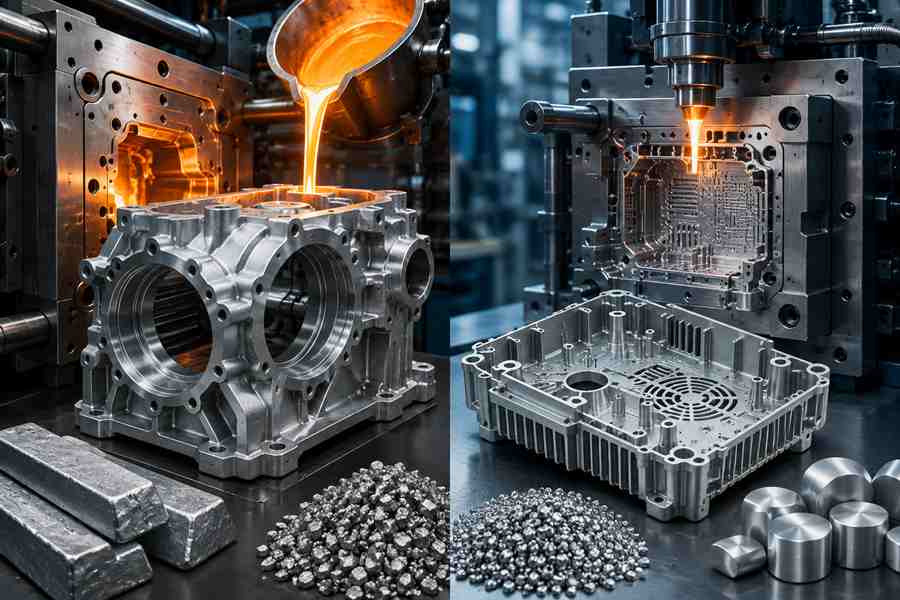
A380 aluminum and ADC12 aluminum are widely used in high-pressure die casting. A380 is common in North American projects, while ADC12 is frequently specified across Japan and other Asian supply chains.
Their performance is similar, but they are not identical grades. ADC12 generally offers better fluidity for thin details, while A380 often provides slightly higher strength and broad finishing flexibility.
What Is A380 Aluminum?
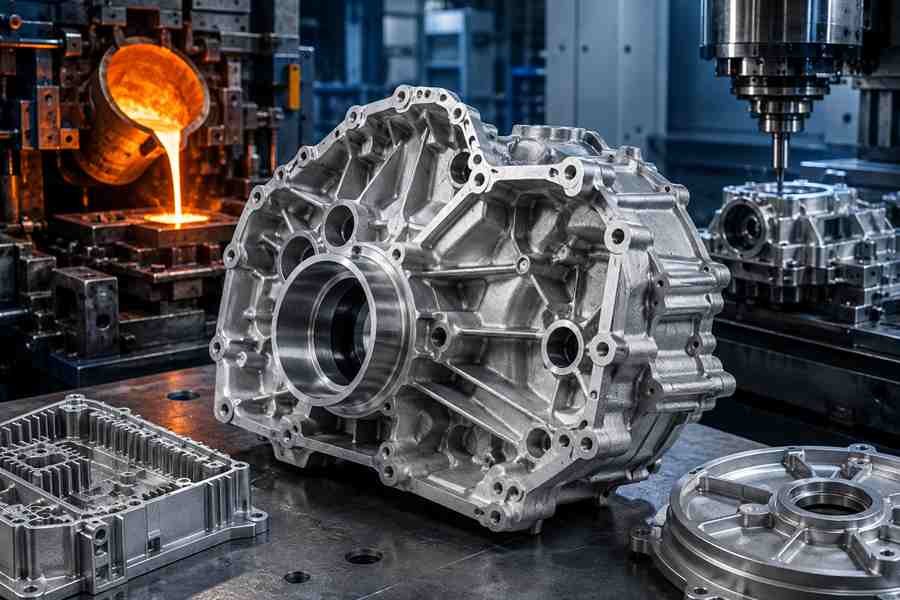
A380 is an aluminum-silicon-copper alloy widely specified for die casting projects in North America. It offers a practical combination of mechanical strength, dimensional stability, castability, and secondary processing performance.
The alloy is commonly selected for medium and large components that require stable dimensions after casting. It also supports machining, painting, powder coating, and other common finishing processes.
Key Characteristics of A380 Aluminum
- Chemical Composition:Generally contains around 7.5%–9.5% silicon and 3.0%–4.0% copper.
- Mechanical Strength:Offers reliable tensile strength, hardness, and load-bearing performance for industrial components.
- Dimensional Stability:Maintains consistent shapes and assembly dimensions during repeated production.
- Machinability:Supports drilling, tapping, boring, and milling with suitable cutting parameters.
- Surface Treatment:Works with powder coating, painting, polishing, and conversion coatings.
- Sourcing Region:Commonly specified by buyers and die casting suppliers serving North American markets.
Common Applications of A380 Aluminum
A380 is widely used for industrial parts that require strength, machining, and predictable assembly performance.
- Transmission Housings:Provides stable dimensions and sufficient rigidity for machined bearing and mounting areas.
- Machinery Brackets:Supports moderate loads while reducing component weight compared with steel.
- Power Tool Housings:Combines impact resistance, dimensional accuracy, and practical surface finishing.
- Appliance Components:Suitable for structural frames, bases, covers, and internal support parts.
- Electronic Enclosures:Provides protection, heat dissipation, and stable mounting positions.
- Automotive Parts:Used for covers, cases, brackets, and other medium-load components.
What Is ADC12 Aluminum?
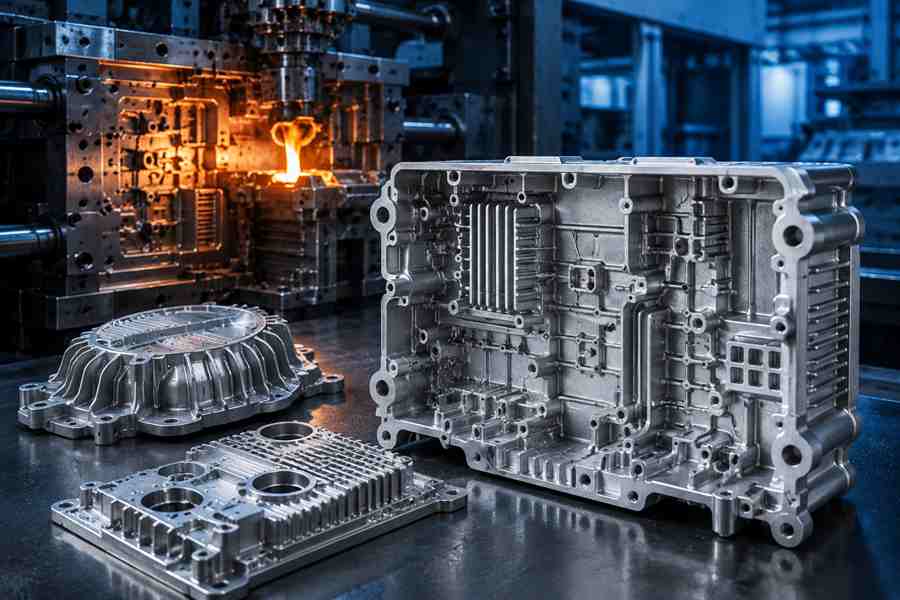
ADC12 is an aluminum-silicon-copper die casting alloy specified under Japanese material systems.This manufacturing technique is widely adopted by casting factories across China, Japan, South Korea and various Southeast Asian nations.
Elevated silicon proportions within the alloy boost the fluidity of liquid metal as it fills casting molds. ADC12 is therefore well suited to thin-wall housings, compact ribs, narrow passages, and detailed external features.
Key Characteristics of ADC12 Aluminum
- Chemical Composition:Commonly contains around 9.6%–12.0% silicon and 1.5%–3.5% copper.
- Mold-Filling Ability:Flows effectively through narrow cavities and long, thin sections.
- Thin-Wall Capability:Suitable for lightweight components with local wall thicknesses around 1.5–2.5 mm when the design and process allow.
- Production Efficiency:Supports fast injection cycles and stable high-volume manufacturing.
- Dimensional Accuracy:Reproduces ribs, bosses, holes, and detailed profiles consistently.
- Sourcing Region:Readily available from many Asian die casting manufacturers.
Common Applications of ADC12 Aluminum
Manufacturers frequently opt for ADC12 alloy to fabricate intricate parts requiring high-volume, high-speed mass production.
- Electronic Housings:Supports thin walls, cooling fins, connector openings, and internal mounting bosses.
- Motor Covers:Fills curved surfaces, ribs, and compact structural details effectively.
- Automotive Cases:Suitable for covers, housings, and lightweight protective components.
- LED Lighting Housings:Combines mold-filling performance with useful heat dissipation.
- Communication Equipment:Produces detailed enclosures with stable assembly features.
- Consumer Product Parts:Supports compact, lightweight, and visually detailed designs.
A380 and ADC12 Aluminum’s Main Distinctions
| Property | A380 Aluminum | ADC12 Aluminum |
| Silicon Content | Around 7.5%–9.5% | Around 9.6%–12.0% |
| Copper Content | Around 3.0%–4.0% | Around 1.5%–3.5% |
| Mold Filling | Good for standard complex castings | Better for thin walls and detailed cavities |
| Mechanical Strength | Usually slightly higher | Suitable for most housings and covers |
| Machinability | Generally easier to machine | Higher silicon may increase tool wear |
| Dimensional Stability | Reliable for medium and large parts | Strong repeatability for thin detailed parts |
| Surface Treatment | Suitable for painting and powder coating | Suitable for coating, but anodizing may appear uneven |
| Regional Availability | Common in North American supply chains | Common across Asian supply chains |
| Typical Use | Brackets, machinery parts, housings, cases | Electronics, motor covers, thin-wall enclosures |
Price Differences
For preliminary budgeting, A380 and ADC12 aluminum prices can be estimated within the following ranges:
- A380 Aluminum:Approximately US$3.6–3.9/kg. It may cost slightly more in Asian markets when the alloy must be purchased under a specific North American standard.
- ADC12 Aluminum:Approximately US$3.2–3.5/kg. Its wide availability across Asian die casting supply chains often supports more stable sourcing costs.
- Typical Difference:ADC12 may be around 5%–15% cheaper at the raw-material stage. However, the final casting cost also depends on tooling, cycle time, machining, coating, inspection, and rejection rate.
For thin-wall, high-volume parts, ADC12 may lower production cost through easier mold filling. A380 can offer better value when the component requires extensive drilling, tapping, or precision machining.
Performance Considerations in Die Casting
Several factors should be reviewed before confirming A380 or ADC12 for a new die casting project.
- Wall Thickness:ADC12 usually fills thin walls and narrow ribs more easily because of its higher silicon level.
- Mechanical Load:A380 is often a better starting point for brackets, mounting parts, and components carrying moderate operating loads.
- Machining Volume:A380 may reduce cutting-tool wear when the casting requires many threaded holes, bores, or precision-machined surfaces.
- Surface Appearance:Both alloys can be painted or powder coated, but neither is ideal for bright decorative anodizing.
- Corrosion Conditions:Copper content can affect corrosion performance, so coating or conversion treatment may be needed in humid or outdoor environments.
- Casting Defects:Gate design, venting, vacuum control, injection speed, and die temperature influence porosity more than the alloy name alone.
- Dimensional Tolerance:Critical sealing faces, bearing seats, and assembly holes should be clearly identified on the drawing.
- Supplier Experience:A factory that processes one alloy regularly may produce better results than a supplier changing materials only to match a written specification.
In my view, buyers should first examine the part geometry and secondary operations. Selecting an alloy by regional popularity alone can overlook the features that actually determine casting quality and total cost.
Which One Should You Choose?
The choice between A380 and ADC12 should follow the finished product rather than the alloy name alone.
- Choose A380 Aluminum:When the project prioritizes mechanical strength, CNC machining, stable dimensions, or compliance with a North American material specification.
- Choose ADC12 Aluminum:When the component contains thin walls, fine ribs, detailed cavities, or will be manufactured through an established Asian supply chain.
A380 is generally more suitable for robust and machined industrial components. ADC12 is often the better option for thin, detailed, and high-volume die cast parts requiring efficient mold filling.