
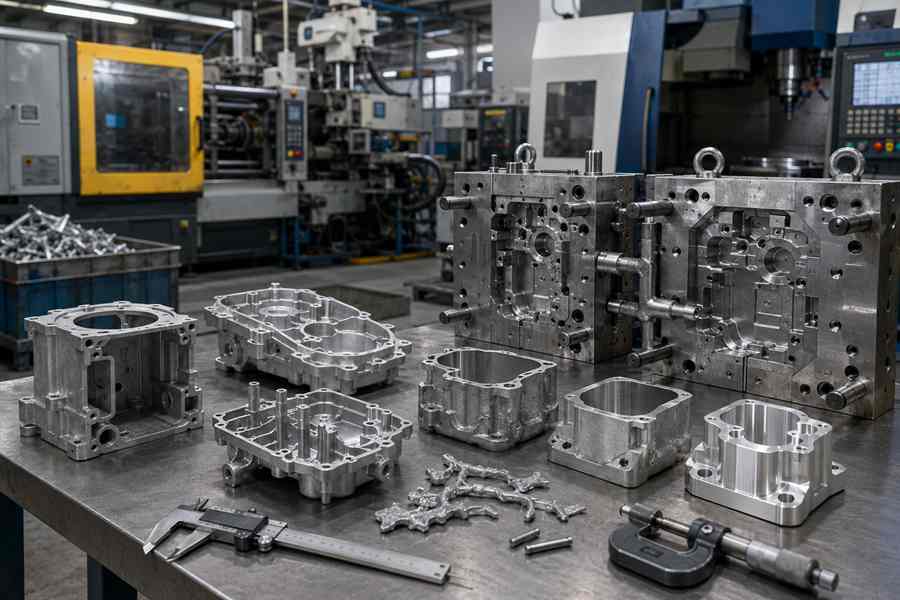
Aluminum die casting costs are strongly linked to how a part performs within the die casting workflow. Projected area, mold opening direction, metal flow, mold thermal balance, gate position and secondary machining all influence the final price quote.
1. Reduce Machine Tonnage
A heavier casting will not always demand the biggest available machine. Within high pressure aluminum die casting, projected area and cavity pressure greatly impact the clamping force that is needed.
For this reason, a broad flat 0.8 kilogram housing may need a larger machine compared to a denser 1.0 kilogram part.
Projected Area Can Change Machine Size:
Assume part redesign cuts its overall projected area sufficiently to shift production from a 600-ton machine to a 500-ton machine. Even with minimal change in aluminum material weight, machine hour expenses can still go down.
| Machine Option | Illustrative Hourly Cost | 40-sec Cycle Cost/Shot* |
| 400 ton | $65/hour | $0.72 |
| 500 ton | $78/hour | $0.87 |
| 600 ton | $92/hour | $1.02 |
At 100000 production cycles, a mere 0.15 dollar difference for each shot equals roughly 15000 dollars in total.
Where feasible, steer clear of overly broad flanges, outsized outer profiles, and features that expand projected area while delivering no functional benefit.
2. Simplify Die Opening
The most cost effective die structure generally lets the majority of the part eject via the primary fixed and moving die halves.
Side facing part features may demand hydraulic slides, angle pin slides or movable cores. Such mechanisms raise tool production costs and bring about extra wear points.
Typical features worth reviewing include:
- Side holes
- Locking grooves
- Lateral slots
- Side-facing clips
- Recesses behind vertical walls
A large side slide may add approximately 3000 to 10000 dollars or more to a medium size tool. This depends on travel range, physical dimension, actuation method and die build design.
For a production run of 10000 pieces, a 6000 dollar slide brings an extra 0.60 dollar cost for every single part. This calculation excludes extra maintenance expenses and cycle time related losses.
3. Simplify the Parting Line
The parting line defines where the two primary die halves come together around the casting.
A fairly straightforward parting surface is simpler to machine, assemble, seal and service. Stepped or heavily contoured parting lines extend die fitting time and make flash management more challenging.
Complex Parting Lines Can Add Cost Through:
- More die machining
- Additional fitting work
- Greater flash risk
- More trimming
- Harder maintenance
- Higher sensitivity to die wear
For purchasers, the concern is not whether the parting line shows up within CAD files. Instead, it matters whether cosmetic or structural features oblige die builders to develop an overly intricate shut off surface.
Shifting a decorative step, flange or split feature by just a few millimeters can at times yield a far simpler die structure while leaving the finished component’s functionality unaffected.
4. Shorten Metal Flow Paths
Thin wall capacity represents one benefit of high pressure aluminum die casting. Yet thin sections grow harder to fill when molten metal needs to flow over longer distances.
A 2 mm wall section placed near the gate performs quite differently compared with a 2 mm wall sitting at the far end of an extended housing after multiple directional turns.
Long flow paths may require:
- Higher injection speed
- More demanding gate design
- Additional venting
- Vacuum assistance
- Larger overflow areas
These measures may raise tooling complexity or narrow the available process window. Rather than merely asking “Can this wall be 1.8 mm?”, buyers ought to also evaluate how far aluminum material has to flow through that 1.8 mm section.
Whenever feasible, shorten long narrow flow paths, prevent frequent sharp shifts in flow direction, and place ultra thin sections nearer to viable feeding points.
5. Reduce Local Hot Spots
A thick boss or solid metal block does not just raise aluminum material usage. It also alters heat transfer behavior inside the die.
For instance, a 9 mm boss enclosed by 2.5 to 3 mm walls may stay hot even after surrounding sections have fully solidified. This localized mass can demand extra cooling capacity and raise risks of shrinkage defects or die soldering.
They can lead to:
- Longer solidification time
- Additional cooling circuits
- Greater porosity risk
- Local die overheating
- More process adjustment
- Longer cycle time
Assume a heavy material zone extends cycle time from 38 to 42 seconds.
The theoretical output drops from approximately 95 shots per hour down to 86 shots per hour, marking around a 9 to 10 percent decrease. Removing redundant metal within these hot zones can therefore cut down both material consumption and repeated machine runtime.
6. Cast More Features Directly
One key benefit of aluminum die casting is its capacity to produce near net shape geometries.
If the design fails to leverage this advantage and machines every hole, boss, pocket and recess out of solid stock, secondary operation costs can climb rapidly.
Features that may be partly or fully formed in the die include:
- Pilot holes
- Mounting bosses
- Recesses
- Counterbore preforms
- Locating features
- Non-critical openings
For instance, rather than casting a fully solid boss and drilling a full Ø10 mm hole, the die can produce an Ø8.5 to 9 mm pilot hole. Only a small volume of material remains for the final machining pass.
This cuts machining duration, chip generation and cutting tool wear, while still maintaining the dimensional accuracy needed for assembly work.
7. Plan Gates and Ejector Pins
A finalized CAD model can appear fully finished, yet the die still requires practical zones for metal inlet, overflow discharge and component ejection.
Difficulties occur if every outer surface is defined as cosmetic, leaving no acceptable spots for gate traces, overflow trimming marks, ejector pin impressions or parting lines.
During design review, identify surfaces that can accept:
- Gate trimming
- Overflow connections
- Ejector pin marks
- Parting-line witness
- Minor post-trim variation
This point holds particular importance for consumer housings, lighting parts, electronic enclosures and other aluminum components with visible surfaces.
When gate and ejector positions face tight constraints, die builders may be forced to adopt more complex runner designs, extra polishing steps, additional trimming work or secondary cosmetic finishing operations.
8. Reduce CNC Machining
Certain aluminum die cast surfaces truly need machining operations. Bearing bores, O ring grooves, motor mounting faces, threaded holes and key sealing zones serve as typical examples.
A costly error comes when applying these strict precision standards to surfaces with no functional impact.
Consider an aluminum housing produced at 100,000 pieces:
| Process | Original | Optimized |
| Die casting | $4.20 | $4.20 |
| CNC Setup 1 | $0.75 | $0.75 |
| CNC Setup 2 | $0.60 | — |
| Drilling/Tapping | $0.35 | $0.35 |
| Total | $5.90 | $5.30 |
Eliminating the second CNC setup cuts costs by 0.60 dollars for each part, which equals roughly 60000 dollars across 100000 units.
That explains why critical mating surfaces ought to be distinctly separated from standard as cast geometry. Hidden ribs, cooling fins or non mating bosses generally do not demand the same tolerance levels as bearing seats.
Production Volume Changes the Cost Priority
The optimal aluminum die casting design is not necessarily the option with the lowest tooling expense. Production volume decides whether purchasers should place greater emphasis on upfront die cost or ongoing per unit expense.
Assume eliminating one slide cuts tooling cost by 6000 dollars, meanwhile another design adjustment delivers 0.30 dollar savings on every individual part.
| Production Volume | $6,000 Tooling Saving | $0.30 Unit Saving |
| 5,000 pcs | $1.20/part | $1,500 total |
| 50,000 pcs | $0.12/part | $15,000 total |
| 100,000 pcs | $0.06/part | $30,000 total |
| 250,000 pcs | $0.024/part | $75,000 total |
For low-volume production runs, simplifying slides, cores and parting lines can deliver the biggest cost improvements. At higher output volumes, machine cycle duration, cast-in features, machining time and scrap rates gradually take control of total lifetime cost.
Where the Biggest Savings Usually Come From
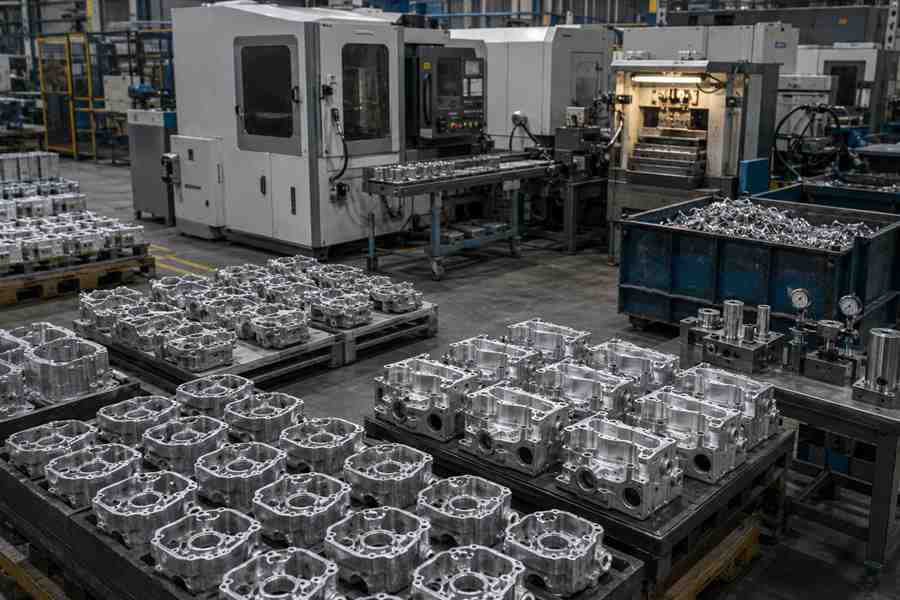
The greatest cost savings frequently come from operations repeated on every shot or each finished component. A 5000 dollar cut to die tooling provides a one‑time saving of 5000 dollars. By contrast, removing a 0.45 dollar machining step generates roughly 45000 dollars in savings across 100000 units.
For purchasers of aluminum die cast parts, cost reduction is thus closely linked to production volume and process design:
- Low volume:simplify die opening, slides, cores, and parting lines.
- Medium volume:balance tooling cost with machine size and machining.
- High volume:prioritize cycle time, cast-in features, scrap, and secondary operations.
A cost effective aluminum die casting is more than just a lightweight component. It is a part engineered around practical constraints of clamping force, metal flow, die thermal performance, gate and ejection needs, and near net shape manufacturing.