
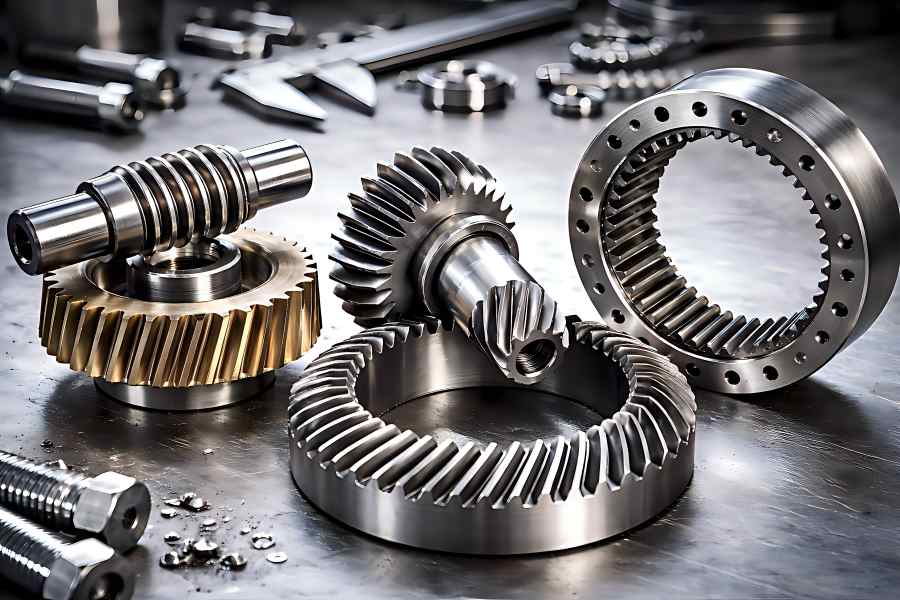
Gear systems ensure torque transmission, motion control, efficiency, and reliability. Worm, hypoid, and internal gears differ in load capacity, efficiency, and layout flexibility. Correct selection is essential to avoid wear, energy loss, and failure, and to achieve optimal performance and lifecycle value in engineering applications.
What Is a Worm Gear?
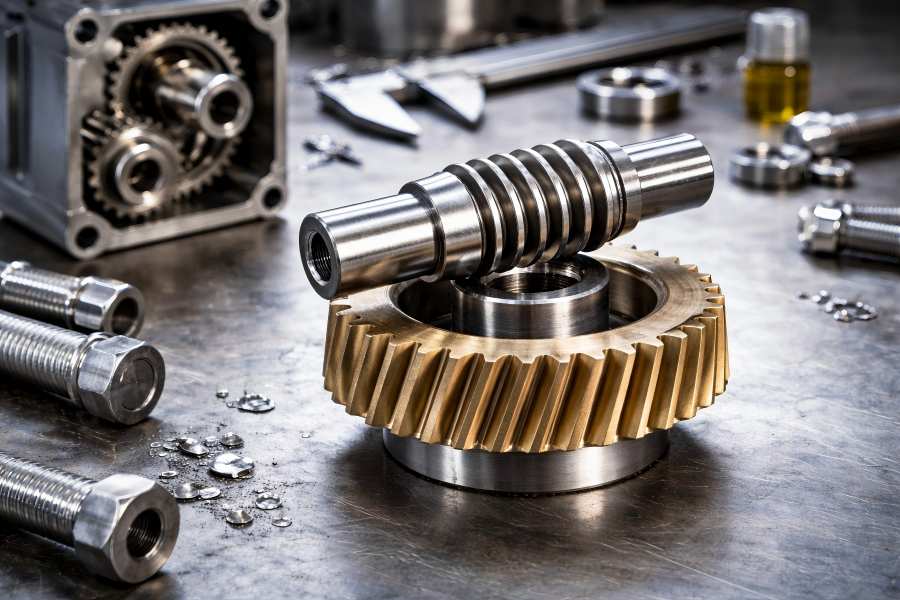
A worm gear consists of a screw-like worm and a worm wheel, used to transmit motion between non-parallel, non-intersecting shafts in compact mechanical transmission systems.
It provides high single-stage reduction, sliding tooth contact, possible self-locking performance, and a simple compact structure for low-speed, high-ratio applications.
| Pros | Cons |
| Extremely high reduction ratio | Reduced effectiveness |
| Self-locking capability | Generates heat |
| Smooth and quiet operation | Higher wear rate |
| Compact design | Requires lubrication |
Typical Applications
- Elevators and lifting systems
- Conveyor drives
- Packaging machinery
- Automotive steering systems
- Industrial reducers
What Is a Hypoid Gear?
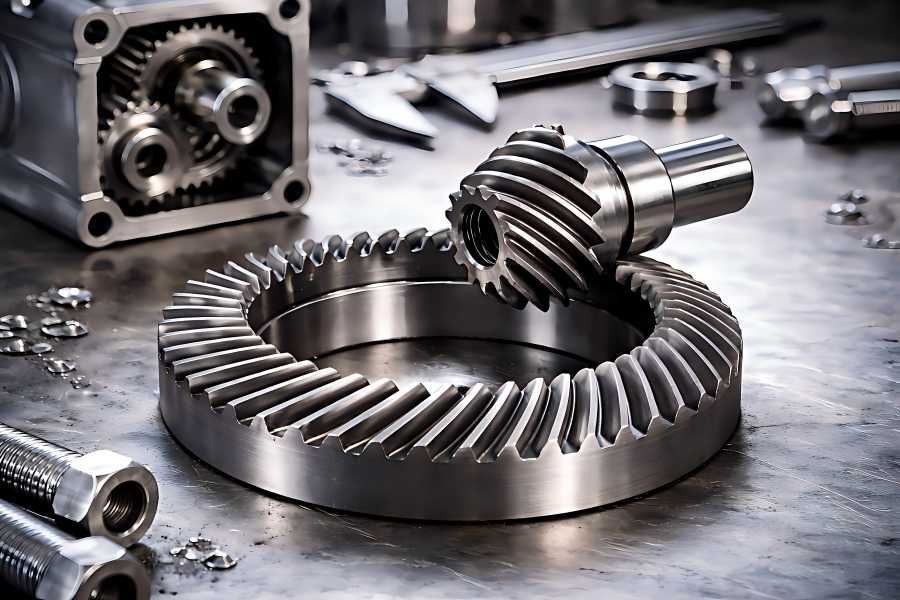
A hypoid gear resembles a bevel gear but uses offset, non-intersecting shafts, enabling smoother meshing and improved torque transmission in compact power transfer systems.
It features spiral teeth, combined rolling and sliding contact, high torque capacity, and quiet operation, making it suitable for demanding, high-performance mechanical applications.
| Pros | Cons |
| High torque transmission | Complex manufacturing |
| Smooth and quiet operation | Lower efficiency than spur/helical |
| Compact and flexible layout | Requires special lubrication |
| Better load distribution | Higher cost |
Typical Applications
- Automotive differentials
- Rear axle systems
- Heavy-duty industrial drives
- Power transmission systems
- High-performance machinery
What Is an Internal Gear?

An internal gear has teeth on the inner surface of a ring and meshes with external gears, commonly in compact planetary transmission systems.
It offers inside-facing teeth, high contact ratio, space-efficient design, suitability for coaxial layouts, and strong performance in compact multi-stage gear arrangements.
| Pros | Cons |
| Compact and efficient | Complex manufacturing |
| Smooth and quiet operation | Limited accessibility |
| High efficiency | Requires precise alignment |
| Ideal for planetary systems | Higher cost |
Typical Applications
- Planetary gearboxes
- Automatic transmissions
- Robotics systems
- Aerospace mechanisms
- Precision machinery
Comprehensive Comparison Table
| Criteria | Worm Gear | Hypoid Gear | Internal Gear |
| Shaft Orientation | Non-parallel | Offset | Coaxial |
| Efficiency | Low to moderate | Moderate | High |
| Capacity to Load | Moderate | High | Moderate to high |
| Noise Level | Low | Very low | Low |
| Reduction Ratio | Very high | Moderate | Moderate |
| Space Efficiency | High | High | Very high |
| Manufacturing Complexity | Moderate | High | High |
| Expense | Moderate | High | High |
| Maintenance | High | Moderate | Moderate |
| Best Use Case | High reduction | High torque | Compact systems |
Performance Comparison by Key Factors
When comparing worm gears, hypoid gears, and internal gears, engineers should evaluate multiple performance factors instead of focusing on a single parameter. The following aspects provide a more practical and application-oriented comparison.
Torque Transmission Capacity
- Hypoid gears provide the highest torque capacity due to larger contact area and load distribution.
- Internal gears offer strong torque performance in compact systems.
- Worm gears are suitable for moderate loads but limited under heavy-duty conditions.
For high-load applications, hypoid gears are typically the most reliable solution.
Load Distribution and Stress Behavior
- Hypoid gears distribute load smoothly across curved tooth surfaces.
- Internal gears provide even load distribution within planetary systems.
- Worm gears experience stress concentration because of sliding contact.
Improved load distribution significantly increases durability, with hypoid gears performing best in heavy-duty systems.
Efficiency and Energy Loss
- Internal gears offer the highest efficiency due to rolling contact.
- Hypoid gears have moderate efficiency due to combined rolling and sliding.
- Worm gears have lower efficiency because of continuous sliding friction.
For energy-sensitive applications, internal gears are the most efficient choice.
Noise and Vibration Performance
- Hypoid gears operate very quietly due to smooth engagement.
- Internal gears provide stable and low-noise operation.
- Worm gears are relatively quiet but may generate heat under load.
Hypoid gears are ideal for noise-sensitive applications.
Alignment and Installation Requirements
- Worm gears are relatively simple to install.
- Hypoid gears require precise alignment due to complex geometry.
- Internal gears demand accurate assembly within gear systems.
For ease of installation, worm gears are the most straightforward, while hypoid gears require the highest precision.
Lubrication and Heat Management
- Worm gears require continuous lubrication due to sliding friction.
- Hypoid gears require specialized lubricants for durability.
- Internal gears require consistent lubrication for multi-gear systems.
Proper lubrication is critical, especially for worm and hypoid gears.
Speed Capability and Dynamic Performance
- Hypoid gears perform well at moderate to high speeds.
- Internal gears operate efficiently at moderate speeds.
- Worm gears are best suited for low-speed applications.
Hypoid gears provide the best balance for dynamic performance.
Wear Resistance and Service Life
- Hypoid gears can achieve a long service life when properly lubricated.
- Internal gears provide consistent wear performance.
- Worm gears may wear faster due to sliding contact.
Hypoid gears generally provide the longest service life.
Cost vs Performance Trade-Off
Cost should be evaluated alongside performance, durability, and service life.
| Factor | Worm Gear | Hypoid Gear | Internal Gear |
| Relative Cost | $20 – $80 | $80 – $200 | $60 – $180 |
| Efficiency | 50–90% | 85–95% | 90–98% |
| Load Capacity | 40–70% | 80–100% | 70–90% |
| Service Life | 5–12 years | 12–20 years | 10–18 years |
| Maintenance | High | Moderate | Moderate |
| Noise Level | Low | Very low | Low |
| Failure Risk | Moderate | Low | Low |
| Best Application | High reduction | High performance | Compact systems |
- Worm gears are cost-effective for high reduction applications.
- Hypoid gears deliver superior performance at higher cost.
- Internal gears provide efficiency and compactness.
Application-Based Selection Guide
Choose Worm Gear When:
- High reduction ratio is required
- Self-locking function is needed
- Space is limited
- Speed is relatively low
Choose Hypoid Gear When:
- High torque transmission is required
- Smooth and quiet operation is critical
- Offset shaft configuration is needed
- High-performance systems are involved
Choose Internal Gear When:
- Compact design is essential
- Planetary gear systems are used
- High efficiency is required
- Coaxial shaft arrangement is needed
Real-World Industry Examples
Understanding real-world applications helps translate theory into practical gear selection.
Automotive Industry
Automotive systems demand high torque, smooth operation, and compact drivetrain layouts.
- Hypoid gears are widely used in rear axle differentials due to their ability to handle high torque and operate quietly under dynamic loads.
- Internal gears are essential in automatic transmissions and planetary gear sets, enabling compact multi-speed systems.
- Worm gears are occasionally used in steering systems for controlled motion and self-locking behavior.
Industrial Machinery
Industrial equipment requires a balance between reliability, efficiency, and cost control.
- Worm gears are widely applied in reducers and conveyor systems because they provide high reduction ratios and a compact structure.
- Hypoid gears are applied in heavy-duty drives where smooth operation and high torque are required.
- Internal gears are utilized in planetary gearboxes to achieve efficient and space-saving power transmission.
Robotics and Automation
Automation systems require precision, low noise, and compact design.
- Internal gears are widely used in planetary gear systems for precise motion control and space-saving design.
- Worm gears are used in positioning systems where self-locking prevents back-driving.
Power Generation and Energy Systems
Energy systems operate under continuous load and high efficiency requirements.
- Hypoid gears are employed in high-performance drive systems where smooth running and durability are essential.
- Internal gears are applied in compact transmission units within turbines and auxiliary systems.
Material Handling and Conveyor Systems
These systems require consistent motion, durability, and controlled speed reduction.
- Worm gears are commonly applied for speed reduction and compact gearbox structures.
- Internal gears are used in advanced conveyor drives where compactness is required.
Aerospace and Marine Applications
These industries demand high precision, dependable performance, and compact mechanical configurations.
- Hypoid gears are applied in propulsion and transmission systems to enable smooth and efficient power transfer.
- Internal gears are used in compact, high-precision mechanisms.
Heavy Equipment and Mining
These applications involve extreme loads, harsh environments, and continuous operation.
- Worm gears are used in lifting and positioning applications because of their self-locking feature.
- Hypoid gears are utilized in heavy-duty drive applications that demand high torque capacity and strong durability.