
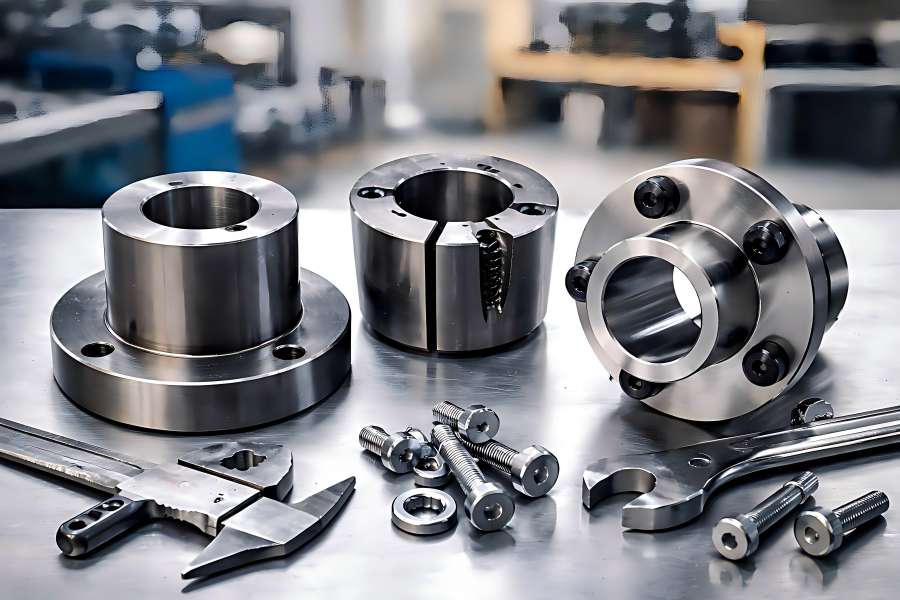
Hub connections play a critical role in torque transmission, alignment, durability, maintenance, and system reliability. Weld-on, taper lock, and bolt-on hubs each offer different strengths in installation, load capacity, flexibility, and serviceability, and choosing the wrong type can lead to misalignment, loosening, or costly downtime.
What Is a Weld-on Hub?

A weld-on hub is permanently attached by welding to pulleys, sprockets, or plates, creating a rigid integrated structure for demanding mechanical applications.
It offers high strength, suits custom fabrication, eliminates extra fasteners, and requires proper welding processes plus inspection to ensure reliable performance.
| Pros | Cons |
| Very high strength and rigidity | Permanent, not easily removable |
| Suitable for heavy-duty applications | Requires skilled welding |
| Customizable design | Risk of heat distortion |
| Cost-effective for large structures | Longer installation time |
Typical Applications
- Heavy machinery
- Mining and construction equipment
- Custom pulleys and sprockets
- Structural assemblies
- Industrial fabrication systems
What Is a Taper Lock Hub?

A taper lock hub uses a tapered bushing to clamp securely onto the shaft, providing strong frictional grip for reliable torque transmission and alignment.
It features self-centering installation, standardized sizing, and easy removal, making it a practical choice for efficient assembly, maintenance, and versatile industrial applications.
| Pros | Cons |
| Easy installation and removal | Higher cost than basic hubs |
| Excellent alignment accuracy | Limited to standard sizes |
| Strong torque transmission | Requires proper tightening |
| Interchangeable bushings | May slip under extreme loads |
Typical Applications
- Conveyor systems
- Pumps and compressors
- Fans and blowers
- Agricultural machinery
- General industrial equipment
What Is a Bolt-on Hub?
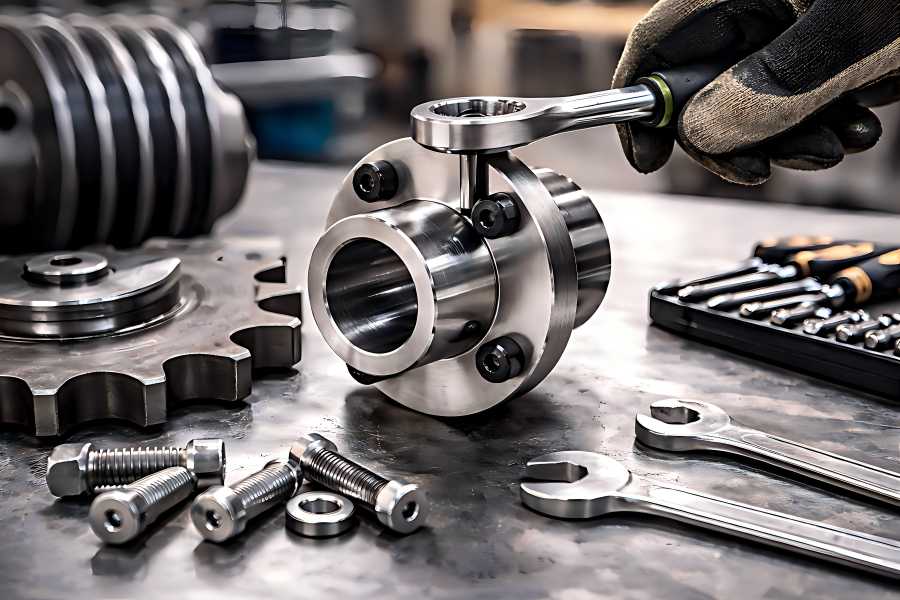
A bolt-on hub attaches to components with bolts through a flanged design, allowing secure mounting and removal without welding in many industrial systems.
It is removable, reusable, requires no welding, and works well in modular equipment where maintenance access and part replacement are important.
| Pros | Cons |
| Easy installation and removal | Lower rigidity than welded hubs |
| Reusable and replaceable | Risk of bolt loosening |
| No heat distortion | Requires proper tightening |
| Good for modular systems | Limited torque capacity |
Typical Applications
- Modular machinery
- Maintenance-friendly equipment
- Medium-duty industrial systems
- Replaceable assemblies
- Light to medium load applications
Comprehensive Comparison Table
| Criteria | Weld-on Hub | Taper Lock Hub | Bolt-on Hub |
| Torque Capacity | Very high | High | Moderate |
| Connection Type | Permanent (welded) | Friction (bushing) | Mechanical (bolted) |
| Alignment Accuracy | Depends on welding | Excellent | Moderate |
| Ease of Installation | Low | High | Moderate |
| Ease of Removal | Very difficult | Easy | Easy |
| Maintenance | Low | Low to moderate | Moderate |
| Reusability | No | Yes | Yes |
| Cost | Low to moderate | Moderate | Low |
| Customization | High | Limited | Moderate |
| Vibration Resistance | Very high | High | Moderate |
Performance Comparison by Key Factors
When comparing weld-on, taper lock, and bolt-on hubs, engineers should consider multiple factors instead of focusing on one parameter. The following points offer a broader application-based comparison.
Torque Transmission Capacity
- Weld-on hubs provide the highest torque capacity due to rigid structural integration.
- Taper lock hubs transmit torque efficiently through friction and clamping force.
- Bolt-on hubs are suitable for moderate torque but limited under heavy loads.
Weld-on hubs are the most reliable for heavy-duty applications.
Load Distribution and Structural Strength
- Weld-on hubs create a continuous structure with minimal stress concentration.
- Taper lock hubs distribute load through the tapered interface.
- Bolt-on hubs rely on bolt distribution, which may introduce localized stress.
Weld-on hubs offer the strongest structural integrity.
Alignment and Precision
- Taper lock hubs provide excellent concentric alignment due to self-centering.
- Bolt-on hubs offer moderate alignment depending on installation accuracy.
- Weld-on hubs depend on welding precision and setup.
Taper lock hubs are preferred for precision applications.
Resistance to Vibration and Shock Loads
- Weld-on hubs provide maximum resistance due to permanent bonding.
- Taper lock hubs maintain strong grip under vibration when properly installed.
- If bolt-on hubs are not tightened, they may come free.
For high-vibration environments, weld-on and taper lock hubs perform better.
Installation, Assembly, and Maintenance
- Taper lock hubs are easiest to install and remove.
- Bolt-on hubs allow easy replacement and maintenance.
- Weld-on hubs require more time and specialized skills.
For frequent maintenance, bolt-on or taper lock hubs are more practical.
Wear Resistance and Service Life
- Weld-on hubs offer long service life with minimal wear.
- Taper lock hubs provide durable performance with proper maintenance.
- Bolt-on hubs may experience wear in bolts and interfaces over time.
Weld-on hubs are the most durable option.
Flexibility and Adaptability
- Taper lock hubs allow flexibility with interchangeable bushings.
- Bolt-on hubs enable modular replacement.
- Weld-on hubs offer minimal flexibility after installation.
Taper lock hubs provide the best adaptability.
Cost vs Performance Trade-Off
Cost should be assessed together with performance, durability, and service life. The usual cost ranges and performance levels for each type of hub are displayed in the table below.
| Factor | Weld-on Hub | Taper Lock Hub | Bolt-on Hub |
| Relative Unit Cost | $20 – $80 | $40 – $120 | $15 – $60 |
| Installation Cost | High | Low | Moderate |
| Torque Capacity | 90 – 100% | 70 – 90% | 40 – 70% |
| Service Life | 15 – 25 years | 10 – 20 years | 8 – 15 years |
| Maintenance Frequency | Very low | Low | Moderate |
| Installation Time | Long | Short | Moderate |
| Failure Risk | Very low (<2%) | Low (3–6%) | Moderate (5–10%) |
| Best Application | Heavy-duty | Flexible systems | Modular systems |
- Weld-on hubs deliver the highest durability and lowest long-term failure risk.
- Taper lock hubs balance performance and flexibility.
- Bolt-on hubs minimize upfront cost but may require more maintenance.
Application-Based Selection Guide
Choose Weld-on Hub When:
- Maximum strength and rigidity are required
- Permanent installation is acceptable
- Heavy loads and harsh conditions exist
- Custom fabrication is needed
Choose Taper Lock Hub When:
- Quick installation and removal are needed
- High alignment accuracy is required
- Flexibility in shaft sizes is important
- Standardized solutions are preferred
Choose Bolt-on Hub When:
- Frequent maintenance or replacement is required
- Modular design is needed
- Welding is not feasible
- Medium-duty applications are sufficient
Real-World Industry Examples
Understanding real industry use helps turn theory into practical selection. Different applications prioritize strength, flexibility, cost, or maintenance.
Heavy Machinery and Construction Equipment
These industries involve extreme loads, shock, and harsh environments, requiring highly durable connections.
- Weld-on hubs are widely used in structural components, large pulleys, and drive systems due to their maximum strength and rigidity.
- Bolt-on hubs are used in replaceable parts where maintenance access is necessary.
Manufacturing and Processing Equipment
Industrial production lines require efficiency, flexibility, and minimal downtime.
- Taper lock hubs are commonly used in conveyors, motors, and rotating equipment because of their quick installation and reliable alignment.
- Bolt-on hubs are used in modular equipment that requires repair parts on a regular basis.
Agricultural Machinery
Agricultural equipment operates under variable loads, outdoor conditions, and frequent maintenance needs.
- Taper lock hubs are popular due to their adaptability to different shaft sizes and easy installation.
- Bolt-on hubs are used where quick repair and part replacement are required in the field.
Mining and Bulk Material Management
Mining systems deal with tremendous loads, abrasive materials, and constant operation.
- Weld-on hubs are used in crushers, conveyors, and heavy-duty drives for maximum strength and reliability.
- Taper lock hubs may be used in auxiliary systems where easier replacement is beneficial.
Power Generation and Energy Systems
Energy systems demand continuous operation, reliability, and high torque transmission.
- Weld-on hubs are used in large rotating equipment and structural assemblies.
- Taper lock hubs are used in motors, fans, and auxiliary systems for easier maintenance and alignment.
Automotive and Transportation
These industries require precision, repeatability, and efficient assembly processes.
- Taper lock hubs are widely used in production environments due to quick installation and consistent alignment.
- Bolt-on hubs are used in modular assemblies and serviceable components.
Maintenance and Service Equipment
Applications involving frequent disassembly or adjustments prioritize convenience.
- Bolt-on hubs are commonly used due to their easy removal and replacement.
- Taper lock hubs allow quick adjustments without damaging components.