
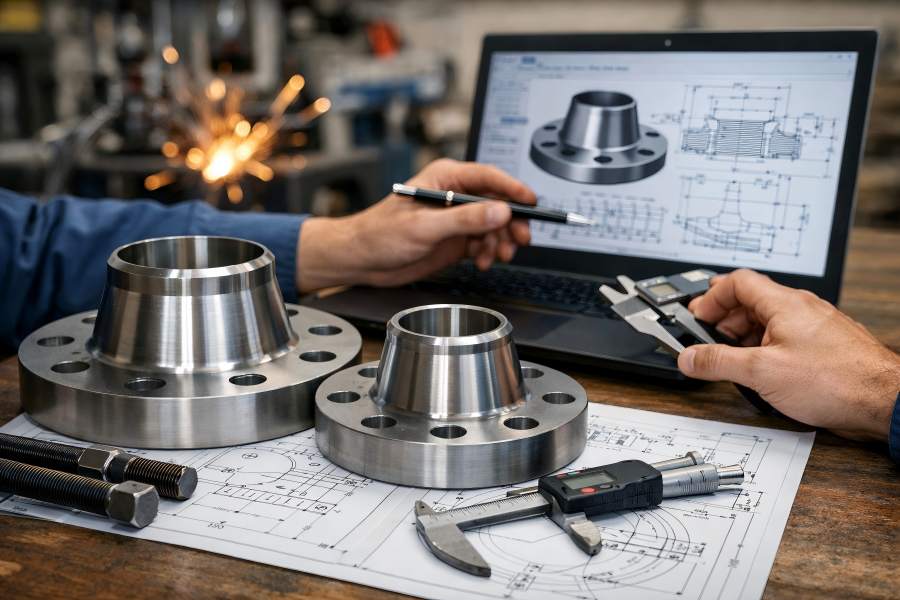
In the world of mechanical engineering, piping systems, and industrial design, weld neck flanges are among the most critical components used for connecting pipes, valves, and equipment. Their importance stems from their ability to provide high structural integrity, withstand extreme pressure and temperature ranges, and maintain leak-free performance even in demanding environments.
However, maximizing the effectiveness of weld neck flanges requires a deep understanding of their dimensions, standards, performance characteristics, and application guidelines.
What Is a Weld Neck Flange?
One kind of flange made to be welded to the outside of a pipe or fitting is called a weld neck flange. The weld is typically a full penetration butt weld, which provides excellent strength and a continuous path for stress transfer between the flange and the pipe.
Weld neck flanges have a long tapered hub that stretches from the flange thickness to the pipe wall thickness, in contrast to several other types of flanges. This special hub shape reduces stress concentration at the weld connection and permits gradual stress dispersion.
Key Features of Weld Neck Flanges
- Hub Structure: The extended hub reinforces the flange and connects with the pipe through welding.
- Stress Distribution: The tapered transition zone reduces stress concentration.
- Full Penetration Weld: Provides a structurally sound and leak-resistant joint.
- Standardized Dimensions: Weld neck flanges conform to strict dimensional requirements per global standards such as ASME, ANSI, DIN, and EN.
Why Dimensions Matter in Weld Neck Flanges
When engineers select a flange for a piping system, dimensions are far more than mere numbers. They directly impact performance, integrity, safety, cost, and maintainability.
Whether in high-pressure oil and gas pipelines, chemical processing units, power generation facilities, or HVAC systems, correct flange dimensions ensure the following:
- Proper Fitment: Accurate alignment ensures piping integrity and minimizes leakage.
- Strength and Stress Resistance: Matching flange dimensions with pipe wall thickness and pressure class lowers the risk of failure under load.
- Standard Compliance: Meeting global standards ensures interchangeability, quality, and regulatory approval.
- Ease of Fabrication: Predictable dimensions streamline welding, machining, and installation workflows.
Standard Dimensions for Weld Neck Flanges
Weld neck flange dimensions are standardized to ensure uniformity across manufacturers and global markets. Although there are numerous industry and regional standards, the most frequently cited ones are as follows:
- ASME/ANSI B16.5: Flanged Fittings and Pipe Flanges
- ASME/ANSI B16.47: Steel Flanges with Large Diameters
- EN 1092-1: European Flanges
- DIN Standards: German Industrial Standards for Pipeline Components
- ISO Standards: International Standards Organization
These standards govern dimensional parameters such as flange outer diameter, bolt circle diameter, number and size of bolts, raised face dimensions, hub length, and more.
Key Dimensional Parameters Explained
To accurately interpret weld neck flange dimensions, engineers must become familiar with several critical terms. Below is a breakdown of the essential dimensions used in specifications and engineering drawings.
Flange Outer Diameter (OD)
The entire width of the flange, measured from one outside edge to the opposite outer edge, is referred to as the outer diameter. Outer diameter varies based on:
- Nominal pipe size
- Class of pressure (e.g., 150, 300, 600, 900, 1500, 2500)
- Standard being referenced
Raised Face (RF) Diameter
The raised face is the surface area around the flange bore that contacts the gasket. The raised face height and diameter are standardized to improve sealing performance.
Bolt Circle Diameter (BCD)
The bolt circle diameter represents the diameter of the imaginary circle on which bolt holes are drilled. It determines the location of bolt holes relative to the flange center.
Number and Size of Bolts
The total number of bolts and their diameters are standardized for each flange size and pressure class. High-pressure classes require larger and more bolts to maintain joint integrity under load.
Hub Length (L)
Hub length is the distance from the flange face to the start of pipe wall thickness. For weld neck flanges, this dimension is critical as it determines the weld zone and stress transition region.
Flange Thickness (C)
The thickness of the flange body is also standardized based on pipe size and pressure class. Thicker flanges are necessary for higher pressure and temperature applications.
Bore Diameter
The bore diameter defines the internal hole through which fluid flows. For weld neck flanges, the bore must match the internal diameter of the corresponding pipe to ensure flow continuity and reduce turbulence.
How Pressure Class Influences Dimensions
Weld neck flange dimensions are not uniform across all pressure ratings. As pressure ratings increase, flange components must also grow in size to handle mechanical stress.
Low vs. High Pressure Classes
Low-pressure classes, such as 150 and 300, have relatively smaller flange thicknesses, bolt sizes, and hub lengths compared to 900, 1500, and 2500 ratings. This progression occurs because higher pressure exerts greater radial and axial forces on flange connections.
Why Safety Margins Increase with Pressure
Safety margins increase with pressure due to factors like:
- Thermal expansion
- Cyclic loading
- Vibration
- Corrosion allowances
- Material strength limits
Thus engineers must refer to flange tables that correlate pressure ratings with precise dimensional values.
Weld Neck Flange Dimensional Tables
Dimensional tables are used universally in piping design documents, fabrication drawings, and procurement specifications. While the specific numbers vary by standard, experiment, and manufacturer variation, the following generalized dimensional attributes apply:
(For the sake of clarity, all numerical values are placeholders representing common dimensional relationships; actual design work should always reference the latest standard tables.)
Nominal Pipe Size (NPS) 1/2″–24″ (ASME B16.5)
| NPS | Pressure Class | OD (mm) | BCD (mm) | No. of Bolts | Bolt Size | Flange Thk (mm) | Hub Length (mm) |
| 1/2″ | 150 | 90 | 65 | 4 | ¾″ | 16 | 51 |
| 1″ | 150 | 105 | 75 | 4 | ¾″ | 19 | 57 |
| 4″ | 300 | 165 | 125 | 8 | ⅞″ | 25 | 70 |
| 8″ | 600 | 254 | 210 | 8 | 1″ | 32 | 95 |
| 12″ | 900 | 343 | 300 | 12 | 1¼″ | 41 | 110 |
| 24″ | 1500 | 610 | 570 | 20 | 1½″ | 60 | 150 |
Note: This table is illustrative. Always use official standard tables for precise design.

Material Considerations
Weld neck flange dimensions are fixed by standards, but the material selection also influences performance and applicability.
Common Materials
- Carbon Steel: Widely used in general piping and pressure applications.
- Stainless Steel: Perfect for environments prone to corrosion, elevated temperatures, and sanitary requirements.
- Alloy Steel: Suitable for use in high-strength and elevated-temperature conditions.
- Duplex and Super Duplex: High resistance to corrosion and extreme stress.
- Non-ferrous Materials (e.g., Nickel Alloys): Ideal for specialized industries like chemicals and aerospace.
Material and Dimensional Relationship
While dimensions remain standard, material strength and weldability influence:
- Wall thickness selection
- Heat treatment requirements
- Weld procedures
- Stress relief practices
Engineers must account for material properties during flange selection and fabrication planning.
Manufacturing Tolerances and Quality Control
Even standardized flange dimensions require tolerances and manufacturing quality control. Standards define allowable deviations to ensure proper fit and performance.
Typical Tolerances
- Outer Diameter: ± tolerance based on machining capability
- Bolt Hole Location: Controlled to ensure bolt alignment
- Raised Face Height: Uniform contact for gaskets
- Hub Length: Critical for weld fit-up
Manufacturers use inspection tools such as:
- Calipers
- Gauges
- Coordinate Measuring Machines (CMM)
- Visual and dye penetrant testing
Welding Procedures and Fit-Up Alignment
Correct welding is paramount to achieving the mechanical strength of weld-neck flange connections.
Pre-Weld Fit-Up
Fit-up must ensure:
- Proper alignment of flange and pipe
- No gaps or eccentricity
- Correct root face contact
Welding Techniques
Common techniques include:
- Gas Tungsten Arc Welding (GTAW)
- Shielded Metal Arc Welding (SMAW)
- Gas Metal Arc Welding (GMAW)
Proper welding parameters must be selected based on material, thickness, and flange class
Case Studies: Weld Neck Flanges in Real-World Projects
Case Study 1: High-Pressure Steam Line
A power plant installed Class 900 weld-neck flanges to connect boiler feed lines. Engineers matched hub length and wall thickness to accommodate thermal expansion and pressure surges, resulting in zero leaks over 5 years.
Case Study 2: Chemical Processing Plant
In corrosive environments, stainless steel weld-neck flanges performed better than slip-on alternatives due to superior stress resistance and sealing reliability.