
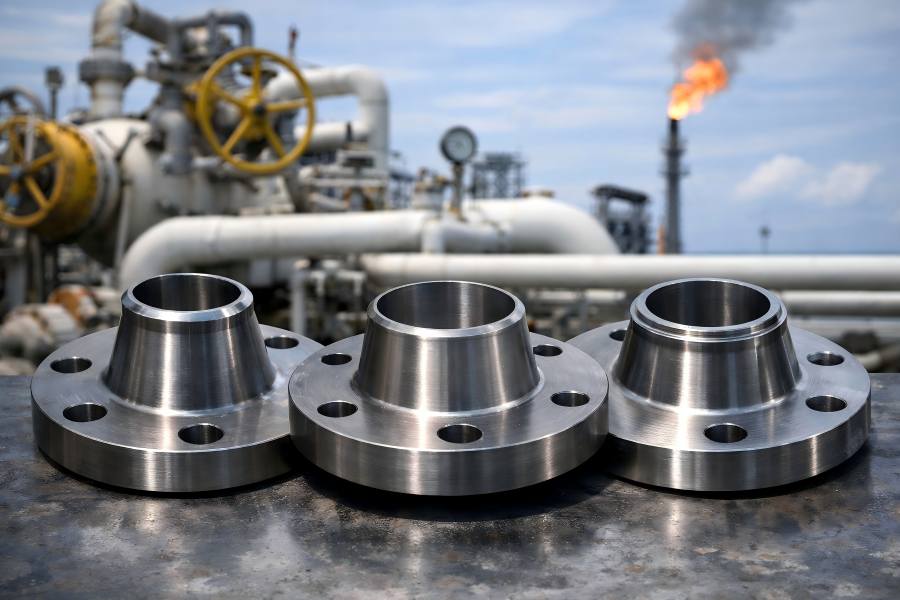
Selecting the correct flange facing is essential for safe and reliable pipeline performance. Raised Face (RF), Flat Face (FF), and Ring Type Joint (RTJ) are the most common weld neck flange facings used in industrial piping systems.
Each type offers different advantages depending on pressure, temperature, sealing requirements, and application conditions. Understanding their differences helps engineers choose the most suitable flange for their pipelines.
What Is a Weld Neck Flange?
A weld neck flange is a reliable and widely used flange in industrial piping systems. Its long, tapered hub fortifies the pipe connection and lessens the concentration of stress.
Typically butt-welded to the pipe, it creates a smooth internal flow path that minimizes turbulence and erosion, making it ideal for high-pressure and high-temperature applications.
Weld neck flanges are extensively utilized in the following industries due to their sturdy design:
- Gas and oil processing
- Petrochemical industry
- High-pressure steam apparatus
- Power generation facilities
- Chemical processing systems
- Offshore platforms
While the weld neck structure provides mechanical strength, the flange facing type determines how the flange seals with the mating flange. The three primary facing designs—RF, FF, and RTJ—each serve different operational requirements.
Raised Face (RF) Weld Neck Flanges
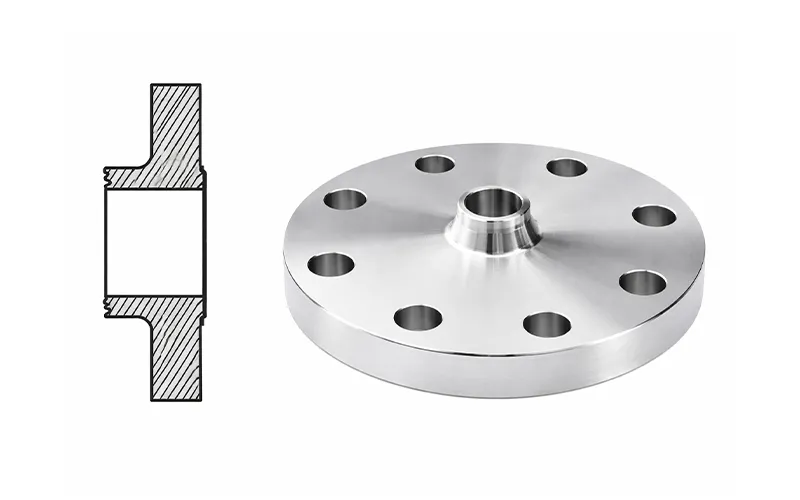
In industrial piping systems, raised face (RF) weld neck flanges are the most widely utilized form. The flange has a little elevated area surrounding its bore, as the name implies. This raised portion concentrates the gasket load onto a smaller area, creating an effective seal between the two flange faces.
The raised face design improves gasket compression and sealing efficiency compared with flat face flanges. It also helps maintain sealing performance even when slight flange distortion occurs during operation.
RF weld neck flanges typically use soft gasket materials such as:
- Spiral wound gaskets
- Compressed fiber gaskets
- Graphite gaskets
- PTFE gaskets
These gaskets compress under bolt tightening pressure and create a tight seal between the flange faces.
Raised face flanges are widely used in moderate to high-pressure piping systems, particularly in industries such as oil refining, petrochemical processing, water treatment, and general industrial pipelines.
| Pros | Cons |
| Better sealing performance than flat face flanges | Not suitable for extremely high-pressure systems |
| Compatible with many gasket types | Requires correct gasket selection |
| Suitable for medium and high-pressure pipelines | Improper gasket may lead to leakage |
| Standardized in ASME B16.5 specifications | Raised face may create stress when connected to flat-face equipment |
| Relatively easy installation and maintenance | Not ideal for extreme temperature and pressure conditions |
Flat Face (FF) Weld Neck Flanges
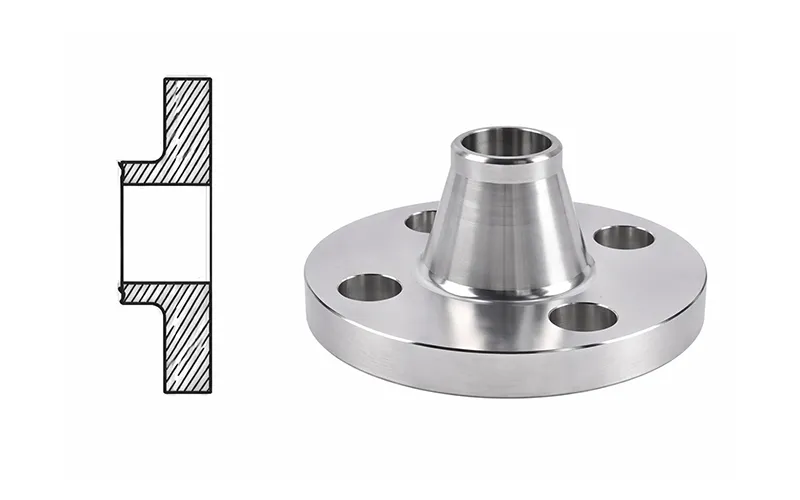
Flat Face (FF) weld neck flanges have a completely flat contact surface without any raised portion. The entire flange face comes into contact with the mating flange surface, distributing bolt pressure evenly across the full flange surface.
Flat face flanges are commonly used when connecting to equipment such as cast iron pumps, valves, or compressors. Many cast components are not designed to withstand the concentrated stress caused by raised face flanges.
In these situations, a flat face flange prevents cracking or mechanical damage to the equipment.
Its long, tapered hub reduces the concentration of stress and strengthens the pipe connection. These gaskets distribute sealing pressure across the entire flange face.
Common gasket materials include:
- PTFE sheets
- Rubber gaskets
- Non-asbestos compressed fiber sheets
- Soft sealing materials
| Pros | Cons |
| Even bolt load distribution across the full flange face | Lower sealing performance under high pressure |
| Simpler machining compared with RF flanges | Higher leakage risk in high-temperature systems |
| Suitable for fragile equipment like cast iron pumps | Less gasket compression than RF flanges |
| Reduced risk of flange distortion | Not suitable for high-pressure industrial pipelines |
| Ideal for low-pressure systems and water pipelines | Limited use in critical sealing applications |
Ring Type Joint (RTJ) Weld Neck Flanges
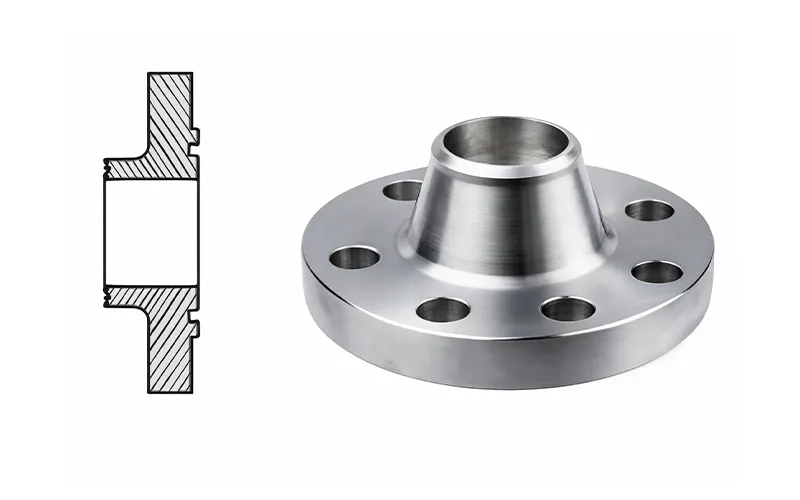
Ring Type Joint (RTJ) weld neck flanges are made especially for high temperatures and pressures. RTJ flanges use a metal-to-metal sealing mechanism in place of soft gaskets.
RTJ flanges feature a precision-machined groove on the flange face. A metallic ring gasket is placed inside this groove. When the flange bolts are tightened, the ring gasket is compressed between the two grooves, forming a tight metal seal.
This design provides superior sealing performance under high pressure.
RTJ flanges are extensively utilized in vital sectors like:
- Offshore oil and gas production
- High-pressure steam systems
- Petrochemical refineries
- Subsea pipelines
- LNG facilities
RTJ flange metal ring gaskets are often composed of materials like:
- Stainless steel
- Soft iron
- Alloy steel
- Inconel or other high-performance alloys
| Pros | Cons |
| Excellent sealing under very high pressure | Higher manufacturing cost |
| Reliable performance at extreme temperatures | Installation cost is relatively high |
| Resistant to vibration and thermal expansion | Requires precise machining |
| Metal-to-metal sealing ensures strong integrity | Requires accurate alignment during installation |
| Long service life in harsh environments | Installation requires skilled technicians |
Comparison Table: RF vs FF vs RTJ Weld Neck Flanges
| Feature | RF Weld Neck Flange | FF Weld Neck Flange | RTJ Weld Neck Flange |
| Sealing Type | Soft gasket seal | Full-face gasket seal | Metal-to-metal seal |
| Face Design | Raised sealing surface | Completely flat surface | Grooved surface with metal ring |
| Pressure Capability | Medium to high | Low to medium | Very high |
| Temperature Tolerance | Moderate to high | Moderate | Very high |
| Installation Complexity | Moderate | Easy | High |
| Cost | Medium | Low | High |
| Typical Applications | General industrial pipelines | Water systems, equipment connections | Oil & gas, high-pressure pipelines |
Typical Application Scenarios
Different flange facings are suitable for different industries and operating conditions. Each type of flange’s usual applications are displayed in the table below.
| Industry | RF Flange | FF Flange | RTJ Flange |
| Oil and Gas | Commonly used | Rarely used | Widely used |
| Petrochemical | Common | Limited | Common |
| Water Treatment | Common | Very common | Rare |
| Power Plants | Common | Limited | Common |
| Offshore Platforms | Limited | Rare | Very common |
| HVAC Systems | Common | Common | Rare |
These application differences are mainly determined by pressure rating and sealing requirements.
Important Considerations when Selecting a Flange
Selecting the correct flange facing requires evaluating several important factors.
Operating Pressure
When choosing a flange, one of the most important criteria is pipeline pressure. High-pressure systems require stronger sealing performance.
- Low-pressure systems → FF flange
- Medium pressure systems → RF flange
- High-pressure systems → RTJ flange
Operating Temperature
High temperatures can affect gasket materials and sealing performance. Metal ring gaskets used in RTJ flanges perform better in extreme temperatures compared with soft gaskets.
Equipment Compatibility
When connecting pipelines to pumps or valves made of cast iron, flat face flanges are usually recommended. Raised face flanges may cause excessive stress and lead to cracking.
Maintenance Requirements
Some systems require frequent maintenance or disassembly. RF and FF flanges are easier to disassemble compared with RTJ flanges.
Budget Considerations
Cost is also an important factor. RTJ flanges require precise machining and metal ring gaskets, making them more expensive.
The table below provides a simplified selection guide.
| Pipeline Condition | Recommended Flange |
| Low-pressure water pipelines | FF flange |
| General industrial piping | RF flange |
| High-pressure oil and gas systems | RTJ flange |
| Cast iron equipment connection | FF flange |
| Extreme temperature systems | RTJ flange |