
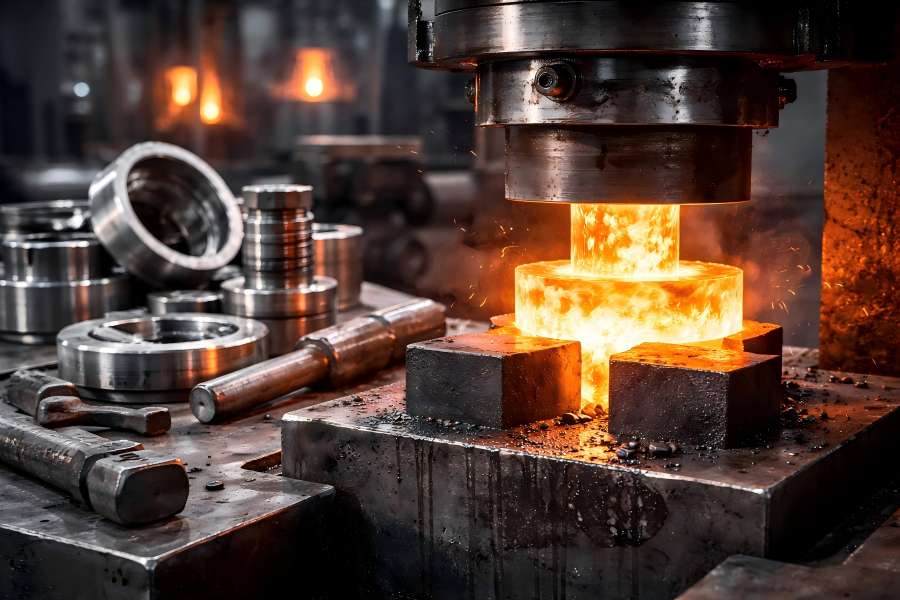
Forging remains one of the most critical metal forming processes in modern manufacturing, directly influencing component strength, reliability, and lifecycle cost.
Making the correct forging method choice has become a strategic engineering decision as industries demand tighter tolerances and higher performance. Metal properties and part geometry directly affect manufacturability, performance, cost, and sustainability.
What Are Forging Processes?
In order to create the required shape and internal structure, metal is plastically deformed under compressive forces during the forging process. Unlike casting, which relies on molten metal solidification, forging reshapes solid metal, resulting in superior grain continuity and mechanical integrity.
At the core of forging lies controlled plastic deformation. When metal is compressed beyond its yield strength but below its fracture limit, the material flows and reorganizes its grain structure. This process refines grain size, aligns grain flow with load paths, and eliminates internal voids commonly associated with cast components.
Forging operations are typically classified by temperature range:
- Hot forging occurs at temperatures exceeding recrystallization, allowing extensive deformation with reduced forming loads.
- Warm forging takes place at intermediate temperatures between hot and cold forging, achieving a compromise between material formability and dimensional control.
- Cold forging is performed at or near ambient temperature, delivering superior surface quality and dimensional accuracy, although it demands significantly higher forming forces.
Each temperature regime interacts differently with metal properties, making temperature selection inseparable from forging method selection.
Overview of Major Forging Methods
Modern forging encompasses several distinct methods, each optimized for specific materials, geometries, and production volumes.
- Open-die forging relies on flat or minimally contoured dies that do not completely surround the workpiece. The metal is progressively shaped through repeated compressive actions, making it suitable for large or relatively simple parts.
- Closed-die forging, often referred to as impression-die forging, uses contoured dies that fully confine the workpiece, directing material flow into precise die cavities This method enables complex geometries and consistent repeatability.
- Drop forging is a subtype of closed-die forging where deformation energy is delivered through repeated hammer blows, producing refined grain structure in smaller components.
- Upset forging shortens the workpiece through axial compression, resulting in an increased cross-sectional area, and is commonly used for producing fasteners and shaft ends.
- Roll forging reduces or shapes cross-sections using rotating dies, commonly used for stepped shafts and preforms.
- Ring forging produces seamless rings with excellent circumferential grain flow, widely applied in bearings and pressure vessels.
- Precision forging focuses on near-net-shape components, minimizing machining and material waste.
Each method presents trade-offs between tooling cost, achievable geometry, production efficiency, and mechanical performance.
How Metal Properties Influence Forging Method Selection
Material behavior under deformation plays a decisive role in forging method choice. Metals vary significantly in their response to heat, stress, and strain rate.
Ductility determines how much deformation a metal can undergo before cracking. Highly ductile materials such as aluminum alloys allow complex shapes through closed-die or precision forging, while low-ductility alloys may require open-die or controlled hot forging.
Flow stress affects forming force requirements. Materials with high flow stress, such as stainless steel or titanium, demand robust equipment and careful temperature control.
Thermal conductivity influences heat retention during forging. Aluminum dissipates heat rapidly, necessitating faster operations, while steel retains heat longer.
Oxidation sensitivity impacts surface quality. Titanium and some stainless steels require protective atmospheres or rapid processing to prevent surface degradation.
Recrystallization behavior determines how grain structure evolves during deformation, affecting final mechanical properties.
Understanding these material characteristics enables engineers to eliminate unsuitable forging methods early in the process.
Choosing Forging Methods for Carbon Steel
The most popular forged metal is still carbon steel because of its exceptional strength, ductility, and affordability.
- Good hot workability makes low- and medium-carbon steels appropriate for a variety of forging operations. For big shafts and blocks where dimensional flexibility is necessary, open-die forging is frequently utilized. Closed-die forging dominates in automotive and industrial applications where repeatability and complex geometry are essential.
- Upset forging is particularly effective for carbon steel fasteners, bolts, and flanged shaft ends. Roll forging is frequently used to create preforms that reduce material waste in subsequent operations.
Carbon steel’s forgiving forging window allows manufacturers to prioritize production efficiency and tooling economics without compromising mechanical integrity.
Choosing Forging Methods for Alloy Steel
Chromium, molybdenum, nickel, and vanadium are among the constituents that give alloy steels their extra complexity.
- These alloying elements enhance strength, toughness, and fatigue resistance but also increase flow stress and reduce forgeability. As a result, hot forging with precise temperature control is often necessary.
- Closed-die forging is commonly selected for alloy steel components requiring high dimensional accuracy and consistent mechanical performance. Roll forging and upset forging are used to optimize grain flow in shafts and load-bearing components.
Tooling design becomes critical, as alloy steels exert higher die wear. However, the performance benefits often justify the increased processing complexity, particularly in automotive drivetrains, heavy machinery, and energy applications.
Choosing Forging Methods for Stainless Steel
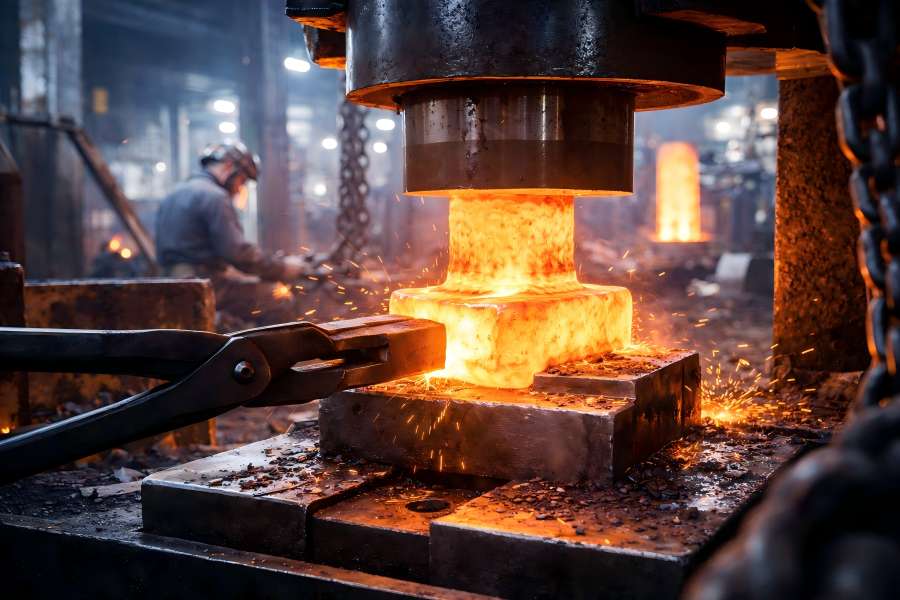
Stainless steels present distinct challenges due to their higher strength at elevated temperatures and sensitivity to thermal gradients.
- Austenitic stainless steels exhibit good ductility but high flow stress, making hot closed-die forging the preferred approach for complex shapes. Martensitic and duplex stainless steels require stricter temperature control to avoid cracking and phase imbalance.
- Open-die forging is often chosen for large stainless steel components where internal quality is prioritized over surface complexity. Precision forging is increasingly applied to reduce machining costs in corrosion-resistant parts.
Post-forging heat treatment is essential to restore corrosion resistance and mechanical balance, influencing overall process planning.
Choosing Forging Methods for Aluminum Alloys
Aluminum alloys are valued for their low density, corrosion resistance, and excellent formability.
- Hot forging allows aluminum to flow easily into complex die cavities, making closed-die and precision forging highly effective. Cold forging is also widely used for small aluminum components requiring excellent surface finish and tight tolerances.
- Due to aluminum’s high thermal conductivity, forging operations must be rapid to maintain temperature consistency. Tool life is generally favorable, and material utilization is high.
These characteristics make aluminum forging ideal for aerospace, automotive, and transportation applications.
Choosing Forging Methods for Titanium and High-Performance Alloys
Titanium alloys and nickel-based superalloys demand exceptional process control.
These materials have narrow forging temperature windows and exhibit strong sensitivity to strain rate and oxidation. Hot forging in controlled atmospheres is typically required.
For large aerospace components, open-die forging is frequently employed to control deformation progressively. Closed-die forging is reserved for high-value parts where dimensional accuracy justifies tooling cost.
Although forging titanium is expensive, the resulting strength-to-weight ratio and fatigue resistance are unmatched, making process optimization critical.
The Role of Part Geometry in Forging Method Selection
Part geometry often dictates forging method selection as strongly as material choice.
Simple, axisymmetric shapes such as rods, discs, and rings are well suited to open-die, roll forging, or ring forging. Complex geometries with ribs, bosses, and cavities require closed-die or precision forging.
Thin sections increase the risk of incomplete die fill, favoring higher-temperature processes or multi-stage forging. Undercuts and sharp transitions demand careful die design and may necessitate additional machining.
Tolerance requirements also influence method choice, as cold and precision forging deliver superior dimensional accuracy compared to open-die processes.
Matching Forging Methods to Common Part Types
| Part Type | Preferred Forging Methods | Key Advantages |
| Shafts and rods | Open-die, roll forging | Aligned grain flow, flexible sizing |
| Flanges and discs | Closed-die, upset forging | High strength, dimensional control |
| Rings and bearings | Ring forging | Seamless structure, fatigue resistance |
| Gears and splines | Closed-die, precision forging | Accurate tooth geometry |
| Structural parts | Closed-die, open-die | Load path optimization |
This alignment between geometry and forging method ensures optimal performance and manufacturability.
Tooling, Die Design, and Production Volume Considerations
Tooling represents a significant portion of forging cost and must align with production volume.
Open-die forging requires minimal tooling, making it ideal for low-volume or custom components. Precision and closed-die forging provide lower per-part costs at scale, but they require a larger initial tooling investment.
Die life depends on material hardness, forging temperature, and lubrication. Automation further enhances consistency and productivity in high-volume production.
Balancing tooling cost against production volume is essential for economic viability.
Cost, Efficiency, and Material Utilization Analysis
| Forging Method | Tooling Cost | Material Utilization | Production Efficiency |
| Open-die forging | Low | Medium | Low to medium |
| Closed-die forging | High | High | High |
| Precision forging | Very high | Very high | Medium to high |
| Ring forging | Medium | High | Medium |
Closed-die and precision forging often yield the lowest total cost for high-volume production despite higher tooling expenses.
Case Studies
A carbon steel industrial shaft benefits from open-die forging for flexibility and cost efficiency. An aluminum aerospace bracket achieves weight reduction and precision through closed-die forging. A stainless steel pressure component relies on controlled hot forging to maintain corrosion resistance.
Incorrect method selection often results in excessive machining, reduced fatigue life, or increased scrap rates.