
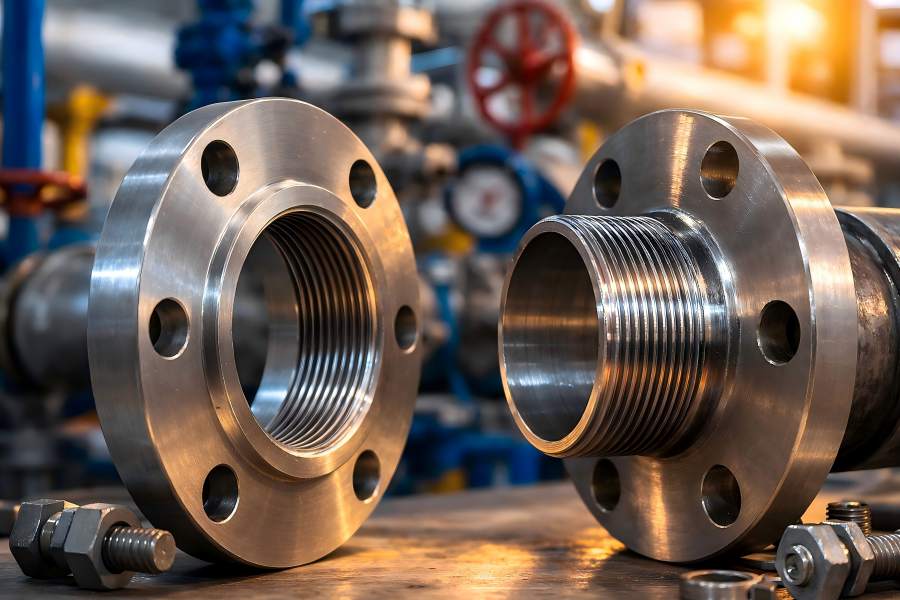
Industrial piping systems rely heavily on reliable connection components. Among them, threaded flanges are widely used for small-diameter pipelines and moderate-pressure applications.
Choosing between female threaded flanges and male threaded flanges can significantly influence installation efficiency, sealing reliability, and long-term system performance.
What Is a Threaded Flange?
A threaded flange, or screwed flange, connects pipes using internal or external threads instead of welding. Unlike weld neck or slip-on flanges, it allows installation without welding equipment, making it suitable where welding is impractical, unsafe, or unnecessary.
Threaded flanges are typically used in small-diameter pipelines (½ to 4 inches) and low- to medium-pressure systems, common in industries like oil and gas, water treatment, chemical processing, and HVAC. Their main advantage is ease of installation, as they can be connected quickly with minimal tools and easily disassembled for maintenance or replacement.
However, threaded connections may create potential leak paths if not properly sealed, especially under vibration or temperature fluctuations. PTFE tape or liquid thread sealants are typically applied to improve sealing.
ASME B16.5, which specifies dimensions, pressure ratings, materials, and tolerances, is used in the production of the majority of threaded flanges. Class 150, Class 300, and Class 600 pressure classes are frequently encountered.
Generally speaking, threaded flanges fall into two major categories:
- Female threaded flanges
- Male threaded flanges
Each type has its own structural characteristics and application scenarios.
What Is a Female Threaded Flange?
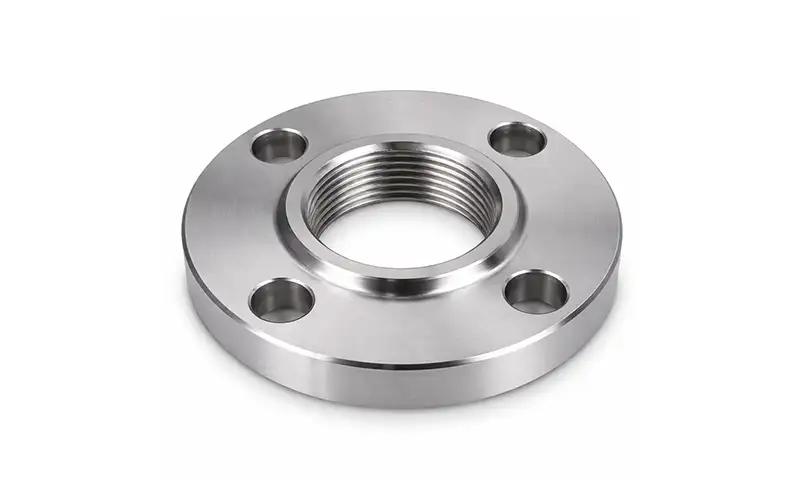
Internal threads on a female threaded flange enable direct screwing onto an outwardly threaded pipe or fitting. The threads are machined inside the flange bore, enabling the pipe to be inserted and tightened without welding.
Female threaded flanges are among the most widely utilized threaded flange types in industrial pipe systems because of this design. Because most pipes are manufactured with external threads, female threaded flanges are naturally compatible with many standard piping components.
The installation process is relatively simple. The externally threaded pipe is aligned with the flange and then rotated until the connection becomes tight. A sealing material such as PTFE tape is typically applied to the pipe threads before installation to prevent leakage.
When fast installation and simple removal are crucial, female threaded flanges are frequently utilized. Maintenance operations become easier because the flange can be removed without cutting or welding the pipe.
Typical materials for female threaded flanges include:
- Carbon steel
- Stainless steel
- Alloy steel
- Brass or bronze (for certain applications)
These flanges are extensively utilized in a variety of industries, including chemical processing equipment, compressed air pipes, fire safety systems, and water treatment facilities.
The internal thread design also provides a certain level of protection because the threads are not exposed to external damage. This can improve the durability of the connection in some environments.
What Is a Male Threaded Flange?
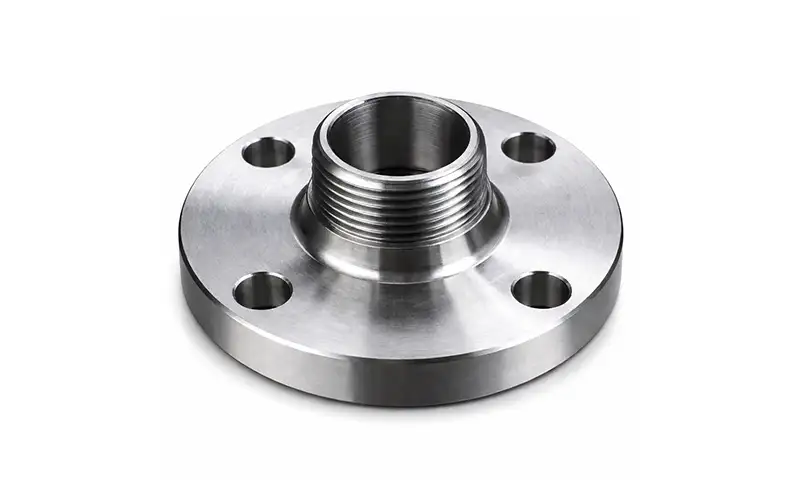
A male threaded flange is designed with external threads on its connection surface. Instead of screwing onto a pipe, it is screwed into a female-threaded component, such as a pipe fitting, valve body, or equipment connection.
Male threaded flanges are less common than female threaded flanges in standard piping systems. However, they serve an important role in specialized connection configurations where a female-threaded interface is already present.
In a typical installation scenario, the male threaded flange is inserted into the internally threaded port of a pipeline component. The threaded connection forms a strong mechanical bond as the flange is tightened.
Male threaded flanges are frequently utilized in the following circumstances:
- Equipment or valves have female-threaded ports
- A transition between different threaded components is required
- Special adapter connections are needed
The threads must be handled carefully during shipment and installation to prevent damage because they are visible on the outside. Thread protection caps are sometimes used to prevent thread deformation.
Male threaded flanges can also be manufactured from similar materials as female threaded flanges, including carbon steel, stainless steel, and alloy steel. Pressure ratings typically follow ASME B16.5 standards.
Although they are less common, male threaded flanges provide flexibility in certain pipeline configurations where standard female-threaded flanges may not be suitable.
Structural Differences
The primary difference between female and male threaded flanges lies in the thread location and orientation. This structural distinction directly affects how the flanges interact with pipes and fittings.
Because female threaded flanges have internal threads, they can be screwed onto pipes with exterior threads. In contrast, male threaded flanges can screw into internally threaded components because they have exterior threads.
Another structural difference involves thread protection and durability. Internal threads are naturally protected by the flange body, while external threads remain exposed and therefore require careful handling.
Installation direction also differs. Female threaded flanges typically rotate onto pipes, while male threaded flanges are rotated into fittings or equipment.
The following table highlights the main structural differences between the two types.
| Feature | Female Threaded Flange | Male Threaded Flange |
| Thread Type | Internal thread | External thread |
| Connection Method | Screws onto threaded pipe | Screws into threaded fitting |
| Thread Exposure | Protected inside flange | Exposed outside flange |
| Installation Direction | Pipe inserted into flange | Flange inserted into fitting |
| Common Usage | Standard piping systems | Specialized connections |
These structural differences determine how each flange type is used in industrial pipelines.
Performance Comparison
When selecting threaded flanges, engineers must evaluate several performance factors, including sealing capability, mechanical strength, and long-term reliability.
Instead of welding, threaded connections are used in both male and female threaded flanges. Therefore, in order to stop leaks, appropriate thread engagement and sealing materials are crucial.
Female threaded flanges generally provide slightly better sealing reliability because the threads are located inside the flange body. This configuration allows better protection from external damage and contamination.
Male threaded flanges can also achieve excellent sealing performance when properly installed. However, they might be more susceptible to harm during handling due of their exposed threads.
Mechanical strength is largely determined by material properties and pressure rating rather than thread orientation. Within the pressure ranges specified by ASME regulations, both types of flanges can function dependably.
The following table compares the performance characteristics of the two flange types.
Overall, both flange types perform well in moderate-pressure systems when installed correctly.
Installation and Maintenance Considerations
Proper installation is critical for threaded flange connections. System failure, thread damage, or leaking might result from improper installation.
The pipe threads should be thoroughly examined to make sure they are clean and defect-free before to installation. Replacement or repair of any broken threads is required.
Thread sealant materials are commonly applied during installation. The most widely used sealing materials include:
- PTFE thread tape
- Liquid thread sealant
- Pipe joint compound
These compounds enhance the connection’s sealing performance by filling in tiny spaces between threads.
When tightening threaded flanges, excessive torque should be avoided. The flange surface may become distorted or the threads may be damaged by overtightening.
Periodic inspection is also recommended during system operation. Engineers should check for:
- Signs of leakage
- Thread loosening
- Corrosion around the flange connection
Maintenance procedures may involve re-tightening the connection or replacing worn sealing materials.
Because threaded flanges can be easily disassembled, maintenance operations are typically simpler than those involving welded flanges.
Typical Industrial Applications
Threaded flanges are widely used across many industries where small pipe diameters and moderate pressure levels are involved.
In the oil and gas sector, low-pressure service pipelines, auxiliary piping systems, and instrumentation lines frequently use threaded flanges.
In chemical processing plants, threaded connections are often used for equipment connections where welding could create contamination risks or require complex procedures.
Water treatment facilities also use threaded flanges in pumping systems and distribution pipelines. Their ease of installation helps reduce maintenance downtime.
Threaded flanges are frequently found in HVAC systems, compressed air pipelines, and fire protection systems as well.
How to Choose the Right Threaded Flange for Your Pipeline
Selecting the correct threaded flange requires careful evaluation of several factors.
The first factor is the temperature and pressure in the pipeline. Typically, threaded flanges are employed in settings with modest pressure. If the system operates at extremely high pressure, welded flanges may be a preferable option.
The second factor is thread compatibility. Pipes and fittings may use different thread standards, such as NPT, BSP, or BSPT. Ensuring compatibility between the flange and pipe threads is essential.
Another important consideration is installation accessibility. If the pipeline requires frequent maintenance or replacement, threaded flanges provide an advantage because they can be easily disassembled.
Engineers must also consider environmental conditions, including corrosion, vibration, and temperature variations. Selecting appropriate materials and protective coatings can improve long-term reliability.
Cost considerations may also influence the selection. Threaded flanges typically reduce installation costs because welding is not required.