
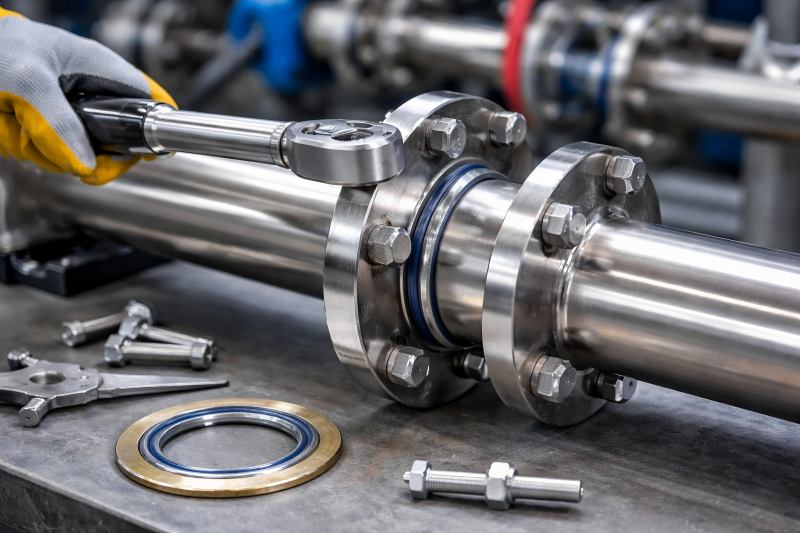
Lap joint flanges are popular in piping systems, enabling easy rotation and precise pipeline alignment. Typically used in conjunction with a stub end, lap joint flanges are ideal for applications requiring frequent inspection, maintenance, or alignment adjustments. Improper use can cause leaks, flange damage, and inefficiency. Understanding common mistakes and implementing best practices can ensure reliable performance, reduce maintenance costs, and extend the service life of piping systems.
Using the Wrong Material for the Flange or Stub End
One of the most frequent mistakes is selecting a flange or stub end material that is incompatible with the pipeline fluid or operating environment. Lap joint flanges themselves are typically low-cost materials, while the stub end carries the exposure to the fluid. Choosing incorrect materials can cause corrosion, cracking, or premature failure.
How to Avoid:
- Match stub end material to fluid type and conditions. For corrosive fluids, stainless steel or high-nickel alloys are recommended.
- Account for temperature and pressure when choosing flange materials.
- Check chemical compatibility charts prior to flange or stub installation.
Recommended Materials for Lap Joint Flanges by Application
| Application Type | Recommended Stub End Material | Flange Material (Low-Cost) |
| Water / Wastewater | Carbon Steel / Stainless Steel | Carbon Steel |
| Chemical / Corrosive Fluids | Alloy 20 / Hastelloy | Carbon Steel / Stainless |
| High-Temperature Steam | Stainless Steel 316 / 304 | Carbon Steel / Mild Steel |
| Food / Pharmaceutical Systems | Stainless Steel 316L | Stainless Steel |
| Oil & Gas Pipelines | Carbon Steel with Anti-Corrosion | Carbon Steel |
Improper Alignment of Flange and Stub End
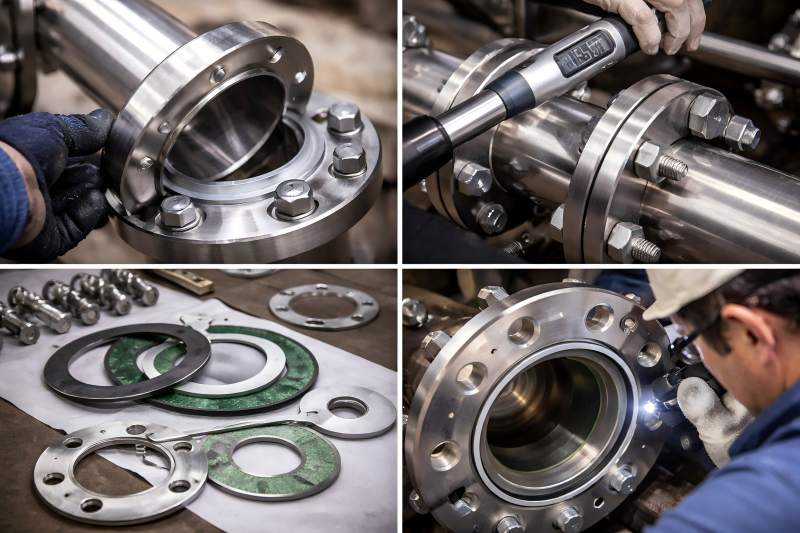
Lap joint flanges rotate freely for easy alignment. A common mistake is forcing the flange to align without properly rotating the flange around the stub end. This can result in uneven bolt stress, leaks, and flange deformation.
How to Avoid:
- Always allow the flange to rotate freely and naturally over the stub end before tightening bolts.
- Use alignment tools or guides to ensure parallelism between flange faces.
Over-Tightening or Under-Tightening Bolts
Incorrect torque is one of the most damaging errors. Over-tightening deforms flanges; under-tightening causes leaks.
How to Avoid:
- Use calibrated torque wrench correctly.
- Tighten bolts in cross pattern.
- Retorque after system reaches temperature.
Typical Torque Values for Lap Joint Flanges (ANSI B16.5 Standard)
| Flange Size (NPS) | Bolt Size | Torque (Nm) |
| 2” – 3” | 5/8” | 40 – 50 |
| 4” – 6” | 3/4” | 80 – 100 |
| 8” – 10” | 7/8” | 150 – 180 |
| 12” – 16” | 1” | 250 – 300 |
| 18” – 24” | 1 1/8” | 400 – 450 |
Using Incorrect Gasket Type
The wrong gasket choice is a frequent contributor to flange failures. Lap joint flanges often use full-face or ring-type gaskets depending on pressure, temperature, and fluid type. Selecting the wrong type can cause leaks or damage to the sealing surface.
How to Avoid:
- For low-pressure, non-corrosive fluids, full-face gaskets are usually sufficient.
- For high-pressure systems, consider ring-type or spiral wound gaskets.
Gasket Selection for Lap Joint Flanges
| Pressure Rating | Temperature Range | Recommended Gasket Type |
| Low (≤150 psi) | -20°C to 120°C | Non-Asbestos / Rubber |
| Medium (150–600 psi) | -20°C to 300°C | Spiral Wound / PTFE |
| High (>600 psi) | Up to 500°C | Ring Type Joint / Graphite |
| Corrosive Fluids | Any | PTFE / Metal Jacketed Gasket |
Improper Cleaning and Surface Preparation
Failure to clean flange faces or stub ends prior to assembly can cause uneven gasket compression, leaks, or premature wear. Residues, rust, or debris compromise the seal.
How to Avoid:
- Clean flange faces and stub ends with a suitable solvent before assembly.
- Remove rust or scale using wire brushes or chemical rust removers.
- Inspect surfaces for scratches, dents, or irregularities that could affect gasket sealing.
Ignoring Thermal Expansion and Vibration
Failing to accommodate these factors can result in flange fatigue, bolt loosening, or gasket failure.
How to Avoid:
- Include expansion joints or loops in long piping runs.
- Use vibration-damping materials or supports for piping near pumps and compressors.
- Periodically inspect bolt tightness and flange alignment.
Incorrect Installation Sequence
Installing lap joint flanges in the wrong order, such as attempting to weld the flange rather than the stub end, is a common mistake. Welding the flange instead of the stub end eliminates the flange’s rotation capability and may cause stress concentrations.
How to Avoid:
- Always weld the stub end to the pipe first.
- Tighten bolts only after the flange is correctly positioned and aligned.
Overlooking Pressure Class Compatibility
Each lap joint flange is rated for a specific pressure class (ANSI/ASME). Using a flange rated for lower pressure in a high-pressure system is a critical error that can lead to catastrophic failure.
How to Avoid:
- Confirm the system operating pressure and temperature.
- Choose lap joint flanges with an appropriate ANSI/ASME pressure rating.
Common Lap Joint Flange Pressure Ratings
| Pressure Class | Max Operating Pressure (psi) | Typical Application |
| Class 150 | 285 | Water, Low-Pressure Steam |
| Class 300 | 740 | General Process Piping |
| Class 600 | 1480 | High-Pressure Steam, Chemicals |
| Class 900 | 2220 | High-Pressure Gas Systems |
| Class 1500 | 3705 | Oil & Gas, High-Temp Fluid |
| Class 2500 | 6170 | Critical Industrial Systems |
Neglecting Regular Inspection and Maintenance
Lap joint flanges suit systems needing frequent disassembly. Neglecting scheduled maintenance can lead to unnoticed leaks, corrosion, or flange deformation.
How to Avoid:
Schedule regular inspections for alignment, torque, gaskets.
Replace worn gaskets immediately.
Inspect for signs of corrosion or stress on both flange and stub end.
Summary of Common Mistakes and Preventive Measures
Table 5: Common Mistakes and How to Avoid Them
| Mistake | Effect | Solution |
| Wrong material selection | Corrosion, failure | Match stub end to fluid & environment |
| Improper alignment | Bolt stress, leaks | Allow flange rotation, use alignment tools |
| Incorrect bolt torque | Gasket failure, leaks | Use torque wrench, cross-pattern tightening |
| Wrong gasket type | Leakages, damage | Select type per pressure, temperature, fluid |
| Poor surface preparation | Uneven sealing, leaks | Clean surfaces, remove debris/rust |
| Ignoring expansion/vibration | Flange fatigue, bolt loosening | Include expansion joints, vibration damping |
| Wrong installation sequence | Loss of rotation, stress | Weld stub end first, slide flange properly |
| Pressure class mismatch | Catastrophic failure | Confirm ANSI/ASME rating vs system pressure |
| Skipping maintenance | Undetected wear, leaks | Implement inspection & maintenance schedule |
Lap joint flanges provide excellent flexibility, ease of maintenance, and cost efficiency when used correctly. However, common mistakes such as improper material selection, misalignment, incorrect bolt torque, and poor maintenance can compromise their performance and lead to failures. By understanding these pitfalls and following best practices—selecting proper materials, aligning correctly, using appropriate gaskets, and maintaining regular inspections—operators can ensure reliable, leak-free operation. Proper training, documentation, and adherence to standards (ANSI/ASME) will maximize system safety, efficiency, and lifespan.