
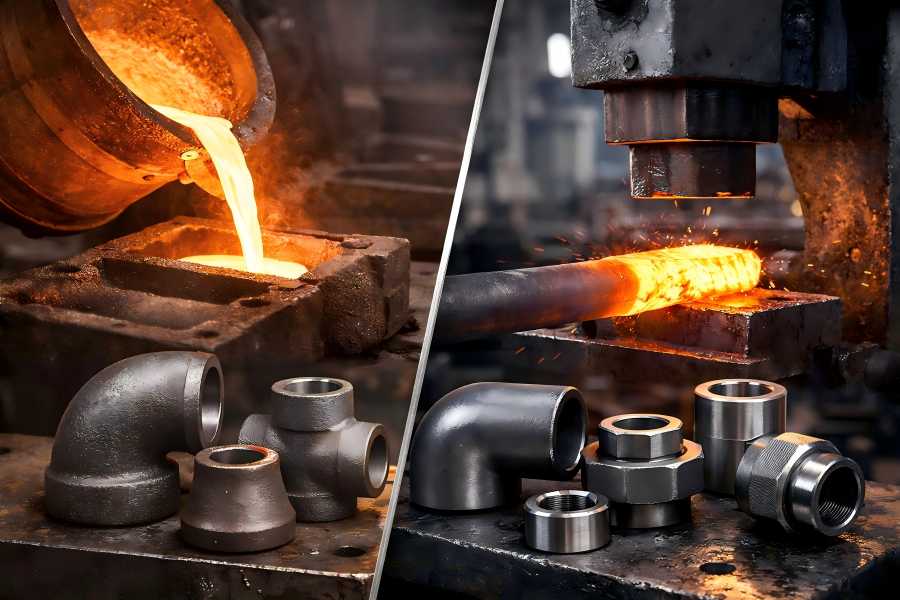
Pipe fittings may look like small parts of a piping system, but they are often the weakest links when something goes wrong. Choosing between cast and forged pipe fittings is therefore not just a purchasing decision; it is a safety and reliability decision that can affect people, equipment, and the environment.
What Are Cast and Forged Pipe Fittings?
Cast pipe fittings
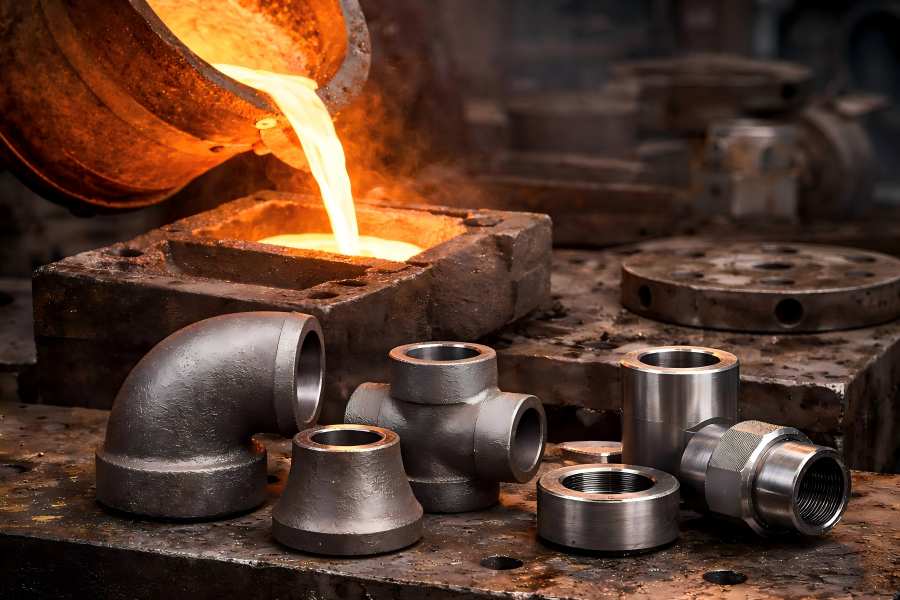
Cast pipe fittings are produced by melting metal and pouring the liquid metal into a mold cavity shaped like the final product. The casting is taken out of the mold, cleaned, and then machined to its final proportions once it has cooled and solidified.
Common features of cast pipe fittings:
- Complex shapes can be produced in one operation.
- Suitable for medium to large sizes.
- Often used for elbows, tees, reducers, valves, and pump bodies.
- Cast carbon steel, alloy steel, stainless steel, and ductile iron are examples of common materials.
Because the metal cools from a liquid state, the internal structure of a casting is generally more random, and there is a risk of internal defects such as porosity or shrinkage cavities if the process is not well controlled.
Forged pipe fittings

Forged pipe fittings start from a solid metal billet or bar. After the billet is heated to a high temperature, presses or hammers are used to shape it. The forging is then machined to obtain the final dimensions and connection ends, such as socket weld or threaded ends.
Common features of forged pipe fittings:
- Strong, dense structure due to plastic deformation of the metal.
- Typically used for small to medium sizes.
- Common for high-pressure socket weld and threaded fittings, unions, couplings, caps, and outlets.
- Stainless steel, alloy steel, and forged carbon steel are common materials.
- The metal’s grain structure is crushed and aligned with the flow direction during forging.
Common materials and standards
Both cast and forged pipe fittings are available in similar material families, often defined by ASTM and ASME standards. For example:
- Carbon steel: ASTM A105, A234, A216
- Stainless steel: ASTM A182, A351, A403
- Alloy steels for high-temperature service
Although the chemical composition can be similar, the different manufacturing processes produce very different internal structures and mechanical behavior.
Manufacturing Process Differences and Their Impact
Casting process overview
For pipe fittings, a streamlined casting procedure comprises:
- The metal is melted in a furnace.
- Pouring into a sand mold, permanent mold, or investment mold.
- letting the metal become solid.
- Cleaning and extracting the casting from the mold.
- Heat treatment, if required.
- Machining to final dimensions.
- Inspection and testing.
Typical defects in cast fittings include:
- Shrinkage cavities where the metal pulls away during solidification.
- Gas porosity from entrapped gases.
- Inclusions from slag or mold material.
- Hot tears or cracks from thermal stresses.
These defects are not inevitable, but they must be strictly controlled through process design, simulation, and quality inspection.
Forging process overview
A simplified forging process includes:
- Cutting billets or bars to length.
- Heating to the forging temperature.
- Forging under a press or hammer into preform and final shape.
- Trimming extra material and sparkle.
- To obtain the necessary mechanical qualities, apply heat treatment.
- Machining.
- Inspection and testing.
During forging, plastic deformation:
- Refines the grain size.
- Produces directional grain flow around the shape of the fitting.
- Closes minor internal voids, making the structure denser.
This is one of the key reasons why forged pipe fittings generally offer higher mechanical strength and better toughness compared with cast equivalents.
Table 1: Comparison of Casting vs Forging Processes for Pipe Fitting
| Process Aspect | Cast Pipe Fittings | Forged Pipe Fittings | Impact on Strength and Safety |
| Starting form | Liquid metal poured into mold | Solid billet or bar deformed under pressure | Forging generally creates a denser, more uniform structure |
| Grain structure | Random, equiaxed grains | Directional grain flow following part shape | Forged grains improve toughness and fatigue resistance |
| Typical defects | Porosity, shrinkage, inclusions, hot tears | Laps, underfills, forging laps (less internal porosity) | Cast defects can act as crack initiation sites |
| Shape complexity | Excellent, complex shapes possible | More limited shapes; often require machining | Castings suit complex geometry; forgings emphasize integrity |
| Mechanical props | More variable, process-dependent | More consistent, higher strength and toughness | Forged fittings usually preferred for critical service |
Metallurgical Structure and Mechanical Properties
Grain structure
In a casting, solidification proceeds from the mold walls inward. Grains grow in multiple directions, and if cooling is not uniform, there may be regions with coarse grains or segregated phases. These areas can be weaker and less resistant to crack initiation.
In a forging, plastic deformation breaks up coarse grains and elongates them along the flow of the metal. This grain flow can be oriented to follow the shape of the fitting, especially in elbows, tees, and reducers. The result is:
- Enhanced tensile strength and yield.
- Better notch toughness.
- Increased resistance to fatigue.
Strength and toughness comparison
Although exact numbers depend on material grade and heat treatment, forged materials typically show:
- Higher yield strength.
- Higher tensile strength.
- Higher impact energy in Charpy tests.
Cast materials can meet minimum specification values, but there is usually more scatter because internal defects have a stronger influence on performance.
Defect density and safety margin
Defects in cast fittings such as porosity and shrinkage act as stress concentrators. Under pressure, thermal expansion, or vibration, cracks can initiate at these defects and grow, eventually causing leakage or sudden rupture.
Forged fittings usually have fewer internal defects and a more homogeneous structure. This adds safety margin, especially in:
- High-pressure service.
- High-temperature lines.
- Cyclic loading conditions.
- Corrosive environments where localized attack can accelerate crack growth.
Table 2: Qualitative Mechanical Performance – Cast vs Forged Pipe Fittings
| Property | Cast Pipe Fittings | Forged Pipe Fittings | Safety Impact |
| Yield strength | Moderate | Higher | Forged fittings can handle higher stresses before yielding |
| Tensile strength | Moderate | Higher | More margin against bursting |
| Impact toughness | Variable, sensitive to defects | Generally high and stable | Better resistance to brittle fracture at low temperature |
| Fatigue resistance | Lower due to internal defects | Higher due to dense, oriented grains | Safer for vibration and cyclic pressure |
| Defect sensitivity | High | Lower | Casting defects can significantly reduce life |
Pressure Rating, Codes, and Standards
Pressure classes
Pipe fittings are classified by pressure classes such as Class 150, 300, 600, 3000, and 6000. At a particular temperature, higher classes equate to higher permissible pressure.
Forged fittings, especially those covered by ASME B16.11, are commonly available in high-pressure classes (e.g., 3000, 6000, and 9000). Cast fittings, especially in cast steel or iron, are more often found in lower to medium pressure classes.
Standards distinction
Some key standards divide fittings by manufacturing route:
- Wrought or forged fittings: ASME B16.9 (buttweld), B16.11 (socket weld and threaded)
- Cast fittings: ASTM A216, A351 for cast steels; other standards for cast iron
These standards define chemical composition, mechanical properties, dimensions, and testing requirements. The existence of separate standards reflects that cast and forged products behave differently and must be controlled separately.
Inspection and NDT requirements
To maintain safety:
- Cast fittings may require radiographic or ultrasonic testing to detect internal shrinkage or porosity.
- Forged fittings may rely more on surface examinations (magnetic particle, dye penetrant) and dimensional checks, as internal porosity is less common.
For critical services, project specifications may call for 100% NDT, positive material identification (PMI), and additional testing regardless of whether fittings are cast or forged.
Safety Performance: Failure Modes and Risk Factors
Failure modes of cast fittings
Typical failure patterns include:
- Leakage along porous zones that were not fully sealed by machining.
- Cracks starting at shrinkage cavities or inclusions.
- Brittle fracture in areas with coarse grains or high residual stresses.
These failures can sometimes appear suddenly, especially at low temperatures or under pressure spikes.
Failure modes of forged fittings
Forged fittings usually fail due to:
- Overload beyond design pressure or temperature.
- Improper heat treatment causing embrittlement.
- Poor machining creating sharp stress risers.
Although forged fittings are stronger, they are not immune to failure if specified or installed incorrectly.
Role of operating conditions
The relative risk for cast versus forged fittings depends strongly on operating conditions:
- High pressure: favors forged fittings.
- High temperature: favors forged fittings with appropriate alloy and heat treatment.
- Severe cyclic loading or vibration: favors forged fittings because of better fatigue resistance.
Non-critical, low-pressure water or air service: cast fittings may be sufficient and more economical.
Application Scenarios: Where Each Option Makes Sense
Typical applications for cast fittings
Cast pipe fittings are often used in:
- Low and medium pressure water distribution.
- Fire protection systems (depending on local codes).
- HVAC piping.
- General utility services in industrial plants.
- Some chemical processes at moderate pressure and temperature.
In these applications, cost is a major factor, and the consequences of leakage may be manageable.
Typical applications for forged fittings
Forged pipe fittings are commonly selected for:
- High-pressure steam lines.
- High-temperature hydrocarbon services.
- Oil and gas production, refinery, and petrochemical plants.
- Power generation boiler and turbine lines.
- Offshore and subsea systems.
- High-pressure hydraulic lines.
In such systems, a single failure can cause serious safety, environmental, and financial losses, so the extra safety margin of forged fittings is usually worth the additional cost.
Example comparison
Consider two scenarios:
- High-pressure steam line feeding a turbine: forged fittings are normally mandatory due to high temperature, pressure, and energy content.
- Low-pressure cooling water system circulating water through heat exchangers: cast fittings may provide acceptable performance at lower cost, as leakage risk is less critical and can be managed.
Cost vs Strength and Safety: Lifecycle Perspective
Initial purchase cost
Cast fittings usually have:
- Lower tooling cost for complex shapes.
- Lower material and processing cost per unit in many size ranges.
Forged fittings generally:
- Use higher-quality billets.
- Require heavy forging equipment and more machining.
- Cost more per piece, especially in stainless and alloy steels.
Maintenance and downtime costs
A single failure can cause:
- Unplanned shutdowns.
- Costly repairs.
- Production losses.
- Environmental cleanup or safety incidents.
When downtime is expensive, the higher reliability of forged fittings can quickly pay back the higher initial price.
Lifecycle evaluation
To compare lifecycle cost, engineers should consider:
- Expected service life.
- Probability of failure.
- Consequence of failure.
- Inspection and maintenance costs.
In critical service, forged fittings often deliver lower lifecycle cost despite higher purchase price.
How to Choose Between Cast and Forged Pipe Fittings
Key engineering factors
Important factors when choosing fitting type include:
- Design pressure and temperature.
- Fluid type (corrosive, flammable, toxic, clean water).
- Cyclic loading, vibration, and thermal cycling.
- Required standards and client specifications.
- Accessibility for inspection and replacement.
Practical selection guidance
A simple approach:
- For high-pressure, high-temperature, or safety-critical lines, choose forged fittings whenever available.
- For low-pressure, non-hazardous services where leakage risk is acceptable and easily managed, cast fittings may be an economical solution.
Table 3: Typical Selection Guide – Cast vs Forged Pipe Fittings
| Service Condition | Recommended Option | Reason |
| High-pressure steam, superheated | Forged fittings | High strength and better fatigue resistance |
| High-temperature hydrocarbon | Forged fittings | Safety critical, high consequence of failure |
| Toxic or flammable gas service | Forged fittings | Minimize leak risk and sudden rupture |
| Low-pressure cooling water | Cast fittings may be OK | Lower consequence of leakage, cost sensitive |
| General plant air or inert gas | Cast or forged, depends | Use forged where vibration is severe |
| Fire water ring main | Depends on code and risk | Some codes accept cast, others prefer forged |