
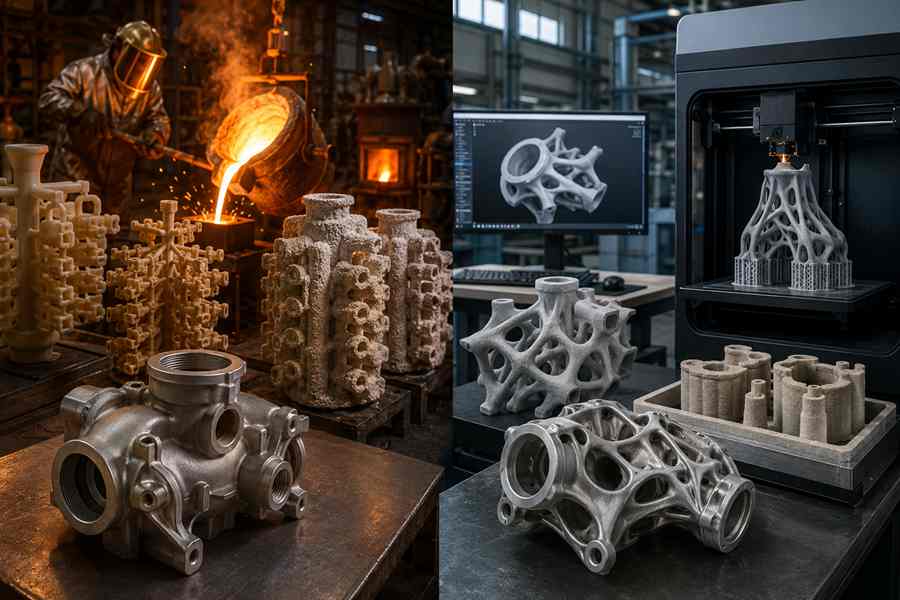
Lost wax investment casting and 3D printed patterns both support complex metal parts. Molded wax patterns suit stable mass production, while 3D printed patterns provide greater flexibility for prototypes, custom components, and frequent design changes.
Introduction to Lost Wax Precision Casting Process
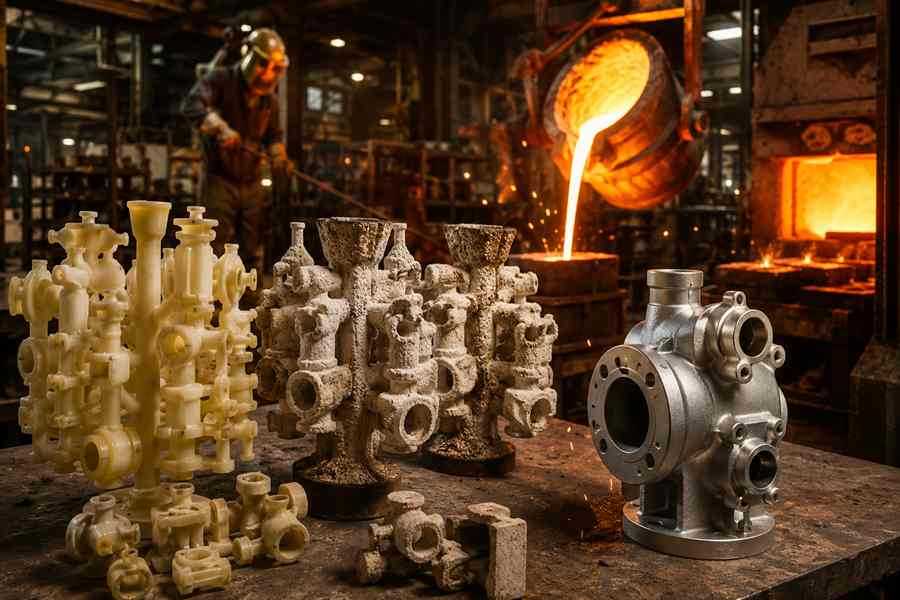
Precision lost wax investment casting involves coating a one-time-use wax pattern with ceramic coating to form a hard shell mold. After clearing out all wax content, liquefied metal fills the hollow mold cavity to take shape as target mechanical parts.
Mass production of wax forms mostly adopts injection molding using moulds fabricated from aluminum or steel materials. After the tooling is approved, the same geometry can be reproduced efficiently for hundreds or thousands of castings.
Key Characteristics of Lost Wax Casting
- Uses injection-molded wax patterns
- Reproduces detailed external features
- Delivers relatively smooth cast surfaces
- Maintains consistent dimensions between batches
- Requires dedicated pattern tooling
- Fits medium- and high-volume production
Advantages
- Creates smooth and uniform pattern surfaces
- Provides dependable dimensions across repeat orders
- Supports rapid pattern production after mold approval
- Lowers pattern cost as order quantities increase
- Allows multi-cavity molds for higher output
- Uses a mature process offered by many foundries
Disadvantages
- Requires an initial investment in tooling
- Extends the first sampling and development period
- Makes later design revisions more expensive
- Pattern release can limit certain undercuts
- Offers less value for one-off components
- Increases financial risk when future demand is unclear
What Are 3D Printed Casting Patterns?
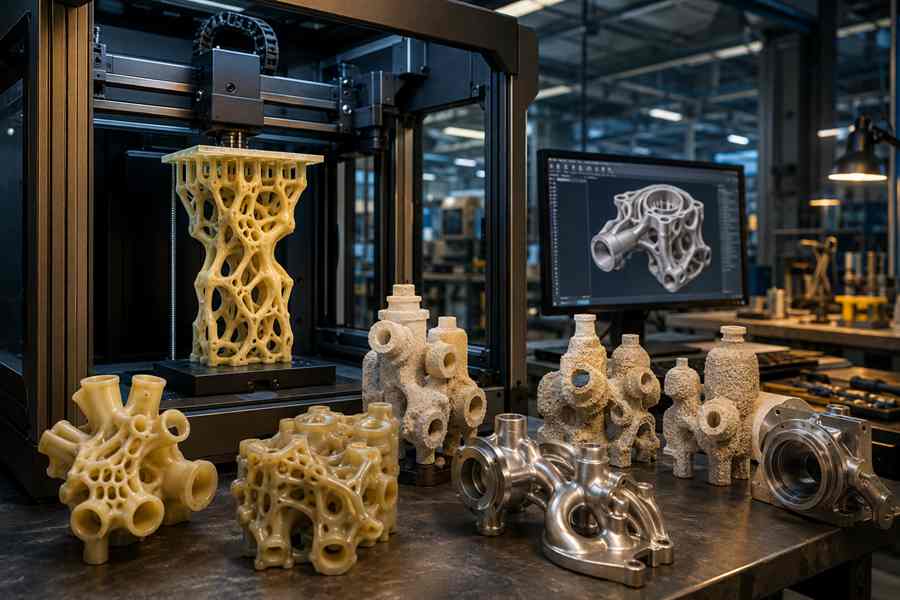
3D printed casting patterns are expendable models made directly from digital CAD files. Suppliers may use castable resin, wax-like polymers, or other materials designed to burn out with minimal residue.
The printed model receives a ceramic coating and is removed before molten metal is poured. The main change is how the pattern is produced, while most later investment casting operations remain similar.
Key Characteristics of 3D Printed Patterns
- Manufactured directly from digital models
- Eliminates the need for wax injection tooling
- Supports quick geometry updates
- Handles irregular and organic shapes
- Fits prototypes and limited production runs
- Requires controlled printing and burnout
Advantages
- Removes the need for dedicated pattern molds
- Shortens preparation for prototype castings
- Allows CAD designs to be modified quickly
- Supports undercuts and unusual surface transitions
- Helps reproduce discontinued replacement components
- Works well for customized and low-volume products
Disadvantages
- Has a higher pattern price per unit
- Produces patterns more slowly at larger volumes
- May transfer visible layer marks to the casting
- Needs clean burnout to prevent shell contamination
- Can deform when sections are wide and thin
- Depends heavily on print orientation and calibration
Lost Wax Patterns vs 3D Printed Casting Patterns
| Comparison Factor | Molded Wax Patterns | 3D Printed Patterns |
| Design Freedom | Supports complex geometry but remains affected by tooling structure and pattern release | Handles undercuts, organic forms, internal passages, and frequent revisions |
| Tooling Requirements | Requires a machined wax injection mold | Works from CAD files without dedicated pattern tooling |
| Surface and Detail | Produces smooth surfaces and repeatable fine features | Depends on print resolution, orientation, supports, and finishing |
| Dimensional Consistency | Provides stable repeatability after tooling approval | Can vary with printing, curing, shrinkage, and machine calibration |
| Order Quantity | More economical for medium and large production volumes | Better for prototypes, custom components, and short runs |
| Lead Time | Needs more time before sampling but supports faster repeat output | Shortens initial sampling but takes longer per pattern at volume |
| Cost Structure | Higher tooling investment with lower pattern cost in volume | Lower upfront spending with a higher pattern cost per piece |
Design Freedom
- Molded Wax Patterns:Can reproduce curves, ribs, logos, thin walls, and fine surface features, but the pattern must separate from the mold without damage.
- 3D Printed Patterns:Provide more freedom for undercuts, internal channels, organic contours, and uneven geometric transitions.
Printed patterns are particularly useful while wall thicknesses, joint positions, or internal structures are still being adjusted. Buyers can evaluate multiple versions without producing a new mold for every change.
However, a shape that can be printed is not always suitable for metal casting. Metal flow, shell strength, shrinkage, venting, and cleaning access must still be reviewed.
Tooling Requirements
- Molded Wax Patterns:Need a machined aluminum or steel injection mold, with cost affected by part size, cavity number, mold construction, and tolerance level.
- 3D Printed Patterns:Are made directly from CAD data, allowing revised models to enter production without altering physical tooling.
Reducing dependence on tooling is the most important advantage of printed patterns in my view. It gives buyers more time to confirm function and market demand before investing in a permanent mold.
Surface and Detail
- Molded Wax Patterns:Deliver smooth surfaces, defined edges, small ribs, logos, and repeatable details when the injection tooling is accurately machined.
- 3D Printed Patterns:Depend on layer height, build direction, support position, and final surface treatment for their visible quality.
Layer lines and support traces can transfer from the printed model into the ceramic shell and appear on the finished metal part. Sanding, sealing, or coating can improve the surface, but these operations add labor.
Buyers should confirm whether the quotation includes printed-pattern finishing. Some prices cover direct printing only.
Dimensional Consistency
- Molded Wax Patterns:Maintain reliable dimensions once the tooling and wax injection settings have been stabilized, making them suitable for repeated assembly parts.
- 3D Printed Patterns:May change slightly because of curing, shrinkage, print orientation, equipment calibration, or deformation during handling.
Small dimensional differences may be acceptable for five prototype pieces. For thousands of parts that must fit the same assembly, molded wax patterns usually provide more predictable control.
Order Quantity
- Molded Wax Patterns:Become more cost-effective as volume increases because tooling expenses are divided across more parts and each injection cycle is relatively fast.
- 3D Printed Patterns:Avoid mold expenses but require separate printing time for every pattern, especially when the component is large.
Typical purchasing ranges include:
- 1–20 parts:3D printed patterns are generally more practical.
- 20–100 parts:The best choice depends on pattern size, complexity, and future demand.
- 100–500 parts:Both pattern routes should be quoted and compared.
- More than 500 parts:Molded wax patterns normally offer better unit economics.
These quantities are general planning references rather than fixed production limits.
Lead Time
- Molded Wax Patterns:Commonly need two to six weeks for mold design, machining, trial injection, and corrections before regular production begins.
- 3D Printed Patterns:Can often move from an approved CAD file to physical pattern production within several days.
Printed patterns are therefore useful for urgent prototypes, development projects, and discontinued replacement parts. They shorten the period before the first casting is made.
This advantage becomes smaller in mass production. A multi-cavity wax mold can produce patterns much faster than a printer working through repeated build cycles.
Cost Structure
- Molded Wax Patterns:Usually require about US$1,500–8,000 in injection tooling, while each pattern may cost around US$1–10 during repeat production.
- 3D Printed Patterns:Need little dedicated tooling, but individual patterns commonly cost about US$20–200, depending on size, material, resolution, and finishing.
Printed patterns may lower initial project spending by roughly 30%–70% when only a few samples are required. This saving mainly comes from avoiding a mold that would be used for a very limited quantity.
These figures are intended for early budgeting. Pattern volume, print technology, surface treatment, shell compatibility, and final order size will influence the actual quotation.
Application Comparison
The preferred pattern type depends on whether the project places more value on design flexibility, dimensional consistency, or unit-cost control.
Prototype Development
- Recommended Type:3D Printed Casting Patterns
- Reason:Several versions can be tested without making separate injection molds, reducing early investment and revision time.
Customized Components
- Recommended Type:3D Printed Casting Patterns
- Reason:Each digital model can be adjusted independently, making the method suitable for personalized hardware, art pieces, and custom replacements.
Regular Industrial Production
- Recommended Type:Molded Wax Patterns
- Reason:Stable wax injection delivers repeatable dimensions, higher pattern output, and lower costs across ongoing orders.
Complex Internal Geometry
- Recommended Type:3D Printed Casting Patterns
- Reason:Direct printing supports curved channels, difficult undercuts, and forms that cannot easily release from a conventional injection mold.