
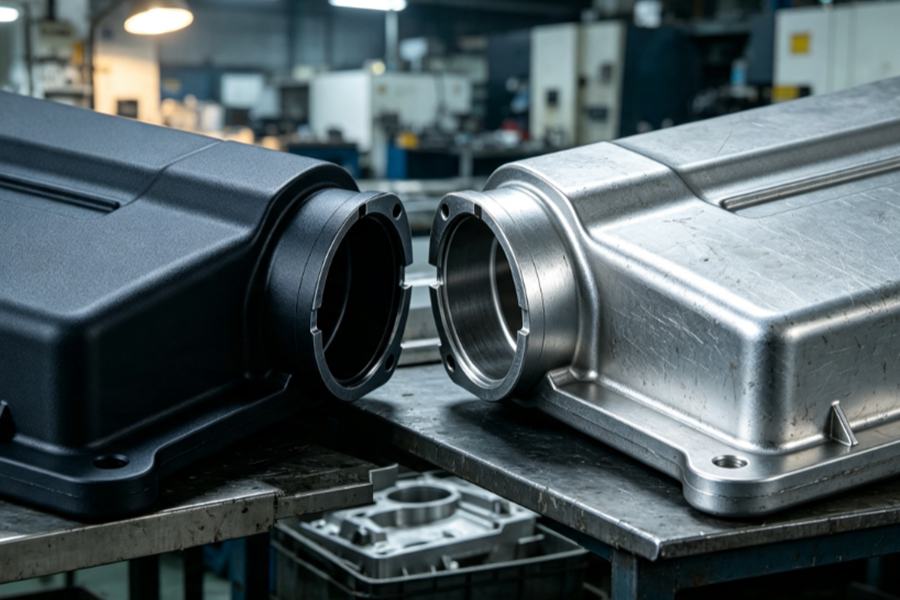
Powder coating offers uniform color, defect coverage, and corrosion protection, while anodizing preserves metallic appearance, adds surface hardness, and suits tight tolerances. Selection depends on alloy, porosity, function, and finish.
Main Differences
| Comparison | Powder Coating | Anodizing |
| Process | Adds protective film | Forms oxide layer |
| Appearance | Solid or textured color | Metallic finish |
| Surface Coverage | Hides minor marks | Shows original surface |
| Thickness | Higher | Lower |
| Wear Resistance | Scratch and impact resistant | Higher surface hardness |
| Color Stability | Easier to control | Alloy-dependent |
| Dimensional Impact | Greater | Lower |
| Best For | Housings and outdoor parts | Precision and decorative parts |
Objectives of Surface Treatment
Surface treatment should be selected around the function of the finished component rather than appearance alone. Before comparing powder coating and anodizing, the project team should define several requirements:
- Corrosion exposure
- Outdoor or indoor operation
- Surface color and gloss
- Scratch and impact resistance
- Electrical grounding requirements
- Dimensional tolerance after finishing
- Masking of threads and sealing faces
- Expected production quantity
- Acceptable appearance variation
The finishing method therefore needs to match the complete component specification, not merely the alloy name.
Powder Coating
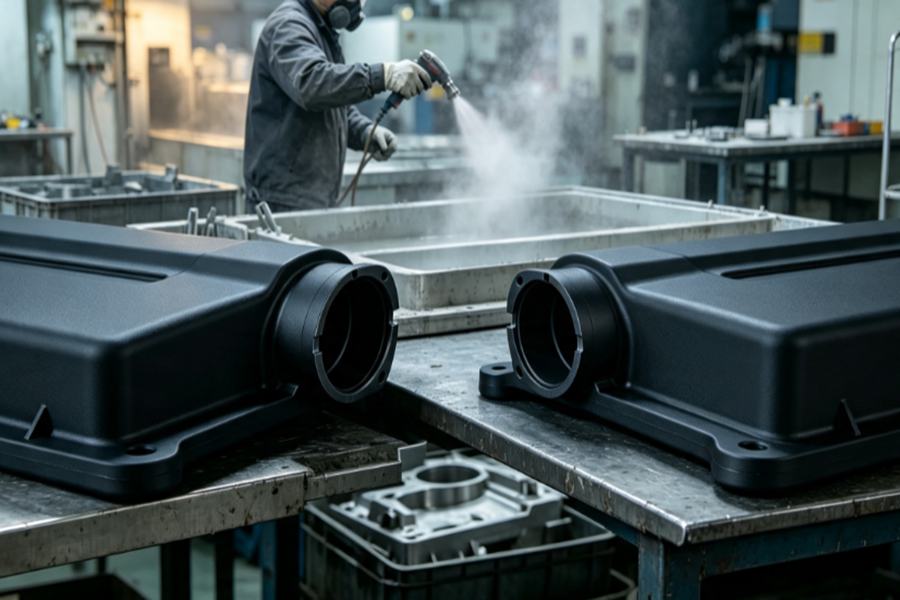
Powder coating applies electrically charged powder to a prepared aluminum surface. Subsequent heating of the coated workpiece melts the powder particles, enabling them to fuse and solidify into an intact protective coating.
The process is frequently used for aluminum die cast housings, covers, brackets, enclosures, handles, equipment frames, and outdoor components. It is especially practical when the casting needs a uniform decorative surface or when minor as-cast marks must be concealed.
Typical process stages include:
- Degreasing and surface cleaning
- Removal of release agent residue
- Blasting or chemical pretreatment
- Masking of functional areas
- Electrostatic powder application
- Thermal curing
- Appearance and adhesion inspection
Surface Coverage
Powder coating forms a visible film over the casting. It can reduce the appearance of fine flow lines, slight texture differences, polishing marks, and minor surface inconsistency.
Color and Appearance
A broad range of colors, textures, and gloss levels can be produced. Common options include:
- Matte black
- Semi-gloss black
- White
- Gray
- Textured industrial finishes
- Customer-specified brand colors
- Outdoor weather-resistant finishes
Coating Build
Powder coating normally adds a more noticeable layer to the component. This helps protection but must be considered around precision fits, screw threads, bearing seats, gasket surfaces, and grounding points.
| Advantages | Limitations |
| Covers minor casting surface variation | Adds measurable coating thickness |
| Provides consistent color across batches | Threads and fits usually require masking |
| Suitable for large and complex housings | Poor preparation may cause pinholes |
| Offers strong outdoor protection | The metallic aluminum appearance is hidden |
| Available in many colors and textures | Sharp edges may receive uneven film build |
| Practical for medium- and high-volume production | Curing temperature must suit the component |
Anodizing
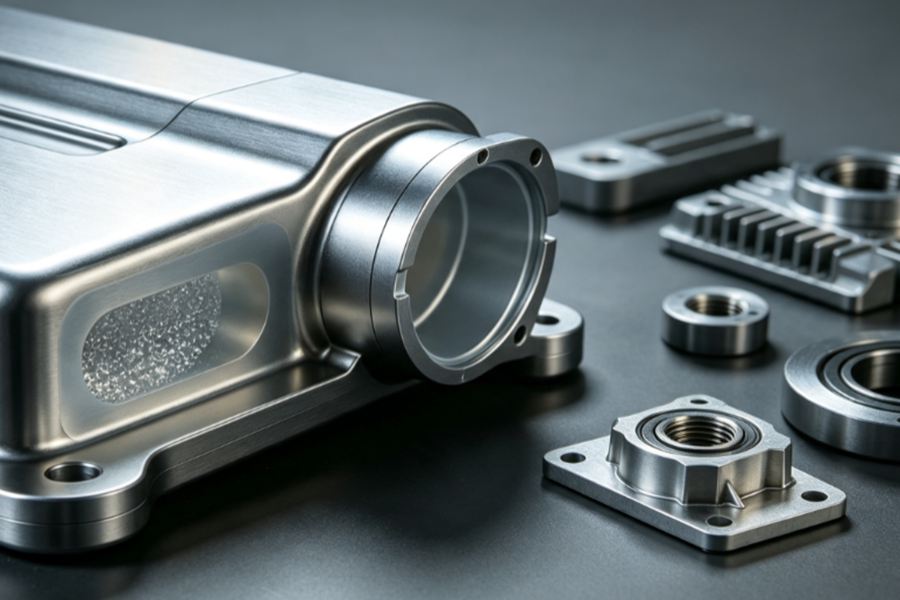
Anodizing converts aluminum into a protective oxide layer without adding paint. It preserves the original surface, so machining marks, pores, textures, and alloy variations remain clearly visible afterward during inspection.
Metallic Surface Appearance
Anodizing can preserve the metallic character of aluminum. Clear, black, gray, bronze, and other dyed finishes may be available depending on the alloy and process.
The result is often attractive on CNC-machined aluminum. Aluminum die castings are less predictable because their silicon, copper, and other alloying elements influence oxide formation and color.
Low Surface Build
Anodizing creates a thin, integrated layer suited to close-fitting parts, but precision bores, threads, sealing faces, and electrical contacts may still require masking or dimensional allowance during production and assembly.
Wear and Surface Protection
Without forming thick coatings, anodizing improves the hardness and wear resistance of contact and sliding parts. Yet it fails to mask uneven textures and voids, rendering surface defects more obvious.
| Advantages | Limitations |
| Retains the metallic appearance of aluminum | Exposes rather than hides surface defects |
| Creates a thin, integrated oxide layer | Color varies with die cast alloy composition |
| Suitable for tight dimensional features | High-silicon alloys may appear gray or uneven |
| Improves surface hardness and light wear resistance | Cast and machined areas may not match |
| Does not peel like an applied coating | Surface pretreatment demands rigorous regulation |
| Useful for selected functional surfaces | Decorative consistency can be difficult in large batches |
Die Cast Alloy Affects the Finish
The alloy should be confirmed before the surface treatment is finalized. Two aluminum components with similar shapes may behave differently during anodizing or curing because their chemical compositions are not the same.
Alloy Type
- High-Silicon Alloy: Powder coating provides stable coverage, while anodizing may appear darker or uneven.
- Aluminum-Magnesium Alloy: Both treatments perform well, but anodizing usually creates a cleaner metallic finish.
Surface Condition
- Machined Surface: Powder coating hides tool marks; anodizing may reveal color differences.
- Porous Surface: Powder coating risks outgassing, while anodizing exposes pores.
- Blasted Surface: Suitable for uniform coatings or matte anodized finishes.
- Polished Surface: Powder hides polishing; anodizing retains a brighter metallic appearance.
When decorative consistency is the priority, powder coating is usually the lower-risk route. When the design requires a metallic finish, an anodizing trial should be completed using actual production castings.
Surface Defects and Pretreatment Requirements
Neither treatment can compensate for uncontrolled casting quality.
Internal cavities inside workpieces may emit gas while the powder cures, resulting in bubbles or tiny pinholes on finished coatings. Pre-baking, controlled casting parameters, proper cleaning, and suitable powder selection can reduce this risk.
With anodizing, pores and material segregation are not covered. They may appear as dark dots, cloudy areas, or shade differences.
Application
| Application | Recommended Finish | Key Benefit |
| Outdoor Enclosures | Powder Coating | Corrosion protection |
| Motor & Machinery Housings | Powder Coating | Uniform appearance |
| Lighting Components | Powder Coating | Color durability |
| Precision Instruments | Anodizing | Thin metallic finish |
| Sliding or Handled Parts | Anodizing | Surface hardness |
| Heat Sinks | Selective Anodizing | Controlled thickness |
| Grounding Components | Either with Masking | Conductive contact |
| Decorative Die Cast Parts | Anodizing | Metallic appearance |
Important Considerations
Component Alloy
Confirm the actual die cast alloy rather than specifying only “aluminum.” Alloy composition has a major influence on anodized color and treatment consistency.
Surface Appearance
Choose powder coating when the objective is a solid, uniform finish. Choose anodizing when the design needs a visible metallic surface and can accept some natural variation.
Operating Environment
Outdoor equipment, wet environments, and frequently handled components require a finish selected around corrosion, UV exposure, abrasion, cleaning chemicals, and maintenance conditions.
Dimensional Tolerance
Check whether coating build will affect mating surfaces, holes, threads, or press fits. Masking requirements should be defined before quotation.
Casting Quality
Porosity and surface contamination create different risks for each process. Powder coating may develop outgassing defects, while anodizing may expose pores and material flow patterns.
Batch Quantity
Powder coating is effective for repeated industrial colors and larger component batches. Anodizing can also support volume production, but alloy and surface stability require tighter control when cosmetic consistency is important.
Inspection Standard
Define color range, gloss, coating thickness, adhesion, visible defect limits, masking boundaries, and inspection distance.
The practical decision is not powder coating versus anodizing in isolation. It is alloy, casting quality, machining, pretreatment, masking, inspection, and finish working as one production route.