
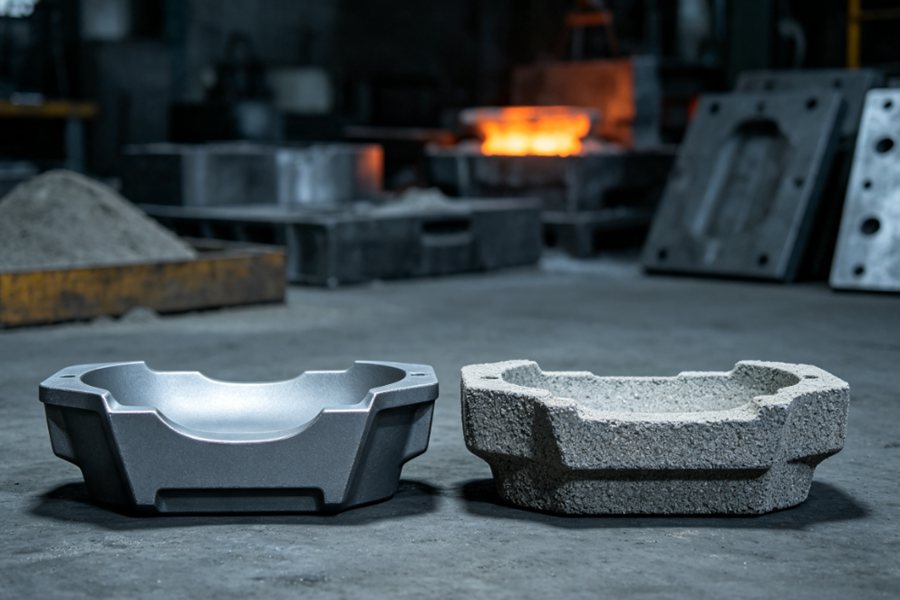
Shell mold and sand casting serve different needs. Shell mold provides better surface finish and accuracy, while sand casting offers flexibility for larger, complex, and cost-sensitive components.
Comparison
| Comparison | Shell Mold Casting | Sand Casting |
| Mold Type | Resin-coated fine sand shell | Green sand or resin sand mold |
| Surface Finish | Smoother surface with better detail reproduction | Rougher surface, depends on sand quality |
| Dimensional Accuracy | Higher accuracy | Moderate accuracy |
| Machining Allowance | Lower due to better surface quality | Higher due to rougher casting surface |
| Pattern Cost | Higher initial tooling cost | Lower tooling investment |
| Suitable For | Precision industrial parts | Large and complex components |
Shell Mold Casting
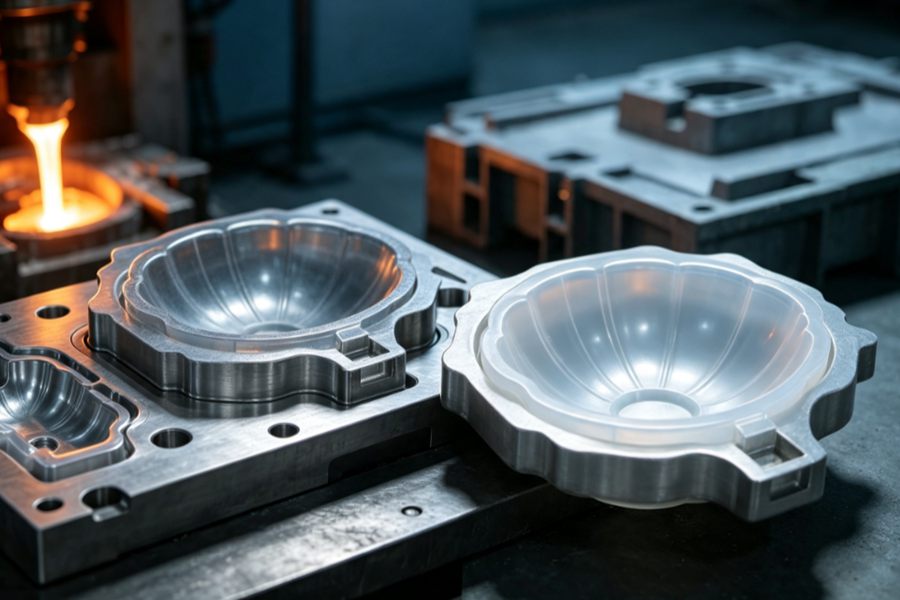
The molding medium adopted in shell mold casting is a thin shell structure manufactured with fine sand particles pre-treated by thermosetting resin coatings.
The mold is formed around a heated pattern, creating a rigid and accurate cavity before metal pouring.
Compared with traditional sand molds, the shell structure provides better cavity stability and smoother mold surfaces. During casting, the molten metal can reproduce finer details with fewer surface irregularities.
Core benefits are listed below:
- Better surface finish
- Improved dimensional consistency
- Reduced machining requirements
- More stable production for repeated parts
For custom shell mold castings, this process is often selected when component appearance, dimensional tolerance, and reduced secondary machining are important factors.
Sand Casting
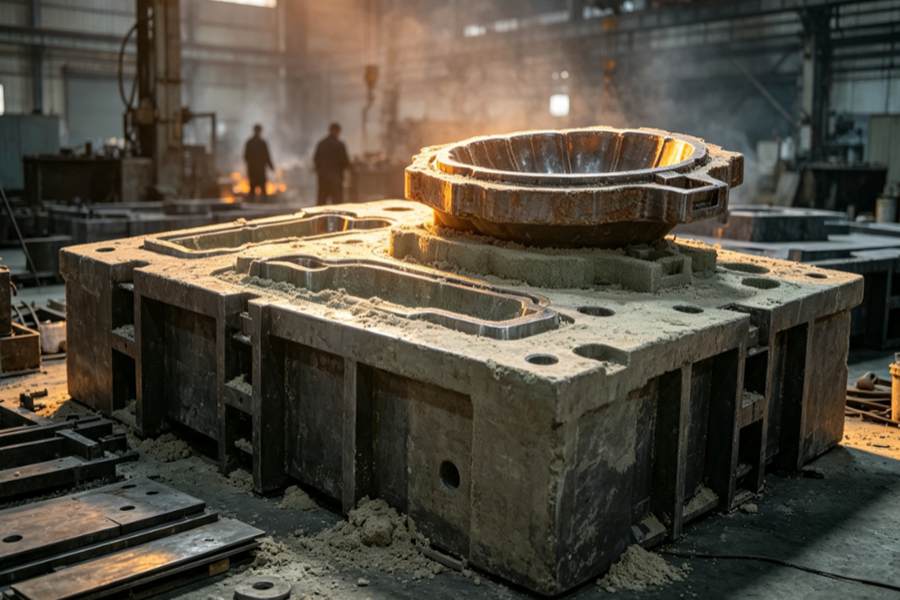
Sand casting remains one of the most adaptable casting methods because it can produce a wide range of component sizes and geometries.
Sand casting is commonly used for:
- Large industrial housings
- Heavy equipment parts
- Pump bodies
- Valve components
- Structural castings
Resin sand molding delivers a notably better surface finish with updated technologies, even though its surface smoothness is typically inferior to shell casting.
Shell Mold Casting Provides Better Surface Quality
The surface quality of a casting is mainly influenced by mold material, sand particle size, mold strength, and metal flow behavior.
Shell mold casting improves surface quality through several key factors:
Fine Sand Particle Structure
Shell molds use finer sand particles compared with many traditional sand casting methods. The smaller grain size creates a smoother cavity surface, allowing molten metal to capture more detailed features.
It offers distinct advantages for components with the following characteristics:
- Narrow edges
- Detailed profiles
- Complex surfaces
- Limited machining allowance
Higher Mold Rigidity
The resin-bonded shell provides better strength and stability during pouring. A stronger mold reduces deformation, shifting, and surface defects caused by mold movement.
For precision components, stable mold geometry helps maintain consistent dimensions between production batches.
Better Control of Casting Surface
The smooth surface characteristic of shell mold cavities minimizes subsequent grinding and machining work on completed cast components.
Such measures help cut down on:
- Material removal
- Processing time
- Tool wear
- Overall manufacturing cost
However, shell mold casting is not always the best choice. For extremely large castings or low-volume projects, sand casting may still provide better economic efficiency.
Surface Quality Comparison
| Surface Factor | Shell Mold Casting | Sand Casting |
| Mold Surface Smoothness | Higher due to fine coated sand | Lower due to larger sand particles |
| Detail Reproduction | Excellent for complex features | Suitable for general shapes |
| Surface Roughness | Around Ra 3.2–12.5 μm | Around Ra 12.5–50 μm |
| Casting Appearance | Cleaner and more consistent | More variation possible |
| Post-Machining Requirement | Reduced | Usually higher |
Factors Affecting Casting Surface Quality
The final surface quality of castings is influenced by multiple process factors. The core disparities between shell mold casting and sand casting originate chiefly from mold surface features and how liquid metal interacts with the mold cavity.
| Surface Factor | Shell Mold Casting | Sand Casting |
| Sand Grain Size | Fine sand particles create smoother mold surfaces | Larger sand particles may leave rougher textures |
| Mold Strength | Rigid shell reduces cavity deformation | Mold stability depends on sand compaction |
| Metal Flow | Better cavity reproduction for detailed surfaces | More affected by turbulence and mold condition |
| Surface Detail | Captures smaller features more effectively | Fine details may require additional machining |
The surface condition of castings is fixed prior to machining operations. Optimized mold designs help cut down subsequent surface finishing procedures.
Choosing
Shell mold casting is generally more suitable when:
- The component requires better surface finish
- Machining allowance needs to be minimized
- Dimensional consistency is important
- Production quantity justifies higher tooling cost
Sand casting is often preferred when:
- The component size is large
- The geometry is complicated
- Production volume is limited
- Lower tooling investment is required
In practical manufacturing, surface quality should match the actual application requirements. A smoother casting surface does not always mean a better solution if the additional cost does not improve component performance.
Cost Consideration
Choosing between shell mold casting and sand casting requires evaluating the complete manufacturing process rather than only the mold cost.
| Cost Factor | Shell Mold Casting | Sand Casting |
| Tooling Cost | US$1,000–10,000+ | US$300–5,000+ |
| Machining Cost | US$5–50/part | US$10–100+/part |
| Finishing Cost | US$2–20/part | US$5–50+/part |
| Production Volume | 500–50,000+ pcs/year | 1–10,000+ pcs/year |
| Best For | Precision parts, lower machining | Large parts, flexible production |
Despite higher preliminary capital expenditure, certain casting processes deliver better cost performance thanks to less subsequent machining and consistent product output.
Industry Application Matching
The suitable casting process depends on more than surface finish requirements. Part size, production volume, machining allowance, and final application also influence the optimal choice.
Tips at a Glance
| Application | Recommended Process | Part Size | Surface Roughness | Annual Volume |
| Automotive precision parts | Shell Mold Casting | 100–500 mm | Ra 3.2–12.5 μm | 5,000–100,000 pcs |
| Machinery housings & pump bodies | Resin Sand Casting | 500–2,000+ mm | Ra 12.5–50 μm | 100–5,000 pcs |
| Hydraulic precision components | Shell Mold Casting | 50–400 mm | Ra 3.2–6.3 μm | 10,000–50,000 pcs |
| Heavy structural parts (frames, bases) | Green Sand Casting | 1,000–5,000+ mm | Ra 25–50 μm | 10–1,000 pcs |
Automotive Precision Components
For automotive components such as gear housings and valve blocks, surface consistency and dimensional stability are often more important than the initial mold cost.
Shell mold casting provides:
- Better replication of fine surface features
- Lower machining allowance
- More stable dimensions during repeated production
Large Engineering Equipment Parts
Large pump bodies, valve bodies, and machinery housings usually require different priorities.
Resin sand casting is commonly selected because it provides:
- Flexible mold production for large dimensions
- Lower tooling investment
- Capability for complex internal structures
Hydraulic Precision Components
Hydraulic components often contain thin walls, narrow passages, and complex geometries. Surface defects or excessive machining can affect final assembly accuracy.
Shell mold casting is suitable for these parts because it can reproduce:
- Fine edges
- Small grooves
- Complex external profiles
Heavy Structural Castings
For machine bases, frames, and other structural castings, surface appearance is usually not the primary concern. Strength, size capability, and cost control are more important.
Traditional sand casting remains a practical solution because:
- Large molds can be produced economically
- Tooling cost is lower
- The process is adaptable for one-off or small-batch production
Shell mold casting offers better surface quality, higher dimensional accuracy, and reduced machining requirements, making it suitable for precision industrial components. For large-size castings and low-quantity production runs, sand casting boasts better adaptability and more economical manufacturing costs.