
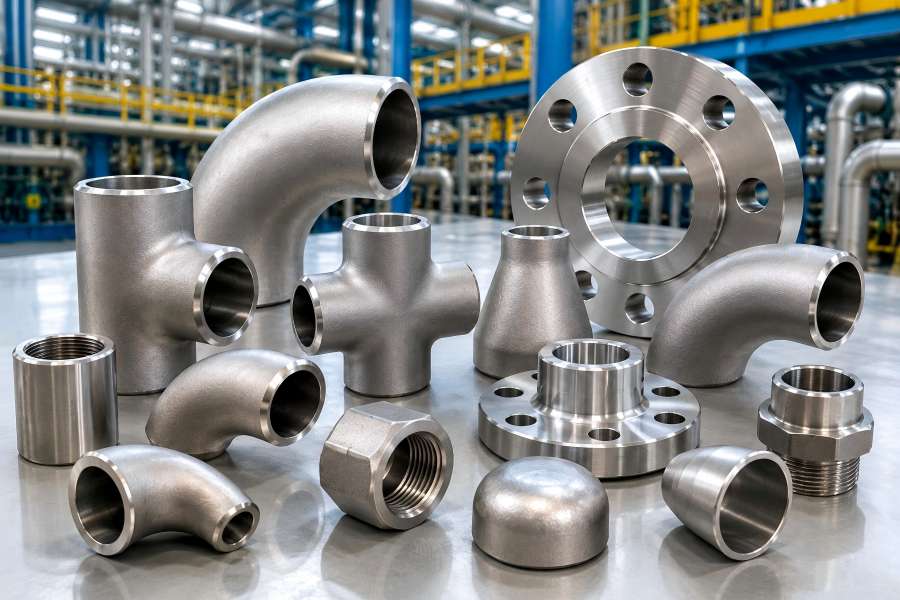
Industrial piping systems rely on metal pipe fittings to connect pipes, change flow direction, branch lines, adapt sizes, and support maintenance. In high-pressure, high-temperature, or corrosive environments, choosing the right fitting is essential for safe, efficient, and reliable operation.
1. Elbow Fittings
Elbow pipe fittings are designed to change the direction of flow within a piping system. Since industrial facilities rarely have straight pipeline layouts, elbows are among the most frequently installed fittings in nearly every process plant.
The most common elbow angles are 45°, 90°, and 180°. Depending on the piping layout, elbows can redirect fluids around equipment, structures, walls, or other obstacles while maintaining flow continuity.
Elbows are generally manufactured as either long-radius (LR) or short-radius (SR) designs. Long-radius elbows provide smoother flow transitions and lower pressure losses, while short-radius elbows are useful where installation space is limited.
Advantages of Elbow Fittings
The primary advantage of elbow fittings is their ability to provide routing flexibility without requiring extensive pipe fabrication. They allow engineers to create efficient piping layouts while minimizing installation complexity.
Additional advantages include:
- Improved system flexibility
- Wide range of pressure ratings
- Availability in various materials
- Long service life
- Strong mechanical performance
Long-radius elbows are especially valuable in high-flow systems because they reduce turbulence and energy losses.
Common Industrial Applications
Elbows are used throughout industries such as:
- Oil and gas production
- Petrochemical processing
- Power generation
- Water treatment
- Food and beverage manufacturing
- Pharmaceutical processing
In refineries, elbows direct hydrocarbons through complex process units. In power plants, they help route high-temperature steam between boilers and turbines.
Selection Considerations
When selecting an elbow fitting, engineers should consider:
- Operating pressure
- Temperature range
- Flow velocity
- Corrosion resistance requirements
- Installation space
- Maintenance accessibility
Material selection is equally important. Carbon steel elbows are widely utilized in standard industrial applications, whereas stainless steel and duplex stainless steel elbows are better suited for environments with corrosive conditions.
2. Tee Fittings
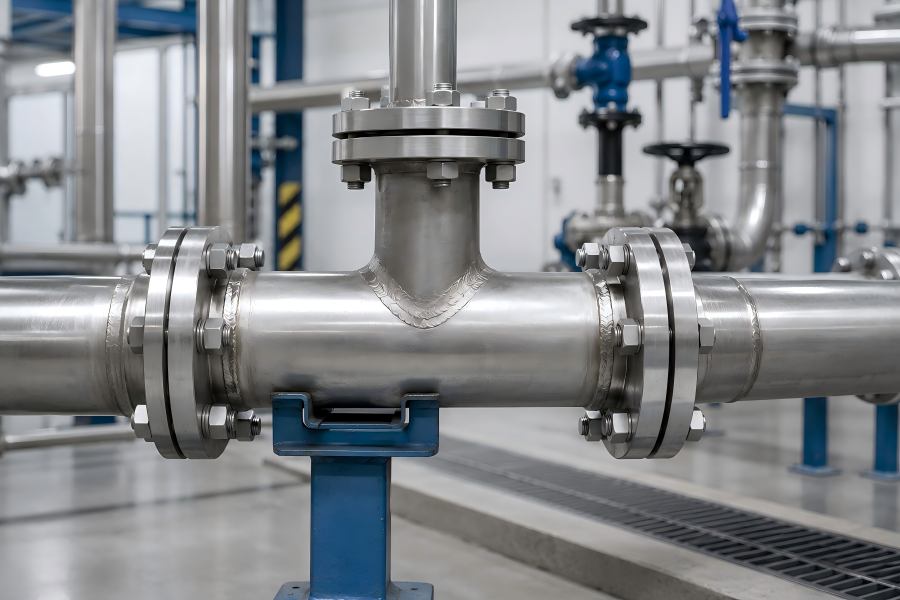
A tee fitting is designed to form a branch connection in a piping system. Its shape resembles the letter “T,” allowing fluid to split into multiple directions or combine from several lines into one.
Tees are typically available as equal tees or reducing tees. Equal tees have identical diameters across all openings, while reducing tees feature a smaller branch connection.
Because industrial systems often require fluid distribution to multiple locations, tee fittings are among the most widely used components in piping networks.
Advantages of Tee Fittings
Tee fittings simplify piping design by creating branch lines without requiring extensive fabrication.
Key benefits include:
- Efficient flow distribution
- Compact piping layouts
- Reduced installation time
- Lower fabrication costs
- Easy integration into existing systems
Tees can also improve system scalability by making it easier to add future process lines or equipment.
Industrial Applications
Common applications include:
- Fire protection systems
- Chemical processing plants
- Water distribution networks
- Compressed air systems
- HVAC installations
- Industrial utility piping
For example, a water treatment facility may use tee fittings to distribute treated water from a main pipeline to multiple filtration units.
Selection Considerations
Engineers should evaluate:
- Main pipe size
- Branch pipe size
- Pressure rating
- Flow distribution requirements
- Potential pressure losses
Improper tee sizing can increase turbulence and reduce system efficiency.
3. Reducer Fittings
Reducer fittings connect pipes of different diameters and provide a gradual transition between pipe sizes. They help maintain desired flow velocities while minimizing pressure losses.
The two primary reducer designs are concentric reducers and eccentric reducers.
Concentric reducers have aligned centerlines and are typically installed in vertical piping systems. Eccentric reducers have a flat side and are commonly used in horizontal pipelines to avoid air entrapment or fluid buildup.
Advantages of Reducers
Reducers play an important role in optimizing hydraulic performance.
Their benefits include:
- Improved flow control
- Reduced turbulence
- Better pump performance
- Lower energy consumption
- Smooth flow transitions
Without reducers, sudden diameter changes can create excessive pressure drops and increase wear on downstream equipment.
Industrial Applications
- Pump systems
- Compressor installations
- Water treatment facilities
- Oil and gas pipelines
- Chemical processing plants
- Industrial utility networks
They are frequently used where equipment nozzle sizes differ from the main pipeline diameter.
Selection Considerations
Key factors include:
- Flow velocity requirements
- Pressure drop limitations
- Cavitation prevention
- Pipe orientation
- Maintenance accessibility
Correct reducer selection helps improve overall system efficiency and equipment lifespan.
4. Coupling Fittings
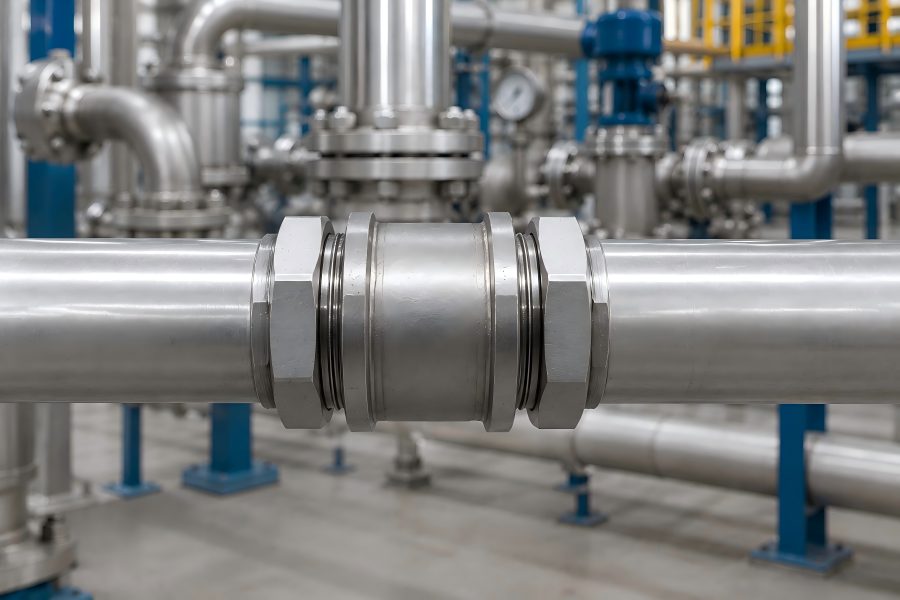
A coupling is a pipe fitting used to join two sections of pipe together. Couplings are among the simplest yet most versatile pipe fittings and are available in welded, threaded, compression, and mechanical designs.
Depending on the application, couplings may provide permanent or removable connections.
Advantages of Couplings
- Fast installation
- Easy maintenance
- Reduced downtime
- Cost-effective pipe connections
- Wide compatibility
Flexible couplings can also absorb vibration and thermal movement, helping protect pumps and rotating equipment.
Industrial Applications
Couplings are used in:
- Municipal water systems
- Mining operations
- Industrial utilities
- Fire suppression systems
- Chemical processing facilities
- Compressed air systems
Flexible couplings are especially common near pumps and compressors where vibration isolation is important.
Selection Considerations
Engineers should consider:
- Connection type
- Pressure rating
- Pipe material compatibility
- Environmental conditions
- Maintenance requirements
For high-pressure service, welded couplings generally provide the highest reliability.
5. Union Fittings
Union fittings perform a similar function to couplings but offer a significant advantage: they can be disconnected without cutting or rotating the pipe.
A typical union includes a male fitting, a female fitting, and a union nut designed to fasten the assembly together.
This design makes unions particularly valuable in systems that require routine maintenance.
Advantages of Unions
Benefits include:
- Quick equipment removal
- Reduced maintenance time
- Lower labor costs
- Reusable connections
- Simplified inspections
By allowing easy disassembly, unions help minimize downtime during repairs and equipment replacement.
Industrial Applications
- Pumps
- Heat exchangers
- Flow meters
- Control valves
- Boilers
- Instrumentation systems
In many facilities, unions are strategically placed at maintenance points to improve serviceability.
Selection Considerations
Important factors include:
- Pressure rating
- Connection type
- Material compatibility
- Maintenance frequency
- Installation accessibility
Where regular servicing is expected, unions often provide the most practical solution.
6. Cross Fittings
A cross fitting provides four-way connections within a piping system. Its shape resembles a plus sign (+), allowing fluid to move in multiple directions from a central point.
Although less common than tee fittings, cross fittings can simplify certain piping layouts.
Advantages and Limitations
Advantages include:
- Multiple branch connections
- Reduced fitting count
- Space-saving design
- Simplified routing
However, cross fittings can also create:
- Higher turbulence
- More complex flow patterns
- Increased stress concentrations
For this reason, engineers often evaluate whether multiple tees may provide better hydraulic performance.
Industrial Applications
- Fire sprinkler systems
- Water distribution networks
- HVAC systems
- Utility piping
- Industrial service lines
Selection Considerations
Engineers should consider:
- Pressure requirements
- Flow balancing needs
- Structural support
- Thermal expansion effects
Proper support is especially important because cross fittings may experience higher mechanical loading.
7. Cap Fittings
Pipe caps are designed to close off pipe ends and provide a reliable seal. They can be installed by welding, threading, or mechanical connection based on system needs.
They are commonly used in construction, inspection, maintenance, and planned system expansion.
Advantages of Pipe Caps
Pipe caps provide:
- Reliable sealing
- Leak prevention
- Contamination control
- Equipment protection
- Future expansion flexibility
Industrial Applications
- Pipeline testing
- Process plant construction
- Temporary isolation
- Future branch connections
- Storage systems
Many facilities install capped connections for future equipment additions.
Selection Considerations
Important factors include:
- Pressure rating
- Temperature conditions
- Corrosion resistance
- Welding requirements
- Inspection access
For high-pressure service, welded caps are generally preferred.
8. Plug Fittings
Plug fittings are used to seal threaded openings in a piping system. Unlike caps, plugs fit inside a threaded connection rather than over a pipe end.
Common designs include square-head, hex-head, and internal-hex plugs.
Advantages of Plug Fittings
Benefits include:
- Compact design
- Easy installation
- Low cost
- Reliable sealing
- Convenient removal
Their simplicity makes them a common component throughout industrial facilities.
Industrial Applications
Plugs are frequently used for:
- Drain connections
- Instrument ports
- Inspection points
- Hydraulic systems
- Pneumatic systems
- Maintenance access points
Selection Considerations
Engineers should evaluate:
- Thread standards
- Pressure requirements
- Sealing methods
- Chemical compatibility
- Temperature limits
Proper installation helps prevent leakage and ensures long-term reliability.
9. Nipple Fittings
A pipe nipple is a short pipe section threaded externally at one or both ends, designed to connect fittings, valves, instruments, and equipment.
It is available in multiple lengths and configurations for different installation requirements.
Advantages of Pipe Nipples
Key benefits include:
- Flexible equipment connections
- Easy installation
- Cost-effective assembly
- Broad compatibility
- Simplified maintenance
Because of their versatility, nipples are widely used in both utility and process piping systems.
Industrial Applications
Common applications include:
- Pressure gauges
- Instrumentation systems
- Hydraulic equipment
- Water treatment facilities
- Compressed air systems
- Process control installations
Nipples frequently serve as intermediate connectors between valves and instrumentation.
Selection Considerations
Important factors include:
- Thread type
- Material compatibility
- Pressure rating
- Length requirements
- Environmental conditions
Selecting the correct nipple helps ensure leak-free operation and long service life.
10. Flange Connections
Flanges are detachable pipe connection components that allow pipes, valves, pumps, and equipment to be assembled and disassembled easily.
Compared with welded joints, flanged connections allow easier access for maintenance, inspection, and equipment replacement.
Common Flange Types
The most widely used flange types include:
- Weld Neck Flange
- Slip-On Flange
- Blind Flange
- Socket Weld Flange
- Lap Joint Flange
- Threaded Flange
Advantages of Flanges
Flanges provide numerous benefits:
- Easy equipment access
- Reliable sealing
- High-pressure capability
- Standardized dimensions
- Excellent maintenance flexibility
Because industrial facilities often require periodic inspections, flanges remain indispensable throughout process industries.
Industrial Applications
Flanges are heavily used in:
- Oil and gas facilities
- Petrochemical plants
- Offshore platforms
- Power stations
- Water treatment facilities
- Pharmaceutical manufacturing
Large industrial projects may contain thousands of flanged connections.
Selection Considerations
Engineers should evaluate:
- Pressure class
- Temperature rating
- Gasket type
- Bolt material
- Corrosion resistance
Proper flange installation procedures are essential to achieving leak-free performance.
Material Comparison for Metal Pipe Fittings
| Material | Strength | Corrosion Resistance | Typical Applications |
| Carbon Steel | High | Moderate | Oil & Gas, Utilities |
| Stainless Steel | High | Excellent | Food, Chemical, Pharmaceutical |
| Alloy Steel | Very High | Good | High-Temperature Service |
| Brass | Moderate | Good | Water Systems |
| Bronze | Moderate | Excellent | Marine Applications |
| Duplex Stainless Steel | Very High | Excellent | Offshore & Chemical Plants |
How to Select the Right Pipe Fitting
Selecting the right fitting involves more than matching pipe sizes. Engineers should consider:
- Operating pressure
- Temperature range
- Fluid characteristics
- Corrosion resistance requirements
- Connection method
- Maintenance accessibility
- Industry standards
- Lifecycle costs
Evaluating these factors carefully is essential for achieving safe, reliable, and efficient system operation.