
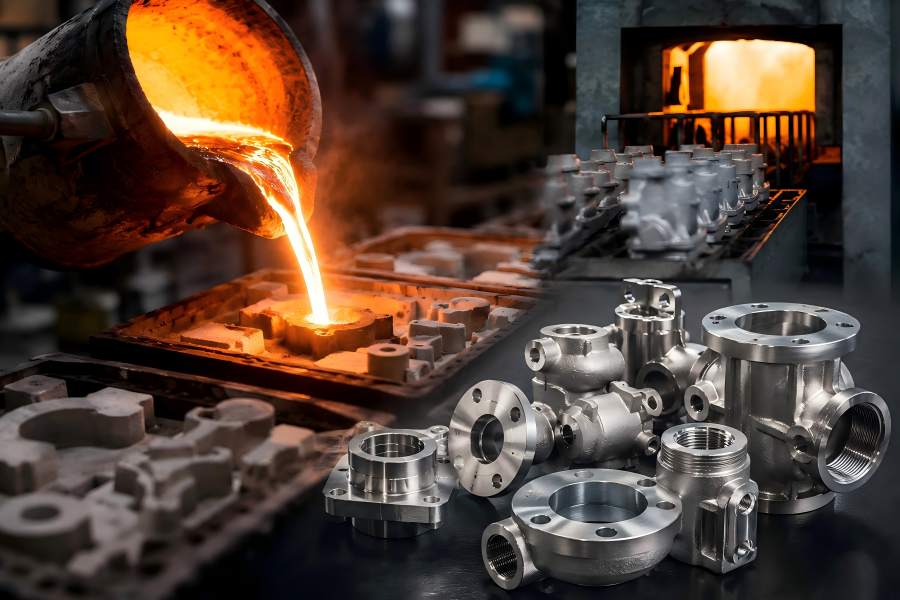
Stainless steel casting is commonly applied in valves, pumps, automotive, marine, food processing, and aerospace sectors due to its strength, corrosion resistance, and precision. Costs vary greatly, from a few dollars for small investment castings to thousands for large industrial components.
Average Stainless Steel Casting Cost
Although exact pricing varies by project, the following ranges provide a general idea.
| Casting Type | Typical Part Size | Estimated Cost Per Part |
| Small investment casting | <1 lb | $5–$25 |
| Medium investment casting | 1–10 lbs | $20–$150 |
| Large investment casting | 10–50 lbs | $150–$800 |
| Small sand casting | 5–20 lbs | $30–$120 |
| Medium sand casting | 20–100 lbs | $100–$600 |
| Large industrial sand casting | 100+ lbs | $600–$5,000+ |
These prices usually include:
- Raw casting
- Basic finishing
- Gate removal
- Surface cleaning
Additional operations such as CNC machining, polishing, heat treatment, passivation, or nondestructive testing will increase costs.
Main Factors That Affect Stainless Steel Casting Costs
Stainless Steel Material Grade
Material cost is a major factor in casting prices. Stainless steel grades vary in alloy content like chromium, nickel, molybdenum, and manganese, and higher alloy levels increase raw material costs significantly.
Common Stainless Steel Casting Grades
| Stainless Steel Grade | Main Features | Estimated Cost Per Part |
| SS304 | General corrosion resistance, widely used | $10–$150 |
| SS316 | Higher corrosion resistance with molybdenum | $20–$250 |
| Duplex Stainless Steel | High strength and chloride resistance | $50–$400 |
| 17-4 PH Stainless Steel | High strength and wear resistance | $80–$500 |
| Heat-Resistant Stainless Steel | Suitable for high-temperature applications | $100–$800 |
For example:
- SS316 typically costs more than SS304 because it contains molybdenum.
- Duplex stainless steel may cost 30–60% more than standard 304 grades.
- Aerospace or heat-resistant stainless alloys can dramatically increase total cost.
Material waste also affects pricing because casting systems require runners, sprues, and risers that consume additional metal.
Casting Process Selection
The manufacturing process strongly influences tooling cost, labor cost, accuracy, and finishing requirements.
Investment Casting Cost
Investment casting is suitable for:
- Precision parts
- Thin walls
- Complex geometry
- Smooth surfaces
- Tight tolerances
Advantages include:
- Minimal machining
- Better dimensional accuracy
- Excellent repeatability
However, it involves:
- Wax pattern creation
- Ceramic shell building
- Longer process cycles
- Higher labor intensity
As a result, investment casting generally has:
- Higher upfront tooling costs
- Higher per-unit labor cost
- Lower finishing cost
Industry sources note that investment casting tooling can range from several thousand dollars to over $80,000 for complex production tooling.
Typical Investment Casting Costs
| Cost Element | Estimated Range |
| Prototype tooling | $250–$2,000 |
| Single-cavity wax die | $600–$2,500 |
| Multi-cavity tooling | $2,000–$12,000 |
| Complex hardened tooling | $40,000–$80,000+ |
Sand Casting Cost
Sand casting tends to be more affordable for:
- Large parts
- Low-volume production
- Simpler geometries
- Heavy industrial components
Advantages include:
- Lower tooling cost
- Faster mold production
- Lower initial investment
However, sand casting usually requires:
- More machining
- More grinding
- Rougher surface finishing
- Larger machining allowances
Industry comparisons show sand casting has lower initial costs but may create higher downstream machining expenses.
Typical Sand Casting Tooling Costs
| Tooling Type | Estimated Cost |
| Simple patterns | $500–$3,000 |
| Medium-complexity tooling | $3,000–$10,000 |
| Large industrial tooling | $10,000–$50,000+ |
Part Size and Weight
Larger castings require:
- More stainless steel
- Larger molds
- More melting energy
- Longer cooling cycles
- Additional handling equipment
As casting size increases:
- Scrap risk rises
- Yield decreases
- Machining becomes more expensive
For example:
- A 0.5 lb precision stainless casting may cost under $15.
- A 500 lb industrial valve body may cost thousands of dollars.
Weight directly impacts:
- Material cost
- Shipping cost
- Machining time
- Heat treatment expense
Part Complexity
Complex designs are significantly more expensive to cast.
Features that increase cost include:
- Thin walls
- Internal cavities
- Undercuts
- Sharp corners
- Tight tolerances
- Deep recesses
- Complex cores
Complex geometry increases:
- Mold difficulty
- Defect risk
- Inspection requirements
- Scrap rate
- Finishing labor
Industry casting guides consistently identify part geometry as one of the most important pricing variables.
Production Volume
Production quantity has a major effect on unit cost.
Low-volume production often results in:
- High tooling cost per part
- More setup expense
- Lower manufacturing efficiency
High-volume production spreads tooling costs across more parts.
Example of tooling cost amortization
| Production Volume | Tooling Cost Per Part |
| 1,000 units | $3–$12 |
| 5,000 units | $0.60–$2.40 |
| 10,000 units | $0.30–$1.20 |
| 50,000 units | $0.06–$0.24 |
For this reason:
- Sand casting is typically favored for prototype making and low-volume manufacturing.
- Investment casting becomes more economical at medium-to-high production volumes.
Machining Requirements
Machining is frequently one of the most expensive secondary operations.
While stainless steel casting can form near-net-shape parts, many components still demand:
- CNC milling
- Drilling
- Turning
- Threading
- Boring
- Surface grinding
Stainless steel is harder to machine than aluminum or carbon steel because:
- It generates more heat
- It causes greater tool wear
- It has lower machinability
Machining costs rise substantially when:
- Tight tolerances are required
- Multiple setups are needed
- Surface finish requirements are high
Industry sources note that machining can sometimes exceed the cost of the casting itself.
Surface Finish Requirements
Surface finishing operations add significant cost.
Common finishing processes include:
- Shot blasting
- Grinding
- Polishing
- Electropolishing
- Passivation
- Sand blasting
- Mirror finishing
Investment casting usually delivers smoother surfaces than sand casting, reducing finishing costs.
Surface Roughness Comparison
| Process | Typical Surface Roughness |
| Investment Casting | Ra 1.6–6.3 μm |
| Sand Casting | Ra 12.5–50 μm |
High-end finishes required for:
- Medical devices
- Food equipment
- Marine hardware
- Decorative products
can substantially increase production cost.
Heat Treatment and Testing
Some stainless steel castings require additional thermal processing.
Common heat treatments include:
- Solution annealing
- Stress relieving
- Aging
- Hardening
Inspection requirements may include:
- X-ray testing
- Dye penetrant inspection
- Magnetic particle testing
- Ultrasonic testing
- CMM dimensional inspection
Typical inspection and finishing costs may range from under $1 to over $10 per part depending on quality standards.
Industries such as aerospace, oil & gas, and medical manufacturing typically require extensive quality control, increasing total price.
Cost Comparison: Stainless Steel Investment Casting vs Sand Casting
The two most common stainless steel casting methods have very different cost structures.
| Cost Factor | Investment Casting | Sand Casting |
| Tooling Cost | Medium-High | Low-Medium |
| Surface Finish | Excellent | Rough |
| Machining Requirement | Low | Higher |
| Precision | High | Moderate |
| Best Volume Range | Medium-High | Low-Medium |
| Part Complexity | Excellent | Moderate |
| Large Parts | Less suitable | Excellent |
| Per-Part Labor | Higher | Lower |
| Material Efficiency | Better | Lower |
When Investment Casting Is More Cost-Effective
Investment casting can lower overall manufacturing costs when:
- Machining is expensive
- Geometry is complex
- Surface finish is critical
- Tight tolerances are required
Even though initial tooling is higher, reduced finishing can lower total ownership cost.
When Sand Casting Is More Economical
Sand casting is often cheaper for:
- Large parts
- Simple shapes
- Prototype production
- Low-volume industrial components
Hidden Costs in Stainless Steel Casting
Many buyers concentrate only on unit price, ignoring hidden manufacturing costs.
Scrap and defect rates may include:
- Porosity
- Shrinkage
- Cracks
- Misruns
- Inclusions
Complex stainless steel castings often have higher rejection rates due to:
- High pouring temperatures
- Shrinkage behavior
- Alloy sensitivity
Poor-quality castings increase:
- Rework costs
- Delays
- Material waste
Shipping Costs
Stainless steel parts are heavy.
Large industrial castings may require:
- Crating
- Export packaging
- Ocean freight
- Oversized transport
Freight costs can become significant, especially for international sourcing.
Lead Time Costs
Longer production cycles create indirect costs:
- Inventory holding
- Project delays
- Missed deadlines
Investment casting usually has longer tooling and shell-building lead times than sand casting.
Cost Examples by Industry
Stainless steel casting costs vary by industry due to differing requirements for strength, precision, corrosion resistance, surface finish, certification, testing, and machining complexity.
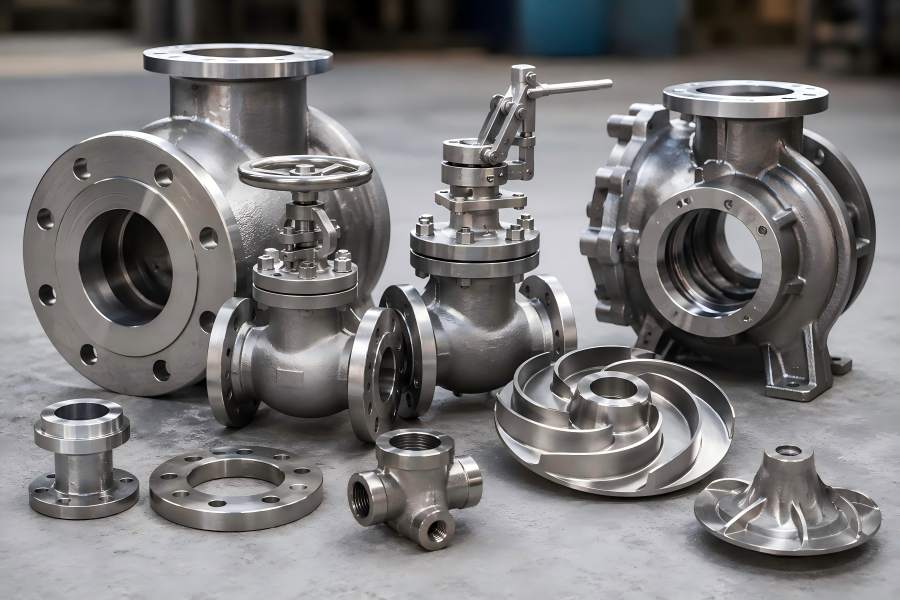
Valve and Pump Components
The valve and pump industry ranks among the largest users of stainless steel castings. Common applications include:
- Valve bodies
- Pump housings
- Impellers
- Pipe connectors
- Flanges
- Flow control components
Common Materials
- 304 stainless steel
- 316 stainless steel
- Duplex stainless steel
Typical Manufacturing Process
- Investment casting for precision valves and impellers
- Sand casting for larger pump housings
Estimated Cost Range
| Component Type | Estimated Cost |
| Small valve body | $15–$80 |
| Precision impeller | $40–$250 |
| Medium pump housing | $150–$800 |
| Large industrial pump casing | $1,000–$5,000+ |
Costs increase when:
- Tight sealing tolerances are required
- Internal flow passages are complex
- Corrosion-resistant alloys are used
- Extensive pressure testing is required
In chemical processing and oil & gas applications, duplex stainless steel and nondestructive testing can significantly raise production costs.
Food Processing Equipment
Food-grade stainless steel castings require excellent hygiene performance and corrosion resistance. Components are commonly used in:
- Food mixers
- Beverage systems
- Dairy equipment
- Brewing machinery
- Conveyor systems
- Sanitary valves and fittings
Common Materials
- 304 stainless steel
- 316L stainless steel
Additional Cost Drivers
Food-industry castings often require:
- Electropolishing
- Passivation
- Precision machining
- Sanitary surface finishing
- Strict dimensional consistency
Estimated Cost Increase
Compared with standard industrial castings, food-grade components may cost:
- 15–40% more due to additional finishing and inspection requirements
For example:
- A standard industrial stainless valve may cost $40
- A sanitary polished food-grade version may exceed $70–$100
The extra expense is mainly associated with labor-intensive polishing and strict cleanliness standards.
Marine Hardware
Marine environments are highly corrosive as stainless steel components are continuously exposed to:
- Saltwater
- Humidity
- UV exposure
- Corrosive chemicals
Common Materials
- 316 stainless steel
- Duplex stainless steel
- Super duplex stainless steel
Typical Manufacturing Process
- Investment casting for precision hardware
- Sand casting for larger marine structures
Estimated Cost Range
| Marine Component | Estimated Cost |
| Small marine fitting | $20–$100 |
| Stainless steel propeller hub | $150–$800 |
| Offshore structural component | $1,000–$10,000+ |
High alloy content and demanding finishing requirements make marine castings more expensive than general industrial products.
Automotive Industry
The automotive sector applies stainless steel castings in both OEM manufacturing and aftermarket performance uses.
Common applications include:
- Exhaust components
- Turbocharger housings
- Sensor housings
- Suspension parts
- High-performance brackets
Common Manufacturing Methods
- Investment casting
- Precision shell casting
Estimated Cost Range
| Automotive Component | Estimated Cost |
| Small sensor housing | $5–$20 |
| Exhaust manifold component | $25–$120 |
| Turbo housing | $80–$300 |
High-volume production helps reduce unit cost, but tooling investment can be substantial during the initial development stage.
Aerospace Components
Aerospace stainless steel castings are among the most technically demanding and expensive products in the casting industry.
Applications include:
- Turbine components
- Structural fittings
- Fuel system parts
- Engine hardware
- High-temperature brackets
Common Materials
- 17-4 PH stainless steel
- Heat-resistant stainless alloys
- Specialty aerospace alloys
Additional Manufacturing Requirements
Aerospace castings often require:
- X-ray inspection
- Fluorescent penetrant testing
- Heat treatment certification
- Coordinate measuring machine (CMM) inspection
- Full documentation and traceability
Estimated Cost Range
| Aerospace Component | Estimated Cost |
| Small precision fitting | $100–$500 |
| Turbine-related component | $500–$5,000+ |
| Complex structural casting | $5,000–$50,000+ |
Although aerospace production volumes are often lower, the extremely high quality standards dramatically increase manufacturing cost.
Oil and Gas Industry
The oil and gas sector requires stainless steel castings capable of surviving harsh operating conditions such as:
- High pressure
- Abrasive fluids
- Corrosive chemicals
- Offshore exposure
- High temperatures
Typical components include:
- Valve bodies
- Pump parts
- Drilling equipment
- Pipeline connectors
- Pressure-control systems
Common Materials
- Duplex stainless steel
- Super duplex stainless steel
- High-alloy stainless steel
Estimated Cost Range
| Oil & Gas Component | Estimated Cost |
| Stainless valve body | $100–$1,000 |
| Pressure-control component | $500–$5,000 |
| Large offshore casting | $10,000+ |
Because failure in oil and gas environments can be catastrophic, quality control requirements significantly increase total manufacturing costs.
Medical Equipment Industry
Medical-grade stainless steel castings require exceptional precision and surface quality.
Applications include:
- Surgical tools
- Implant equipment
- Sterilization systems
- Diagnostic equipment components
Common Materials
- 316L stainless steel
- Medical-grade stainless alloys
Estimated Cost Range
| Medical Component | Estimated Cost |
| Small surgical component | $20–$200 |
| Precision medical housing | $100–$1,000+ |
Even small medical castings can become expensive because of the high finishing and certification standards involved.
How Manufacturers Reduce Stainless Steel Casting Costs
Experienced manufacturers reduce stainless steel casting costs by improving efficiency, minimizing waste and machining time, and optimizing workflows while maintaining strength, precision, and product reliability.
Simplify Part Design
Simplifying component geometry during design reduces mold complexity, production time, defect risks, and machining requirements, making casting far more cost-effective.
Manufacturers often reduce costs by:
- Eliminating unnecessary undercuts and sharp corners
- Maintaining uniform wall thickness
- Reducing extremely thin sections
- Designing smoother transitions between surfaces
- Minimizing deep internal cavities
A casting designed for manufacturability (DFM) not only lowers tooling complexity but also improves metal flow and reduces shrinkage defects. Simpler designs usually result in faster production cycles and higher casting yields.
Reduce Machining Requirements
Machining is frequently one of the most expensive secondary processes in stainless steel casting because stainless steel is harder to cut and causes greater tool wear than many other metals.
Manufacturers reduce machining costs by:
- Using near-net-shape investment casting
- Improving dimensional accuracy during casting
- Designing cast-in holes, slots, and contours
- Avoiding unnecessarily tight tolerances
- Standardizing critical dimensions
When a casting can be produced closer to its final shape, less CNC milling, drilling, and grinding are required. This shortens production time and reduces labor and tooling expenses.
Optimize Material Selection
Different stainless steel grades vary significantly in price. High-alloy materials such as duplex stainless steel or heat-resistant alloys are more expensive because they contain larger amounts of nickel, chromium, and molybdenum.
Manufacturers often reduce costs by selecting materials that match actual application requirements instead of over-specifying premium alloys.
For example:
- SS304 may replace SS316 in non-marine environments
- Standard stainless steel may replace duplex alloys in moderate-pressure applications
- Lower-carbon variants may reduce post-weld treatment requirements
Proper material optimization can lower both raw material costs and machining expenses while still meeting corrosion resistance and strength requirements.
Increase Production Volume
Higher production volumes help distribute tooling and setup costs across more parts. This significantly lowers the cost per unit.
Large-volume production improves:
- Tooling amortization
- Process repeatability
- Material utilization
- Automation efficiency
- Labor productivity
For investment casting projects, multi-cavity tooling can also increase output while reducing cycle time per part. As production scales up, manufacturers can negotiate better raw material pricing and improve overall manufacturing efficiency.
Improve Casting Yield
Casting yield refers to the percentage of molten metal that becomes usable finished product. Poor gating systems and inefficient mold design can waste large amounts of stainless steel.
Manufacturers improve yield by:
- Optimizing runner and gating systems
- Reducing excess riser material
- Using simulation software to improve metal flow
- Controlling pouring temperature more accurately
- Reducing shrinkage and porosity defects
Higher yield means less material waste, lower remelting costs, and better overall production efficiency.
Reduce Scrap and Defect Rates
Defective castings create major hidden costs because they waste material, labor, energy, and machine time. Stainless steel castings can experience issues such as:
- Porosity
- Cracks
- Misruns
- Shrinkage cavities
- Surface inclusions
Manufacturers reduce scrap rates through:
- Better process control
- Automated temperature monitoring
- Mold flow simulation
- Improved quality inspection systems
- Skilled foundry operation management
Even a small reduction in rejection rate can produce substantial savings in high-volume production.
Use Automation and Advanced Manufacturing Technology
Modern foundries increasingly use automation to lower labor costs and improve consistency.
Automated processes may include:
- Robotic grinding and polishing
- Automated wax injection
- CNC-controlled shell building
- Automated pouring systems
- Robotic material handling
Automation improves production speed while reducing human error and variability. Over time, this lowers overall manufacturing cost and improves repeatability for large production runs.
Select the Right Casting Process
Choosing the correct casting method is critical for cost optimization.
For example:
- Investment casting is more economical for complex precision parts because it reduces machining and finishing.
- Sand casting is often cheaper for large, simple, low-volume components.
- Shell mold casting may provide a balance between cost and surface quality.
Using a process that does not match the product requirements can lead to unnecessary tooling costs, excessive machining, or poor production efficiency.
Source From Efficient Supply Chains
Many manufacturers reduce costs by building stable supply chains for:
- Stainless steel raw materials
- Machining operations
- Heat treatment
- Surface finishing
- Logistics
Long-term supplier partnerships can help stabilize pricing and shorten lead times. Some foundries also integrate machining and finishing in-house to reduce outsourcing costs and improve production coordination.
Apply Design and Process Simulation
Advanced simulation software allows manufacturers to predict casting behavior before production begins.
Simulation tools help optimize:
- Metal flow
- Cooling behavior
- Shrinkage control
- Mold filling
- Thermal stress distribution
This reduces trial-and-error development, lowers tooling modification costs, and improves first-pass production success rates.
Typical Stainless Steel Casting Cost Breakdown
The following table shows a simplified cost structure for a medium-sized stainless steel investment casting.
| Cost Category | Percentage of Total Cost |
| Raw material | 25–40% |
| Tooling amortization | 5–20% |
| Labor | 15–30% |
| Energy and overhead | 10–20% |
| Machining | 10–30% |
| Finishing | 5–15% |
| Inspection and testing | 3–10% |
Actual percentages vary depending on:
- Complexity
- Volume
- Quality standards
- Industry requirements
How to Estimate Stainless Steel Casting Costs
A simplified casting cost formula looks like this:
Total Casting Cost = Material + Tooling + Labor + Machining + Finishing + Inspection + Overhead
Manufacturers estimate pricing based on:
- Part drawings
- CAD files
- Material grade
- Tolerance requirements
- Annual volume
- Surface finish specifications
Stainless steel casting costs depend on material grade, process, complexity, volume, machining, finish, and certification. Investment casting offers precision and surface quality, sand casting lowers tooling costs. Best value comes from evaluating total cost, quality control, and supplier capability, not just price.