
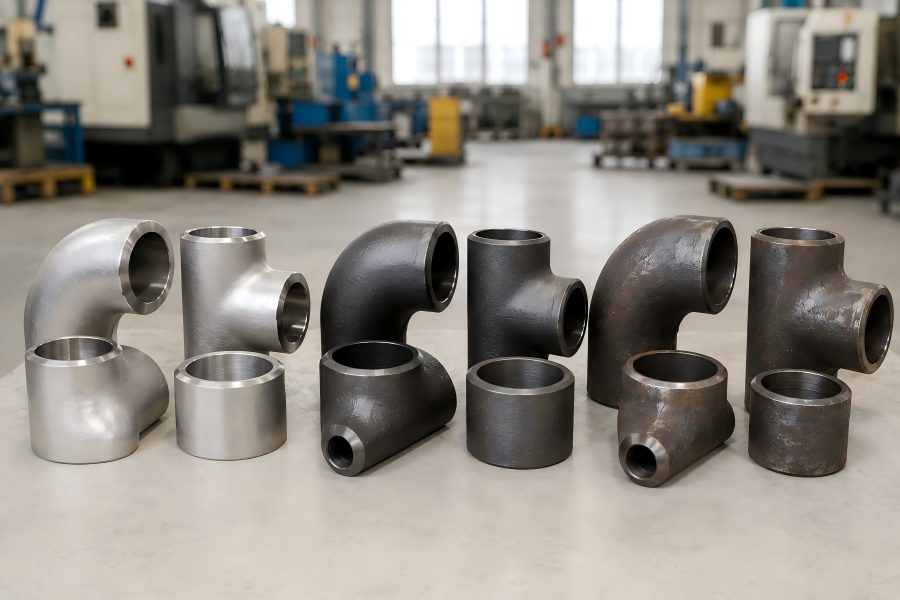
Pipe fittings connect piping systems and ensure sealing, strength, and reliability. Common materials include stainless steel, carbon steel, and alloy steel, each offering different corrosion resistance, strength, and cost, making proper selection essential for durability, safety, and long-term system performance.
A Quick Comparison
| Property | Stainless Steel | Carbon Steel | Alloy Steel |
| Corrosion Resistance | Excellent | Moderate | Moderate to good |
| Tensile Strength | High | Moderate | Very high |
| Fatigue Resistance | Very high | Moderate | High |
| High Temperature Performance | Excellent | Moderate | High |
| Cost | High | Low | Moderate to high |
| Maintenance | Low | Moderate | Moderate |
| Fabrication Difficulty | High | Low | Moderate |
| Service Life | Long (20+ years in harsh environments) | Moderate (10–15 years with maintenance) | Long (15–25 years depending on alloy) |
| Typical Applications | Chemical, marine, food, power | General industrial, water, low-pressure gas | Oil & gas, high-pressure steam, high-temperature chemical |
The table above provides a general comparison of key performance differences, while the following sections will explain each material in more detail for practical selection.
Stainless Steel Pipe Fittings
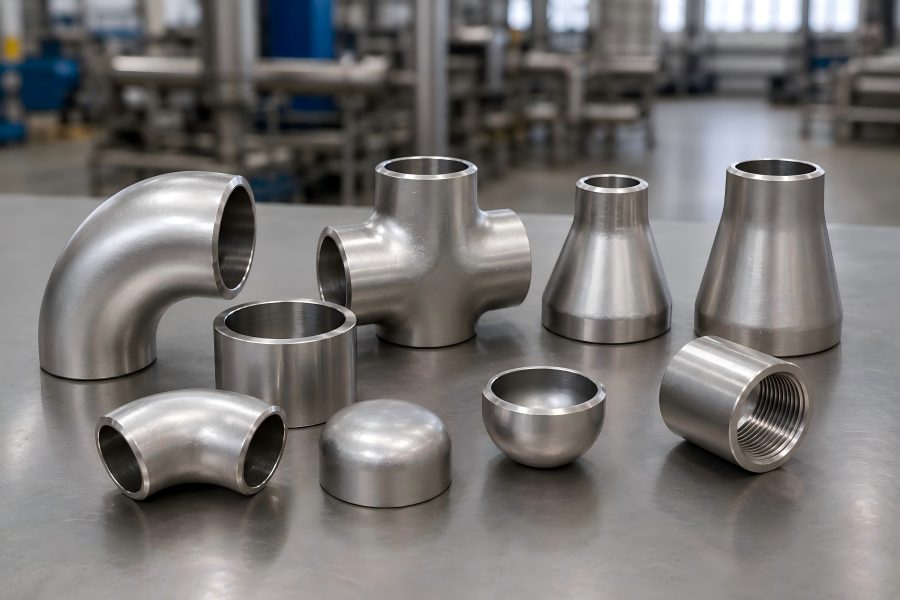
Stainless steel is an iron alloy with at least 10.5% chromium, which creates a protective oxide layer that resists corrosion. This natural barrier allows stainless steel pipe fittings to maintain structural integrity even in aggressive chemical, marine, or high-moisture environments.
| Pros | Cons |
| Superior corrosion resistance | Greater cost than carbon steel |
| Good strength and toughness | More difficult to forge and machine |
| High temperature resistance | Higher deformation resistance during processing |
| Hygienic and easy to maintain | Requires skilled welding and installation |
Typical Grades
- 304 / 304L: General corrosion resistance, widely used in water and food systems
- 316 / 316L: Resistant to marine and chemical exposure
- 317 / 317L: Higher molybdenum content for additional chemical resistance
- 17-4 PH: Precipitation-hardened, high-strength applications
Typical Applications
- Chemical and petrochemical processing
- Food and pharmaceutical industries
- Marine piping systems
- Power generation and high-temperature process lines
Carbon Steel Pipe Fittings
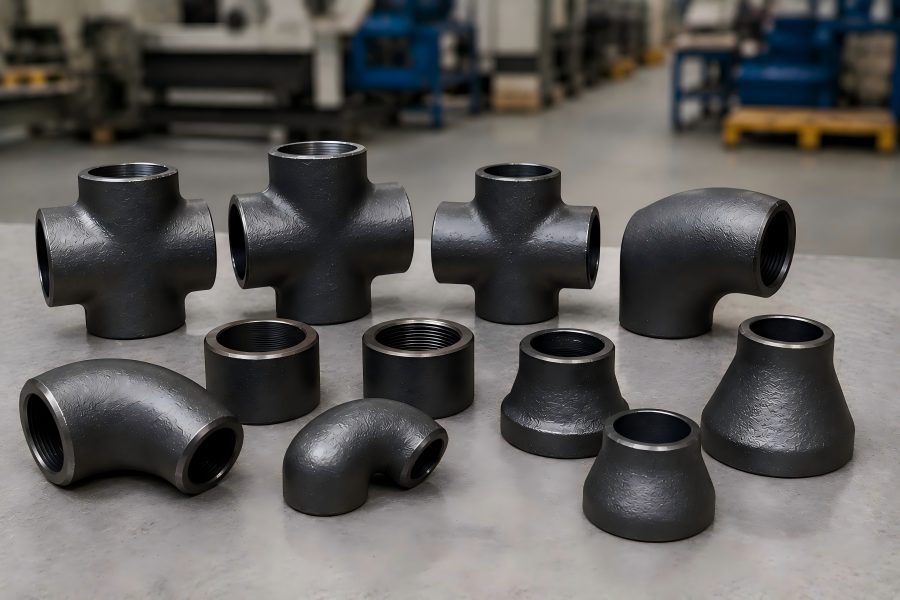
Carbon steel is an iron-based alloy whose main alloying element is carbon. It provides reliable mechanical performance and strength at a lower cost but is more susceptible to corrosion compared to stainless steel.
| Pros | Cons |
| High strength and toughness | Susceptible to corrosion |
| Excellent machinability | Requires coatings or surface treatment |
| Cost-effective | Higher maintenance in harsh environments |
| Wide availability | Less durable than stainless or alloy steel |
Typical Grades
- A106 / A53: Standard carbon steel for high-temperature or general-purpose service
- A234 WPB: Welded carbon steel fittings for moderate pressure and temperature
- ASTM A105: Forged carbon steel flanges and fittings
Typical Applications
- Pressure vessels
- Industrial pipelines for water or air
- Construction and structural piping
- Bearings and gears in mechanical systems
Alloy Steel Pipe Fittings

Alloy steel includes added elements like chromium, molybdenum, nickel, or vanadium, improving strength, hardness, and corrosion resistance over plain carbon steel. Alloy steels can be engineered for specific mechanical and chemical requirements.
| Pros | Cons |
| High mechanical strength | Higher cost than carbon steel |
| Good toughness and wear resistance | More complex fabrication |
| Can handle higher pressures | Requires skilled welding and heat treatment |
| Suitable for high-temperature service | Limited availability compared to carbon steel |
Typical Grades
- Chromium-molybdenum alloys (e.g., 2.25Cr-1Mo, 5Cr-0.5Mo): High-temperature and high-pressure service
- Nickel-chromium alloys: Enhanced corrosion resistance in acidic or marine environments
- Custom alloy steels: Tailored for specific industrial processes
Typical Applications
- High-pressure oil and gas pipelines
- Power generation turbines and piping
- Chemical processing plants
- Industrial machinery subjected to high stress or temperature
Performance Factors to Consider
Choosing pipe fitting materials involves more than just initial cost; multiple performance criteria must be assessed, as they directly affect durability and operational effectiveness over time.
Corrosion Resistance
- Stainless steel: Naturally resists rust, pitting, and chemical attack due to chromium oxide layer. Ideal for marine, chemical, or high-moisture environments.
- Carbon steel: Prone to corrosion; requires protective coatings like galvanization or paint. Suitable for controlled or dry environments.
- Alloy steel: Corrosion resistance varies with alloying elements; some grades resist chemical attack better than carbon steel but generally less than stainless steel.
Mechanical Strength
- Alloy steel delivers the highest tensile and yield strength, ideal for high-pressure pipelines.
- Stainless steel offers balanced strength and toughness for moderate to high-pressure systems.
- Carbon steel provides sufficient strength for general industrial use but may deform under extreme loads.
Temperature Resistance
- Stainless steel performs well at high temperatures (up to ~870 °C for some grades).
- Alloy steel can withstand elevated temperatures depending on heat treatment and composition.
- Carbon steel has a lower maximum operating temperature and may require alloying for high-heat applications.
Fatigue and Wear Resistance
- Alloy steel is ideal for cyclic or high-load systems due to its high fatigue resistance.
- Stainless steel resists wear in corrosive conditions but is less fatigue-resistant than alloy steel.
- Carbon steel is more prone to fatigue failure if protective coatings or maintenance is insufficient.
Maintenance and Lifecycle
- Stainless steel requires minimal maintenance and has the longest service life in aggressive environments.
- Alloy steel balances strength and durability but may require periodic inspection in chemically aggressive or high-temperature service.
- Carbon steel requires regular maintenance and coating inspections to prevent premature failure.
Cost and Lifecycle Value
| Material | Initial Cost | Maintenance | Estimated Service Life | Value Proposition |
| Stainless Steel | High ($5–$15 per fitting) | Low | 20+ years | Ideal for harsh environments with minimal maintenance |
| Carbon Steel | Low ($1–$5 per fitting) | Moderate | 10–15 years | Cost-effective for non-corrosive, moderate-pressure systems |
| Alloy Steel | Moderate–High ($7–$12 per fitting) | Moderate | 15–25 years | High strength and fatigue resistance justify cost in critical systems |
Industry Application
Stainless, carbon, and alloy steel pipe fittings are selected based on industry needs like corrosion resistance, pressure, temperature tolerance, and maintenance requirements.
Oil & Gas Industry
- Alloy steel: High-pressure pipelines and processing units for crude oil, natural gas, and petrochemicals. Excellent for cyclic loads and high temperatures.
- Stainless steel: Used in subsea pipelines, chemical injection lines, and areas exposed to saltwater or aggressive fluids.
- Carbon steel: Suitable for low-pressure service lines or non-critical water transport.
Alloy and stainless steels dominate high-risk, high-pressure environments, while carbon steel is used in non-critical areas for cost efficiency.
Power Generation
- Stainless steel: Steam lines, condensers, and cooling systems in power plants, where corrosion and thermal cycling are concerns.
- Alloy steel: Boiler piping, turbine shafts, and high-pressure steam distribution for long-term durability.
- Carbon steel: Auxiliary water lines, low-pressure air, and general mechanical piping.
High-pressure and high-temperature components require alloy or stainless steel; carbon steel is reserved for low-risk auxiliary systems.
Chemical & Pharmaceutical
- Stainless steel: Sanitary pipelines for chemical processing, food, and pharmaceutical applications, preventing contamination.
- Alloy steel: Handles aggressive chemicals and high-pressure reactions in industrial chemical plants.
- Carbon steel: Limited to non-corrosive fluids, often with protective coatings.
Hygienic and corrosion-resistant stainless steel is mandatory for sensitive fluids, while alloy steel addresses mechanical strength in aggressive processes.
Municipal Water & HVAC Systems
- Carbon steel: Low- to medium-pressure water lines and heating/cooling pipelines.
- Stainless steel: High-humidity environments or corrosive water systems.
- Alloy steel: Specialized high-pressure water distribution or critical pump systems.
Carbon steel is cost-effective for general municipal applications, while stainless steel provides durability in corrosive or long-term installations.
Food & Beverage Processing
- Stainless steel: Main piping for liquids, cleaning lines, and beverage transfer, ensuring hygiene and corrosion resistance.
- Carbon steel: Rarely used; sometimes for structural or non-contact piping.
- Alloy steel: Used for high-pressure cleaning systems or specialized processing lines.
Stainless steel dominates in food and beverage due to hygiene, durability, and corrosion resistance, with alloy steel used only for mechanically demanding processes.