
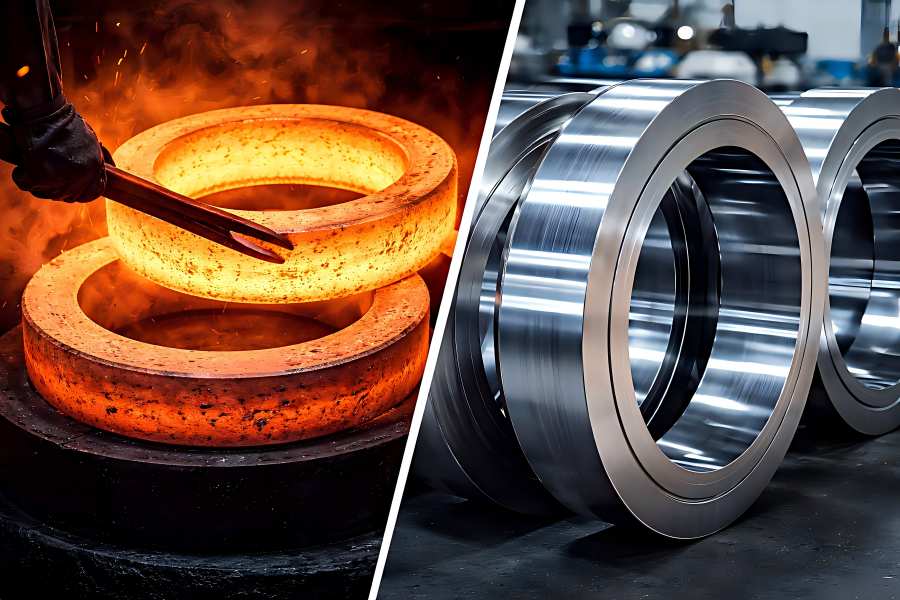
In critical industries such as aerospace, energy, oil and gas, and heavy machinery, forged rings and seamless rolled rings are widely used. Although often confused, they differ in manufacturing process, performance, cost, and application suitability, making proper selection important for engineers, buyers, and manufacturers.
What Are Forged Rings?
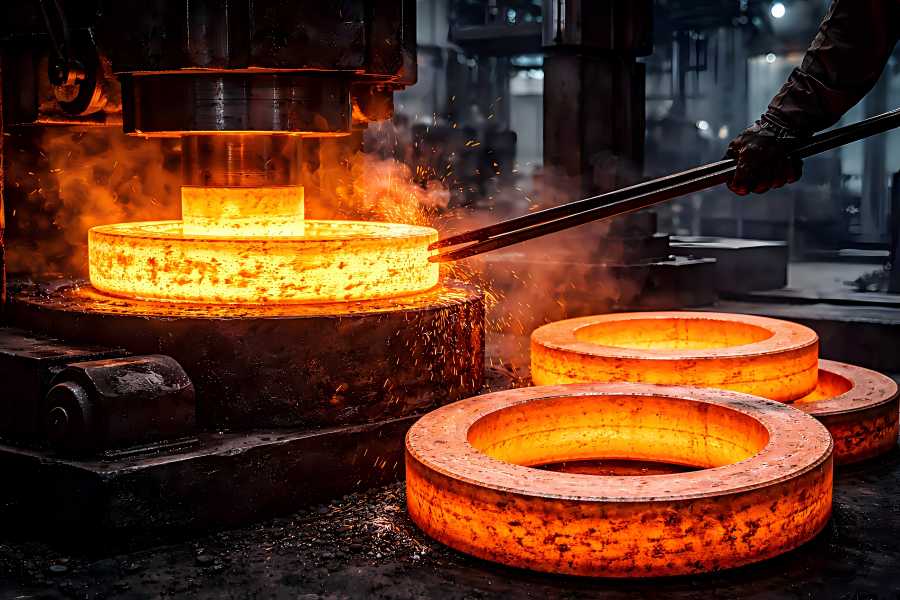
Forged rings are metal components shaped through a forging process, where heated metal is deformed under compressive forces to achieve a desired shape. In the case of rings, this often involves open-die forging or closed-die forging methods.
Key Characteristics of Forged Rings
- Produced by compressing heated metal billets or ingots
- Grain structure is refined through deformation
- Can be machined into ring shapes after forging
- Suitable for both simple and complex geometries
- Typically involves multiple processing steps
Typical Manufacturing Steps
- Material Preparation: A billet or ingot is selected and cut to size.
- Heating: The material is heated to forging temperature.
- Forging: The billet is compressed into a rough shape.
- Piercing (if needed): A hole is created to form a ring-like structure.
- Machining: Final dimensions and tolerances are achieved through machining.
Forged rings are often used when strength and structural integrity are required, but the process may involve more material waste compared to rolled alternatives.
What Are Seamless Rolled Rings?
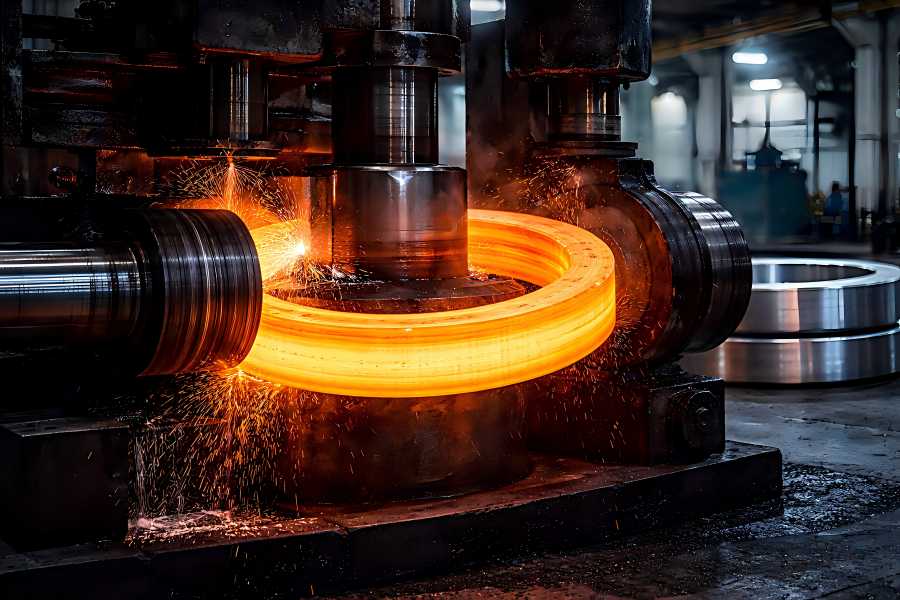
Seamless rolled rings are produced using a specialized process known as ring rolling, where a pre-forged blank is expanded into a ring without seams or welds. This process enhances the material’s grain flow, aligning it with the ring’s geometry.
Key Characteristics of Seamless Rolled Rings
- Manufactured through radial and axial rolling
- No welds or joints (completely seamless)
- Improved grain flow following the ring contour
- High strength-to-weight ratio
- Excellent material utilization
Typical Manufacturing Steps
- Preform Forging: A donut-shaped blank is created.
- Piercing: A hole is formed in the center.
- Ring Rolling: The ring is expanded using rolling mills.
- Sizing and Heat Treatment: Final dimensions and mechanical properties are achieved.
- Machining: Optional finishing operations for precision.
The seamless rolling process produces rings with superior structural integrity and consistency, making them ideal for high-performance applications.
Important Distinctions Between Seamless Rolled Rings and Forged Rings
Although both types originate from forging processes, their differences lie primarily in how the material is shaped and refined.
Manufacturing Process
| Aspect | Forged Rings | Seamless Rolled Rings |
| Process Type | Compression forging | Rolling expansion |
| Shape Formation | Forging + machining | Rolling mill shaping |
| Seam Presence | May require machining from solid | Completely seamless |
| Production Efficiency | Lower | Higher |
Forged rings often rely more on machining to achieve final geometry, while seamless rolled rings are shaped more efficiently during rolling.
Grain Structure and Mechanical Properties
The interior grain structure is one of the biggest variations.
- Forged Rings: Grain flow is improved compared to cast parts but may not fully align with the ring shape.
- Seamless Rolled Rings: Grain structure follows the circular contour, enhancing strength and fatigue resistance.
Impact on Performance
- Higher fatigue resistance
- Improved impact strength
- Better resistance to cracking
- Enhanced load-bearing capacity
This makes seamless rolled rings particularly suitable for dynamic and high-stress environments.
Material Utilization
Material utilization is one of the most important differences between forged rings and seamless rolled rings, especially in projects involving expensive alloys or large ring sizes.
Forged rings often start from larger solid billets or ingots and usually require more machining to remove excess material and achieve the final dimensions. As a result, more scrap is generated during production.
Seamless rolled rings are closer to the final ring shape from the beginning. The ring rolling process distributes the material more efficiently, allowing manufacturers to achieve the required dimensions with less excess stock.
Typical Comparison
- Forged Rings: higher material removal, more scrap, higher raw material consumption
- Seamless Rolled Rings: better material distribution, less waste, improved yield
Typical Data
- Forged rings material utilization: 60%–75%
- Seamless rolled rings material utilization: 80%–90%
This means seamless rolled rings can significantly reduce raw material loss, particularly when using stainless steel, alloy steel, titanium, or nickel-based materials.
Size and Dimensional Capabilities
Both methods can produce a wide range of sizes, but seamless rolled rings excel in certain areas.
| Parameter | Forged Rings | Seamless Rolled Rings |
| Diameter Range | Small to large | Very large diameters possible |
| Wall Thickness | Thick sections | Thin to thick, more uniform |
| Shape Flexibility | High | Moderate to high |
Seamless rolled rings can achieve large diameters with relatively thin cross-sections, which is difficult with traditional forging alone.
Surface Finish and Tolerances
Surface finish and dimensional accuracy are critical for proper fit and performance.
Forged rings usually start with a rougher shape and require more machining to achieve tight tolerances.
Seamless rolled rings are closer to final dimensions, with more uniform geometry and wall thickness, reducing finishing work.
Cost Comparison
Cost differences between forged rings and seamless rolled rings usually come from material usage, machining time, production efficiency, and order volume.
Typical Cost Impact
| Cost Factor | Forged Rings | Seamless Rolled Rings |
| Raw material utilization | 60%–75% | 80%–90% |
| Material waste | 25%–40% | 10%–20% |
| Machining workload | High | Medium to low |
| Production efficiency | Lower | Higher |
| Unit cost in medium/high volume | Higher | Lower |
Example Comparison
For a ring requiring a finished weight of 100 kg:
| Item | Forged Ring | Seamless Rolled Ring |
| Starting material | 135–160 kg | 110–125 kg |
| Scrap/waste | 35–60 kg | 10–25 kg |
| Machining time | 100% baseline | 20%–40% less |
| Estimated unit cost | 100% baseline | 10%–25% lower |
Simple Summary
- Forged ringsoften cost more because they need more input material and more machining.
- Seamless rolled ringsusually reduce waste and processing time, especially for standard ring sizes.
- In small custom orders, forged rings may still be practical.
- In medium or large batches, seamless rolled rings are often the more economical choice.
Advantages of Forged Rings
Despite the advantages of seamless rolled rings, forged rings still hold value in many applications.
Key Benefits
- Suitable for complex or irregular shapes
- Can be produced without specialized rolling equipment
- High structural integrity compared to cast parts
- Flexible production for small batches
Ideal Use Cases
- Custom components
- Prototyping
- Low-volume production
- Parts requiring unique geometries
Advantages of Seamless Rolled Rings
Seamless rolled rings offer superior performance in many industrial applications.
Key Benefits
- Excellent strength and fatigue resistance
- Uniform grain flow
- Reduced material waste
- Consistent quality and repeatability
- Cost-effective for large production
Ideal Use Cases
- Bearings
- Gears
- Flanges
- Pressure vessels
- Aerospace components
- Wind turbine rings
Application Comparison
Both types are used across industries, but selection depends on performance needs, size, and production volume.
Aerospace Industry
The great strength, fatigue resistance, and weight efficiency of seamless rolled rings make them popular. Typical applications include engine cases, turbine rings, and structural components.
Oil and Gas Industry
Both types are common.
- Forged rings: custom parts, heavy-duty components
- Rolled rings: flanges, bearings, pressure systems
Rolled rings are preferred when consistency and reliability are critical.
Power Generation
Wind energy systems, generators, and turbines frequently use seamless rolling rings. Their uniform structure supports long-term operation under continuous load.
Heavy Machinery
- Forged rings: specialized or low-volume parts
- Rolled rings: gears, bearings, and rotating equipment
The choice depends on design complexity and production scale.
General Industrial Equipment
Forged rings are suitable for flexible machining and custom shapes. Seamless rolled rings are more efficient for repeat production, especially when large diameters and material savings are important.
Selection Trend
- Seamless Rolled Rings→ high performance, large volume
- Forged Rings→ custom design, small batch
When to Select Rolled Forged Rings vs. Seamless Rings
Choose Forged Rings When:
- The design is highly complex
- Production volume is low
- Custom geometry is required
- Rolling equipment is not available
Choose Seamless Rolled Rings When:
- High strength and fatigue resistance are critical
- Large diameters are needed
- Material efficiency is important
- Production volume is moderate to high
- Consistency and repeatability are required