
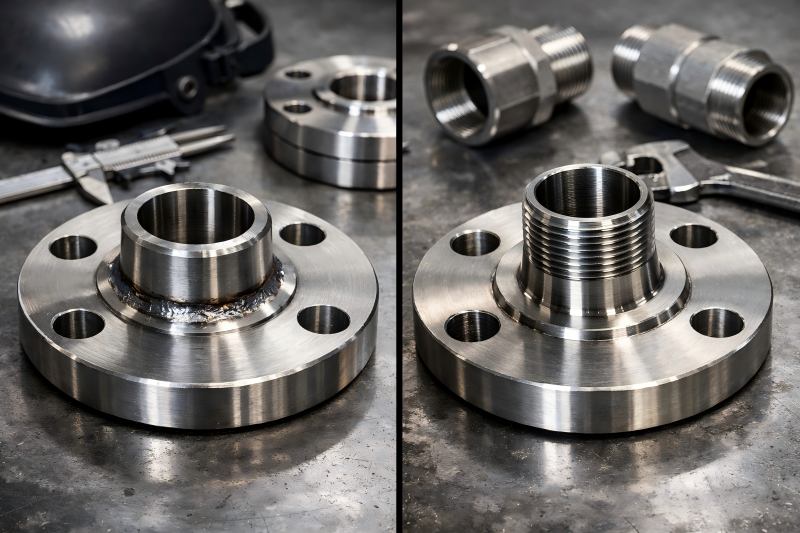
The correct kind of flange must be chosen when designing or maintaining a piping system in order to guarantee its dependability, integrity, and lifespan. Socket weld flanges and threaded flanges are two of the most popular kinds of flanges. Both are designed to connect pipes and maintain the strength and stability of the entire system, but their applications, benefits, and drawbacks differ significantly.
Overview of Socket Weld Flanges

A form of flange known as a socket weld flange has a recessed socket that the pipe is placed into. Once the pipe is fitted into the socket, a full penetration weld is applied around the circumference to create a strong, permanent connection.
Important Socket Weld Flange Features:
- Design: The pipe is welded around itself after being placed into the flange socket.
- Size Range: Typically used for smaller diameter pipes (up to 4 inches).
- Welded Connection: A full penetration weld creates a leak-tight, strong bond between the pipe and flange.
- Pressure Resistance: Suitable for high-pressure systems due to the strength of the welded joint.
Advantages:
- High Pressure Resistance: The full penetration weld ensures a robust seal that can handle high pressure and temperature conditions.
- Leak-Proof: The design minimizes the risk of leaks, which is critical in systems where fluid containment is essential.
- Durability: Socket weld flanges are incredibly resilient and able to endure challenging working circumstances.
Disadvantages:
- Installation Complexity: Installation requires skilled welding, which can increase labor costs and require specific equipment.
- Maintenance: If the flange needs to be replaced, it may require cutting or removing the welded section, which can be time-consuming.
- Limited Size Range: Socket weld flanges are typically used for smaller piping systems (up to 4 inches), limiting their application in larger systems.
A Synopsis of Threaded Flanges

The internal threads of threaded flanges, on the other hand, allow for direct screwing onto the pipe. Because this design does not require welding, threaded flanges can be installed more quickly and easily.
Important Threaded Flange Features:
- Design: The internal threads of the flange correspond to the pipe’s external threads. The flange is then screwed onto the pipe without requiring welding.
- Size Range: Threaded flanges can be used for a wide range of pipe sizes, typically from ½ inch to 24 inches.
- No Welding Required: Threaded connections do not require welding, simplifying installation and reducing costs.
Advantages:
- Simple Installation: Because threaded flanges don’t need to be welded, they are simpler and quicker to install. This can reduce labor costs.
- Cost-Effective: Generally less expensive than socket weld flanges due to the simpler installation process.
- Reusability: The threads allow the flange to be easily removed and reused if necessary, making maintenance and repairs more convenient.
Disadvantages:
- Lower Pressure Resistance: Threaded flanges are not as strong as socket weld flanges and are typically not recommended for high-pressure applications. The threads create weak points that may fail under high pressure.
- Potential for Leaks: The threaded connection may be more prone to leaks, especially in high-pressure systems, as the seal depends on thread integrity and proper torque.
- Vibration Sensitivity: Threaded connections may loosen over time, especially in systems that experience vibration or thermal cycling, which could lead to failure.
Socket Weld Flanges vs. Threaded Flanges: A Comparative Table
Below is a comparison table that highlights the key differences between socket weld flanges and threaded flanges. You can see the important aspects to take into account while deciding between the two with the aid of this table.
| Feature | Socket Weld Flanges | Threaded Flanges |
| Design | Pipe inserted into flange socket and welded | Internal threads on the flange to screw onto the pipe |
| Size Range | Small pipes (typically up to 4 inches) | Larger size range (½ inch to 24 inches) |
| Pressure Resistance | High-pressure resistance | Lower pressure resistance |
| Leak-Proof | Strong, leak-tight connection | Potential for leaks, especially at higher pressures |
| Installation | Requires skilled welding and equipment | Easy installation with no welding needed |
| Maintenance | Difficult to replace or remove without cutting | Can be easily removed and reused |
| Cost | More expensive due to welding labor | Less expensive, cost-effective |
| Applications | High-pressure systems, small pipes | Lower pressure systems, larger pipes |
| Vibration Resistance | High resistance to vibration | Less resistant to vibration |
When to Select Flanges for Socket Welding
High-temperature, high-pressure applications are ideal for socket weld flanges. They are most commonly used in industries such as:
- Oil and Gas: Socket-weld flanges are ideal for use in pipelines that transport high-pressure oil and gas.
- Chemical Processing: These flanges can handle aggressive chemicals and fluids at high pressures.
- Water Treatment: For smaller diameter pipes in pressurized systems where leak prevention is vital.
Socket weld flanges are also a good choice when leak-tight connections are required, and where welding is possible and practical. In smaller piping systems that operate under high pressure, socket weld flanges are often the preferred option due to their durability and strength.
When to Choose Threaded Flanges
Threaded flanges are better suited for applications where ease of installation, lower pressure conditions, and reusability are the priority. They are commonly used in:
- Low-pressure Systems: Threaded flanges are suitable for systems where pressure is not a significant factor.
- Water Systems: Threaded flanges are often used in non-hazardous water pipelines where welding is not feasible.
- Maintenance and Retrofit Projects: Because they are easier to install and remove, threaded flanges are great for retrofit applications where quick changes are necessary.
- Cost-Effective Solutions: For applications with budget constraints, threaded flanges provide a more affordable option than socket weld flanges.
Threaded flanges are often the go-to choice when welding is not possible or when systems do not operate under high-pressure conditions. They are also perfect for systems that might need to be disassembled frequently or for temporary settings.

Advantages and Disadvantages at a Glance
Socket Weld Flanges:
Advantages:
- High pressure and temperature resistance
- Leak-tight, durable connection
- Long-lasting and low maintenance
Disadvantages:
- More complex and costly installation
- Difficult to remove and reuse
- Not suitable for larger pipe sizes
Threaded Flanges:
Advantages:
- Easy and quick installation
- Cost-effective
- Reusable and easy to remove
Disadvantages:
- Lower pressure resistance
- Prone to leakage under high pressure
- Vulnerable to vibration and thermal cycling
The decision between socket weld flanges and threaded flanges depends on the specific needs of the piping system.
- Choose socket weld flanges if you are working with high-pressure systems where leak resistance and durability are paramount. These flanges are ideal for industries that deal with aggressive fluids, high temperatures, or small-diameter pipes where a welded connection is both feasible and beneficial.
- Choose threaded flanges for applications with lower pressure requirements, easy installation needs, and when reusability is a priority. These flanges are a great choice for low-pressure systems, where ease of disassembly and cost-effectiveness outweigh the need for high-pressure resistance.
In practice, a combination of both flange types may be used in the same system, depending on the specific pipe sizes, pressures, and application conditions. You can maintain the safety, effectiveness, and economy of your piping system by being aware of the advantages and disadvantages of each type of flange.