
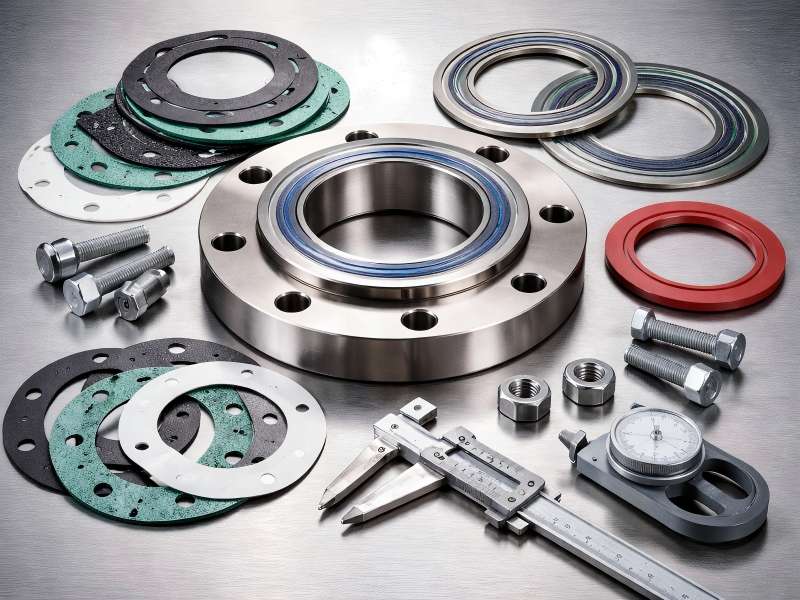
Industrial plumbing for low- to medium-pressure systems frequently uses slip-on flanges. Their ease of installation and cost-effectiveness depend on proper gasket selection to ensure safe, leak-free, and efficient operation.
Understanding Slip-On Flanges

As the name implies, a slip-on flange “slips” over a pipe’s end before being securely welded on the inside and outside. This design is advantageous for its simplicity, alignment ease, and lower stress on the pipe compared to weld neck flanges. Usually, slip-on flanges are utilized in:
- Systems for low-pressure piping
- Water and wastewater pipelines
- HVAC applications
- Low-temperature chemical lines
Despite their convenience, slip-on flanges generally operate at lower pressures compared to other flange types. This makes proper gasket selection even more critical, as these flanges rely on the gasket to achieve a leak-free seal under moderate pressure.
Why Gasket Selection Matters
Gaskets act as sealing elements between two flange faces, compensating for surface irregularities and preventing fluid leakage. Choosing the wrong gasket can result in:
- Leaks: Even small leaks can lead to fluid loss, contamination, and safety hazards.
- Decreased longevity: Gaskets composed of unsuitable materials may deteriorate rapidly and need to be replaced frequently.
- Maintenance issues: Improper gaskets can complicate flange disassembly and reassembly.
- System inefficiency: Pressure drops and reduced flow rates can occur if sealing is not optimal.
For slip-on flanges, where the flange thickness and bolting are often less robust than in weld neck flanges, selecting the correct gasket material, thickness, and type is vital to maintain long-term system integrity.
Key Considerations for Gasket Selection
When choosing a gasket for a slip-on flange, several factors should be considered:
Flange Material and Compatibility
Gasket materials must be compatible with the flange material to avoid galvanic corrosion or chemical reactions. Typical flange materials consist of:
- Carbon steel
- Stainless steel
- Alloy steels
- Aluminum
Some gasket materials react with specific metals or fluids, so compatibility charts should always be consulted.
Temperature and Operational Pressure
Slip-on flanges are frequently utilized in applications with low to medium pressure, usually up to ANSI Class 600. However, system conditions may vary. High temperatures can cause gaskets to harden, crack, or creep, while high pressures can compress them excessively. Always verify the gasket’s pressure-temperature ratings.
| Gasket Material | Typical Temperature Range | Typical Pressure Range | Comments |
| Non-Asbestos | -40°C to 400°C | Up to 3000 psi | Cost-effective, chemically resistant |
| PTFE | -200°C to 260°C | Up to 1500 psi | Superior resistance to chemicals and minimal friction |
| Graphite | -200°C to 450°C | Up to 4000 psi | High temperature and pressure tolerance |
| Rubber (NBR, EPDM) | -50°C to 150°C | Up to 1000 psi | Good for water, oil, mild chemicals |
| Spiral Wound | -200°C to 540°C | Up to 6000 psi | Used for high-pressure, high-temp applications |
Compatibility with Fluid
The fluid being conveyed and the gasket must be chemically compatible. Factors include:
- pH levels: Strong acids or bases can degrade certain materials.
- Solvents: PTFE gaskets handle aggressive solvents better than rubber or graphite.
- Hydrocarbons: Nitrile (NBR) gaskets are generally suitable for oils and fuels.
Manufacturers’ chemical compatibility tables should always be examined.

Type of Flange Face
Common characteristics of slip-on flanges include:
- Flat Face (FF): The gasket rests flat on the flange surface; commonly used with cast iron or other brittle materials.
- Raised Face (RF): Slightly elevated face that concentrates compressive load on the gasket.
- Ring-Type Joint (RTJ): Engineered for use in high-pressure and high-temperature applications.
The gasket type should match the flange face for proper sealing. For most slip-on flanges, RF or FF faces are typical.
Thickness and Compression of the Gasket
Effective sealing without harming the gasket is ensured by proper compression. Factors to consider:
- Too thin: May fail to fill surface irregularities.
- Too thick: May extrude under pressure or reduce bolt load effectiveness.
- Recommended: Use manufacturer guidelines for optimum thickness.
Common Gasket Materials for Slip-On Flanges
Non-Asbestos Gaskets
These are made of synthetic fibers bonded with rubber. Advantages consist of:
- Economical
- Strong tolerance to temperature and chemicals
- Simple to install and cut
Limitations:
- Not suitable for extreme temperatures or very high pressures.
PTFE (Polytetrafluoroethylene)
Ideal for chemical resistance and low-friction applications:
- Manages harsh substances like acids and alkalis
- Broad temperature range: -200°C to 260°C
- Low friction reduces flange wear
Limitations:
- Lower compressibility may require higher bolt loads.
Graphite Gaskets
Graphite gaskets provide excellent thermal stability and chemical resistance:
- High temperature and pressure tolerance
- Suitable for steam, hydrocarbons, and aggressive chemicals
- Excellent recovery and sealing ability
Limitations:
- Can be brittle, may require metal reinforcement.
Rubber Gaskets (NBR, EPDM)
Used for water, mild chemicals, and oils:
- Flexible, resilient, easy to install
- Cost-effective for low-pressure applications
Limitations:
- Limited temperature range; incompatible with some solvents and oils.
Gaskets with spiral wounds
Usually comprised of layers of filler and metal that alternate:
- High-pressure, high-temperature performance
- Suitable for RF or RTJ flange faces
- Excellent resilience and recovery
Limitations:
- More expensive
- Requires precise installation.
Types of Gaskets for Slip-On Flanges
The gasket’s sealing effectiveness is also influenced by its design:
- Full-Face Gasket: Prevents stress concentration by covering the whole flange face.
- Ring Gasket: Fits inside the bolt circle; commonly used for raised face flanges.
- Spiral Wound Gasket: Ideal for RF and high-pressure applications.
| Gasket Type | Suitable Flange | Typical Use | Pros | Cons |
| Full-Face | Flat Face | Low-pressure water, mild chemicals | Uniform load, easy installation | Not ideal for high-pressure |
| Ring | Raised Face | Oils, gases, moderate pressure | Concentrated seal, good recovery | Requires precise flange alignment |
| Spiral Wound | Raised Face | Steam, high pressure | High temp & pressure, resilient | More expensive, complex installation |
Steps for Proper Gasket Selection
Step 1: Determine the System’s Needs
Ranges of temperature and pressure
- Type of fluid
- Flange material and face type
- Regulatory or industry standards (e.g., ASME B16.5, API)
Step 2: Choose Gasket Material
- Cross-check chemical compatibility
- Consider temperature and pressure limits
- Evaluate cost-effectiveness versus performance
Step 3: Select Gasket Type and Thickness
- Full-face vs ring-type vs spiral wound
- Standard thickness determined by pressure rating and flange size
- Ensure sufficient compression to achieve leak-proof sealing
Step 4: Verify Installation Conditions
- Bolt size, torque, and tightening sequence
- Flange surface finish (roughness, flatness)
- Surface treatment (coatings, corrosion protection)
Step 5: Test and Inspect
- Conduct hydrostatic or pneumatic testing
- Check for leaks, bolt relaxation, and gasket integrity
- Adjust the torque or replace the gasket if necessary
Practical Tips for Gasket Installation on Slip-On Flanges
Clean the Flange Surface: Remove rust, paint, oil, or debris.
- Inspect Flange Faces: Ensure no cracks, pits, or irregularities.
- Properly Align the Gasket: Misalignment can cause uneven compression and leakage.
- Tighten Bolts Evenly: Distribute the load using a star or cross pattern.
- Recheck After Thermal Cycling: Systems may expand and contract, requiring bolt retorque.
Common Mistakes to Avoid
- Using a gasket material incompatible with the fluid
- Disregarding the surface condition of the flange
- Using incorrect thickness or type for the pressure rating
- Neglecting temperature effects on the gasket material
Proper gasket selection, considering pressure, temperature, fluid compatibility, flange material, and face type, ensures safe, reliable, and efficient slip-on flange connections. Materials like PTFE, graphite, rubber, and spiral-wound gaskets help prevent leaks and extend system life.