
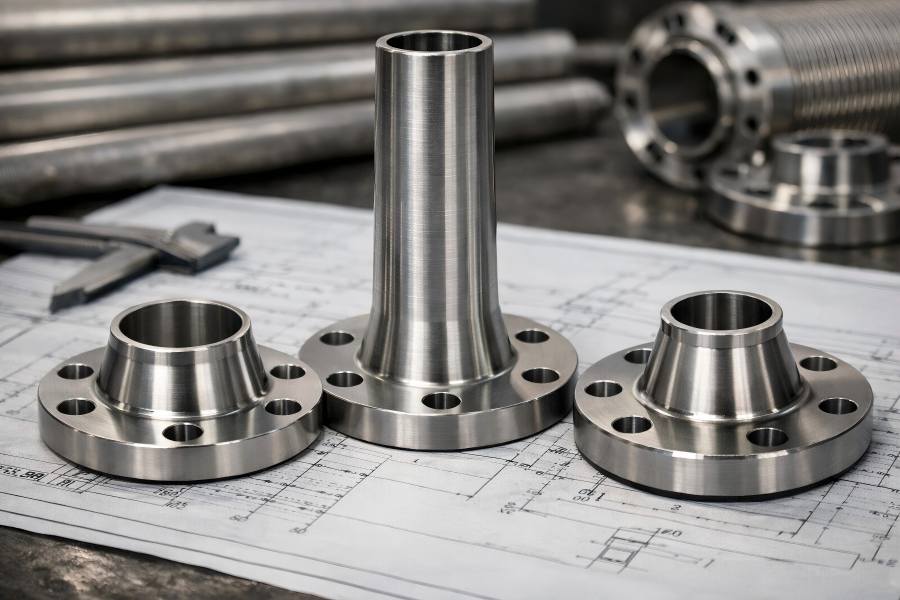
Weld neck flanges are widely used in industrial piping systems because they provide strong, reliable connections for high pressure and temperature conditions. Standard Weld Neck Flanges, Long Weld Neck (LWN) Flanges, and Reducing Weld Neck Flanges are common variations designed for different engineering needs. Understanding their differences helps engineers and buyers select the most suitable option for their piping systems.
What Is a Standard Weld Neck Flange?
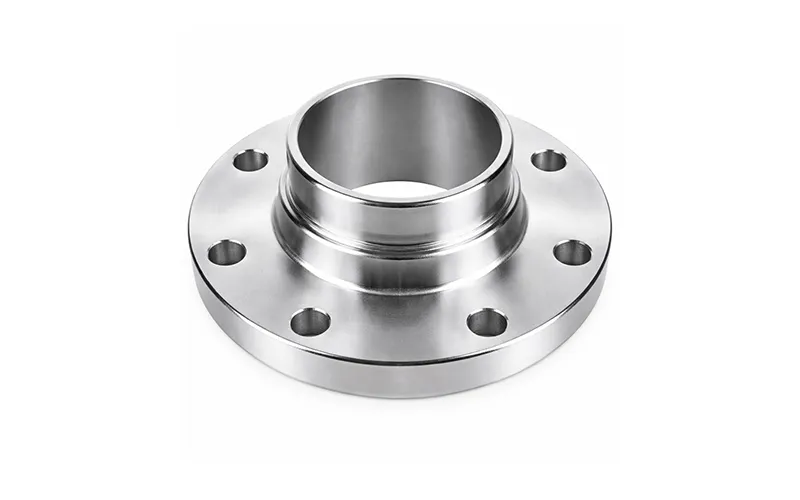
A Standard Weld Neck Flange (WN Flange) is one of the most commonly used flanges in industrial piping systems. It is designed with a long tapered hub that gradually transitions from the flange thickness to the pipe wall thickness. This design helps distribute stress evenly across the connection, reducing the risk of mechanical failure.
Structural Design
The defining feature of a standard weld neck flange is its tapered hub, which is welded directly to the pipe using a butt weld connection. This kind of connection makes the internal bore transition between the pipe and the flange seamless. The smooth flow path minimizes turbulence and reduces erosion within the pipeline.
The flange typically includes the following components:
- Flange face for gasket sealing
- Bolt holes for fastening to another flange
- Tapered neck for stress distribution
- Bore diameter matching the pipe size
This structural configuration ensures that the flange becomes an integral part of the piping system rather than simply acting as an external connector.
| Pros | Cons |
| Excellent strength for high-pressure pipelines | Higher cost than slip-on or threaded flanges |
| Tapered hub distributes stress evenly | Requires skilled butt-weld installation |
| Strong fatigue resistance under pressure cycles | Welding increases installation time |
| Smooth bore reduces turbulence and erosion | Less flexible for pipe size transitions |
| Reliable sealing performance with proper gasket | Not ideal for frequent disassembly |
Typical Applications
Because of their strength and reliability, standard weld neck flanges are widely used in industries such as:
- Chemical processing plants
- Offshore drilling systems
- High-pressure steam pipelines
- Oil and gas pipelines
- Power generation facilities
These industries require piping components capable of operating safely under severe conditions.
What Is a Flange with a Long Weld Neck (LWN)?
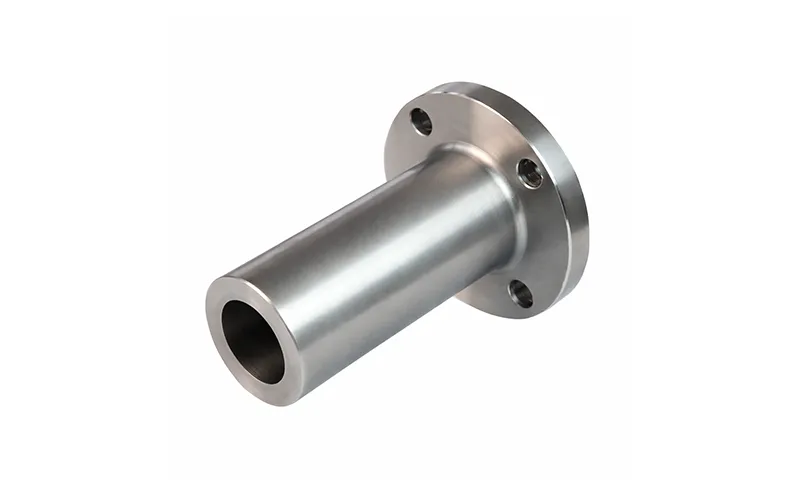
A Long Weld Neck Flange, often abbreviated as LWN flange, is similar in concept to a standard weld neck flange but features a much longer tapered hub. This extended neck provides additional reinforcement and structural support.
Unlike standard weld neck flanges that connect directly to pipes, long weld neck flanges are commonly used in pressure vessels, tanks, and columns where extra reinforcement is required.
Structural Characteristics
The extended neck is the defining characteristic of the LWN flange. The hub is much longer than a typical weld neck flange, though the exact length may vary according on design constraints.
The extended neck allows the flange to function as a nozzle connection for equipment such as pressure vessels. In many cases, the neck thickness is carefully engineered to match the thickness of the vessel wall.
| Pros | Cons |
| Extended neck improves structural reinforcement | Higher manufacturing cost |
| Excellent stress distribution for pressure vessels | Requires more material |
| Ideal for thick-wall equipment connections | Longer forging and machining process |
| Strong performance in high-temperature systems | Heavier than standard flanges |
| Reduces stress concentration near weld area | Limited use mainly in vessel applications |
Typical Applications
- Refinery equipment
- Storage tanks
- Distillation columns
- Heat exchangers
These applications often involve high pressure, high temperature, or thick-walled equipment where standard flanges may not provide sufficient reinforcement.
What Is a Reducing Weld Neck Flange?
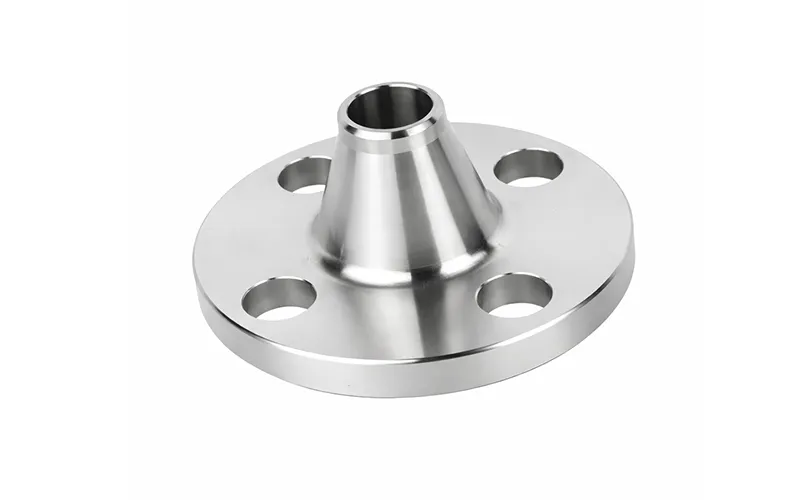
The benefits of a weld neck flange connection are preserved when pipes with varying diameters are connected using a reducing weld neck flange.
Instead of having a bore that matches the pipe diameter, the flange contains a reduced bore that transitions between different pipe sizes.
Structural Design
Reducing weld neck flanges maintain the same overall design as standard weld neck flanges but include a smaller internal bore. This design allows the flange to serve as both a flange and a reducer.
A bigger pipe can be connected to a smaller pipe using a reducing bore while preserving structural integrity and an appropriate flow transition.
The flange is typically manufactured through forging and precision machining to ensure dimensional accuracy.
| Pros | Cons |
| Connects pipes of different diameters | More complex internal machining |
| Eliminates need for separate reducers | Slightly higher cost than standard WN |
| Saves space in compact piping layouts | Bore transition may cause minor flow disturbance |
| Reduces number of welded components | Not suitable for very large diameter reductions |
| Simplifies pipeline design and installation | Requires precise alignment during installation |
Common Applications
Reducing weld neck flanges are often used in:
- Process pipelines
- Chemical plants
- Flow control systems
- Petrochemical systems
- Water treatment facilities
These applications frequently require changes in pipe diameter while maintaining strong and reliable flange connections.
Key Differences Between Standard, Long, and Reducing Weld Neck Flanges
Although these three flange types belong to the same family, their structural designs and applications differ significantly.
| Aspect | Standard Weld Neck Flange | Long Weld Neck Flange | Reducing Weld Neck Flange |
| Neck Length | Standard tapered hub | Extended neck | Standard neck |
| Bore Size | Same as pipe | Same as pipe | Smaller bore |
| Main Purpose | Pipeline connection | Equipment reinforcement | Pipe diameter transition |
| Typical Use | Pipelines | Pressure vessels | Process pipelines |
The table above highlights the fundamental differences that engineers must consider when selecting a flange type.
Design and Structural Comparison
Stress Distribution
Stress distribution is a key factor in flange design. Standard weld neck flanges distribute stress from the pipe into the flange through the tapered hub. As a result, the weld joint experiences less stress concentration.
Long weld neck flanges further improve this distribution by extending the hub length. This is particularly important for equipment connections where the wall thickness may be significantly larger than standard piping.
Reducing weld neck flanges, on the other hand, manage stress associated with diameter transitions in piping systems.
Installation Requirements
All three flange types require butt welding during installation. This welding method ensures a strong metallurgical bond between the pipe and the flange.
During installation, proper alignment is essential to guarantee:
- Uniform bolt load distribution
- Proper gasket compression
- Reliable sealing performance
Reducing weld neck flanges may require additional alignment considerations due to the change in pipe diameter.
Manufacturing Complexity
Manufacturing processes also differ among these flange types.
- Standard weld neck flanges are relatively straightforward to produce using forging and machining processes.
- Long weld neck flanges require longer forging operations and additional material, making them more complex and expensive to manufacture.
- Reducing weld neck flanges requires precise machining of the internal bore to create the diameter transition.
Pressure and Temperature Performance
All three flange types are designed for demanding industrial environments, but their performance capabilities may vary depending on design and material.
| Flange Type | Pressure Capability | Temperature Range |
| Standard Weld Neck | High-pressure pipelines | Wide temperature range |
| Long Weld Neck | Extremely high-pressure equipment | High temperature systems |
| Reducing Weld Neck | Moderate to high-pressure pipelines | Standard industrial temperatures |
Material selection also plays an important role in determining pressure and temperature limits. Common materials include:
- Carbon steel
- Alloy steel
- Stainless steel
- Nickel alloys
Cost Considerations
Cost is an important factor when selecting weld neck flanges for industrial piping systems. While all three flange types belong to the same category, their manufacturing complexity, material requirements, and machining processes can significantly affect their overall price.
Several key factors influence the final cost of a weld neck flange:
- Raw material type (carbon steel, stainless steel, alloy steel, etc.)
- Flange size and pressure class
- Forging and heat treatment processes
- Machining complexity
- Inspection and certification requirements
For example, carbon steel weld neck flanges are typically the most economical, while alloy steel and stainless steel flanges cost significantly more due to material properties and machining difficulty.
Typical Material Cost Comparison
| Material Type | Typical Price Range (USD/kg) | Characteristics |
| Carbon Steel | $1.2 – $2.0 | Economical, widely used |
| Stainless Steel | $3.5 – $6.0 | Corrosion resistant |
| Alloy Steel | $4.0 – $7.0 | High temperature strength |
| Nickel Alloy | $12 – $25 | Extreme corrosion resistance |
Material selection alone can cause the price of a flange to increase 3–10 times compared with standard carbon steel components.
Average Manufacturing Cost by Flange Type
The complexity of forging and machining also affects flange pricing. Long weld neck flanges generally require more raw material and longer forging operations.
| Flange Type | Relative Manufacturing Cost | Reason |
| Standard Weld Neck | Medium | Standard forging and machining process |
| Long Weld Neck | High | Extended hub requires more material and forging time |
| Reducing Weld Neck | Medium–High | Additional internal bore machining |
Typical Price Comparison by Size (Example: 6″ Class 300)
| Flange Type | Typical Price Range (USD) |
| Standard Weld Neck Flange | $90 – $160 |
| Long Weld Neck Flange | $180 – $350 |
| Reducing Weld Neck Flange | $120 – $220 |
In general, long weld neck flanges can cost 1.5–3 times more than standard weld neck flanges, mainly due to their extended neck and increased material consumption.
Reducing weld neck flanges falls between the two in terms of cost, as their internal bore machining requires additional processing but does not require as much raw material as long weld neck flanges.
Additional Cost Factors in Industrial Projects
Beyond the flange itself, several project-level factors can influence total procurement costs:
- Surface treatment (galvanizing, anti-corrosion coating)
- Non-destructive testing (NDT)
- International standards compliance (ASME, ANSI, DIN)
- Transportation and packaging
- Bulk order discounts
For large industrial projects such as oil refineries, offshore platforms, and power plants, flange procurement costs may account for 5–12% of total pipeline material costs, making cost optimization an important consideration during system design.
How to Choose the Right Weld Neck Flange
Selecting the correct flange type requires careful evaluation of system requirements.
Pipeline Diameter Requirements
If the pipeline diameter remains consistent throughout the system, a standard weld neck flange is usually the most appropriate choice.
When a pipeline needs to connect pipes with different diameters, a reducing weld neck flange may be the best option.
Equipment Connection
For pressure vessels, tanks, or heavy industrial equipment, long weld neck flanges provide additional reinforcement and structural integrity.
Pressure and Temperature Conditions
Flanges that can withstand high pressure or extremely high temperatures are necessary for pipelines.
Standard weld neck flanges are suitable for many high-pressure pipelines, while long weld neck flanges are often used for very high pressure vessel connections.
Installation and Maintenance
Ease of installation and maintenance should also be considered. Using a reducing weld neck flange can reduce the number of components in the piping system, simplifying installation and minimizing potential leak points.