
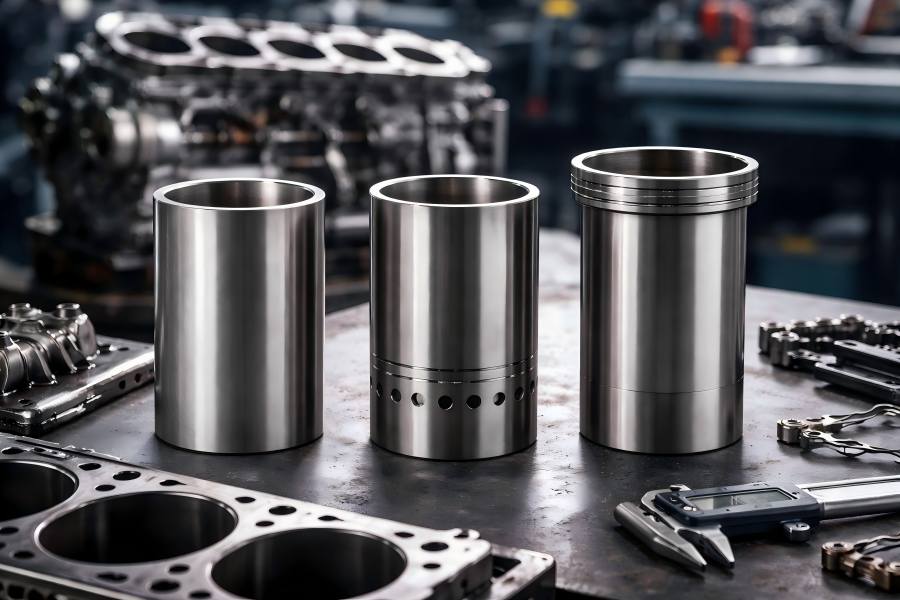
Cylinder sleeves play a critical role in modern engine design, rebuilds, and performance upgrades. Selecting the correct liner type directly affects engine durability, thermal behavior, service life, and rebuild cost. Engine builders must balance cooling efficiency, structural integrity, machining complexity, and long-term reliability when choosing between dry, wet, and flanged cylinder sleeves.
As engines are pushed toward higher power densities, tighter emissions standards, and longer service intervals, the importance of sleeve selection has grown.
What Are Cylinder Sleeves?
A cylinder sleeve, sometimes referred to as a cylinder liner, is a removable cylindrical insert fitted within the engine block bore. It provides the primary running surface for the piston and piston rings, shielding the engine block from wear, thermal stress, and combustion loads.
Cylinder sleeves are typically applied when:
- Aluminum and other softer materials are used to make engine blocks
- Worn or damaged cylinders need restoration
- High-performance or high-load engines require enhanced durability
- Modular serviceability is desired
Sleeves are typically manufactured from centrifugal cast iron, alloyed cast iron, or steel, depending on the application. Some cutting-edge designs use coatings or surface treatments to increase wear resistance and lower friction.
The fundamental functions of a cylinder sleeve include:
- Providing a hard, wear-resistant bore surface
- Maintaining precise cylinder geometry
- Heat transfer to the cooling system from combustion
- Supporting piston ring sealing
- Enabling rebuilds without replacing the entire engine block
The method by which a sleeve interfaces with the engine block and cooling system defines whether it is classified as dry, wet, or flanged.
Dry Cylinder Sleeves
Dry cylinder sleeves are not in direct touch with engine coolant; instead, they are fitted into a machined bore in the engine block. The sleeve is fully supported by the surrounding block material, with heat transfer occurring through the block itself.
Dry sleeves are typically press-fit or shrink-fit into the block bore. Once installed, the internal bore is finish-machined or honed to achieve precise diameter, roundness, and surface finish.
These sleeves rely on tight dimensional tolerances and intimate contact between the sleeve and block to ensure proper heat conduction and structural support.
Advantages
Dry cylinder sleeves offer several structural and manufacturing benefits:
- High block rigidity due to full circumferential support
- Reduced risk of coolant leakage since coolant does not contact the sleeve
- Simpler block sealing design
- Compatibility with many existing engine blocks
- Good dimensional stability under high combustion pressure
Because dry sleeves are fully enclosed by the block, they often provide excellent bore alignment and resistance to distortion, especially in performance or racing engines where block stiffness is critical.
Disadvantages
Despite their strengths, dry sleeves have limitations:
- Heat dissipation is less efficient compared to wet sleeves
- Installation requires precise machining and interference control
- Sleeve replacement can be labor-intensive
- Cooling capacity may be insufficient for sustained high-load operation
- Potential for reduced thermal efficiency in large-bore engines
In engines with high specific output or continuous heavy-duty operation, the indirect cooling path of dry sleeves can become a limiting factor.
Best Use Cases
Dry cylinder sleeves are commonly selected for:
- High-performance gasoline engines
- Racing engines require maximum block stiffness
- Aluminum engine blocks with moderate thermal loads
- Engine rebuilds where coolant system redesign is impractical
- Applications prioritizing structural integrity over cooling capacity
Wet Cylinder Sleeves
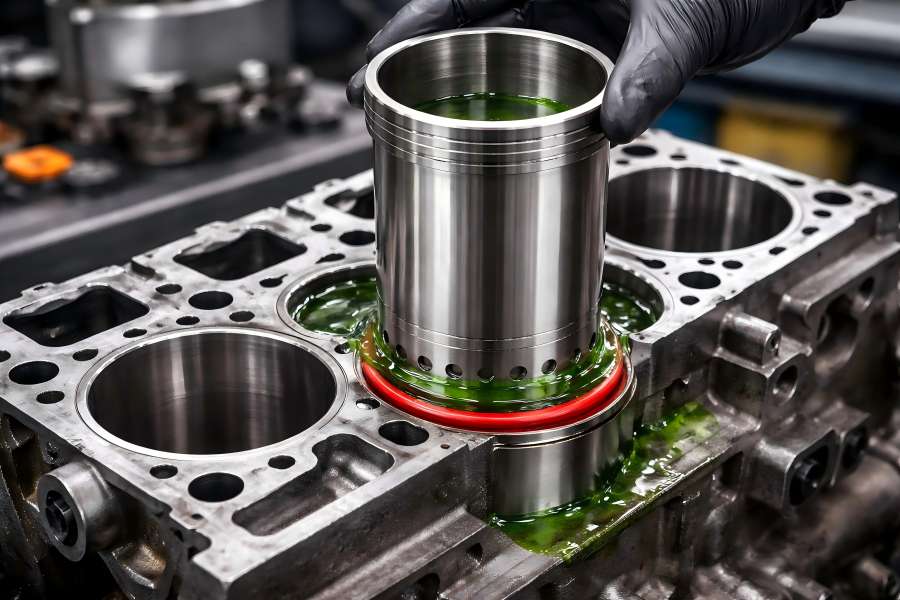
Wet cylinder sleeves are designed so that their outer surface is in direct contact with engine coolant. The sleeve itself forms part of the coolant jacket, allowing heat to be transferred directly from the combustion chamber to the cooling system.
Wet sleeves are typically sealed at the bottom or top using elastomer O-rings or sealing rings to prevent coolant leakage into the crankcase. The upper portion of the sleeve is often supported by the engine block deck.
Because the sleeve is not fully supported along its entire length by the block, its design must carefully manage stiffness, sealing, and alignment.
Advantages
Wet cylinder sleeves offer superior thermal performance:
- Excellent heat transfer due to direct coolant contact
- More uniform cylinder temperature distribution
- Reduced risk of localized hot spots
- Improved piston ring life under high thermal loads
- Easier sleeve replacement during engine overhaul
These characteristics make wet sleeves especially attractive for engines operating under sustained heavy loads.
Disadvantages
The advantages of wet sleeves come with additional complexity:
- Increased risk of coolant leakage if seals fail
- More demanding sealing design and installation
- Potential sleeve movement under high pressure
- Greater sensitivity to corrosion and coolant chemistry
- Reduced block stiffness compared to dry sleeves
Improper installation or degraded sealing materials can lead to catastrophic engine failure, making quality control critical.
Best Use Cases
Wet cylinder sleeves are widely used in:
- Heavy-duty diesel engines
- Industrial power generation engines
- Marine propulsion engines
- Large displacement engines with high thermal loads
- Applications requiring frequent rebuilds
Flanged Cylinder Sleeves
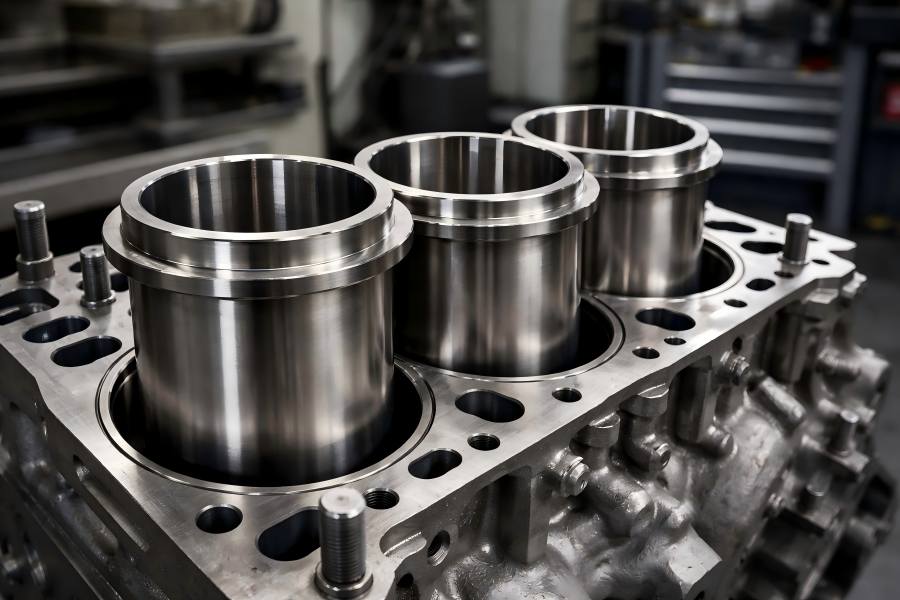
Flanged cylinder sleeves feature an integral flange at the top of the sleeve that seats against the engine block deck surface. The flange provides axial positioning and helps distribute combustion forces into the block.
Flanged sleeves can be either dry or wet in terms of coolant contact. The defining characteristic is the flange, not the cooling method.
The flange prevents the sleeve from moving downward under combustion pressure and ensures consistent deck height alignment.
Advantages
Flanged sleeves provide several critical benefits:
- Positive axial retention under high combustion pressure
- Improved head gasket sealing stability
- Reduced risk of sleeve drop or movement
- Enhanced durability in boosted or high-compression engines
- Accurate and repeatable sleeve positioning
For extreme-duty engines, flanged sleeves often become a structural necessity rather than an option.
Disadvantages
The primary trade-offs include:
- Higher manufacturing and machining cost
- More complex block machining
- Reduced flexibility for future re-machining
- Increased installation time
- Greater design complexity
Best Use Cases
Flanged cylinder sleeves are commonly used in:
- High-boost turbocharged engines
- Racing engines with extreme cylinder pressure
- Large-bore performance builds
- Engines with thin or compromised deck structures
- Applications where sleeve movement must be eliminated
Material and Coating Considerations
Material selection holds equal importance to sleeve type. Typical materials include:
- Gray cast iron: offers superior wear resistance and effective oil retention.
- Alloyed cast iron: features better strength and fatigue resistance.
- Steel: provides outstanding strength for high-pressure scenarios.
Surface treatments and coatings further enhance performance:
- Plateau honing improves oil retention
- Plasma-sprayed coatings reduce friction
- Nickel-based coatings improve wear resistance
- Chrome or ceramic coatings enhance durability
Material choice depends on piston material, ring design, operating temperature, and lubrication strategy.
Performance and Durability Comparisons
Different sleeve types influence engine behavior in measurable ways.
Key Performance Factors:
- Thermal conductivity
- Cylinder distortion resistance
- Wear rate
- Ring sealing stability
- Resistance to cavitation and corrosion
| Factor | Dry Sleeve | Wet Sleeve | Flanged Sleeve |
| Heat Transfer | Moderate | Excellent | Varies |
| Block Stiffness | High | Moderate | High |
| Coolant Leakage Risk | Very Low | Moderate | Low |
| Sleeve Retention | Moderate | Moderate | Excellent |
| Serviceability | Moderate | High | Moderate |
| Cost | Low–Moderate | Moderate | High |
Machining and Installation Factors
Cylinder sleeve installation is a precision machining operation.
Key Machining Considerations:
- Bore roundness and surface finish
- Interference fit tolerance
- Deck flatness
- Sleeve protrusion control
- Alignment with crankshaft centerline
Wet sleeves require precise groove machining for sealing rings, while flanged sleeves require accurate deck counterbores.
Improper machining is a leading cause of sleeve failure, regardless of type.
Application-Specific Selection Guide
Engine builders choose sleeve types based on real-world operating conditions.
Automotive Performance Engines
Dry or flanged sleeves are preferred for stiffness and high RPM stability.
Diesel and Heavy Equipment
Wet sleeves dominate due to cooling efficiency and rebuild convenience.
Marine Engines
Wet or flanged wet sleeves provide thermal stability and serviceability.
Restoration Projects
Dry sleeves allow preservation of original block architecture.
Prototype and Custom Builds
Flanged sleeves offer the highest margin of safety.
Case Studies and Real-World Examples
In high-boost gasoline engines exceeding 30 bar of cylinder pressure, flanged sleeves prevent deck lift and bore movement. In contrast, long-haul diesel engines rely on wet sleeves to maintain thermal balance over thousands of operating hours.
Improper sleeve selection often leads to issues such as:
- Bore distortion
- Head gasket failure
- Excessive oil consumption
- Coolant contamination
Cost and Lifecycle Analysis
| Aspect | Dry Sleeve | Wet Sleeve | Flanged Sleeve |
| Initial Cost | Low | Moderate | High |
| Installation Cost | Moderate | Moderate | High |
| Rebuild Cost | Moderate | Low | Moderate |
| Service Life | Long | Very Long | Very Long |
| Failure Risk | Low | Moderate | Very Low |
Total lifecycle cost often favors wet sleeves in heavy-duty engines, while flanged sleeves justify their cost in performance builds.