
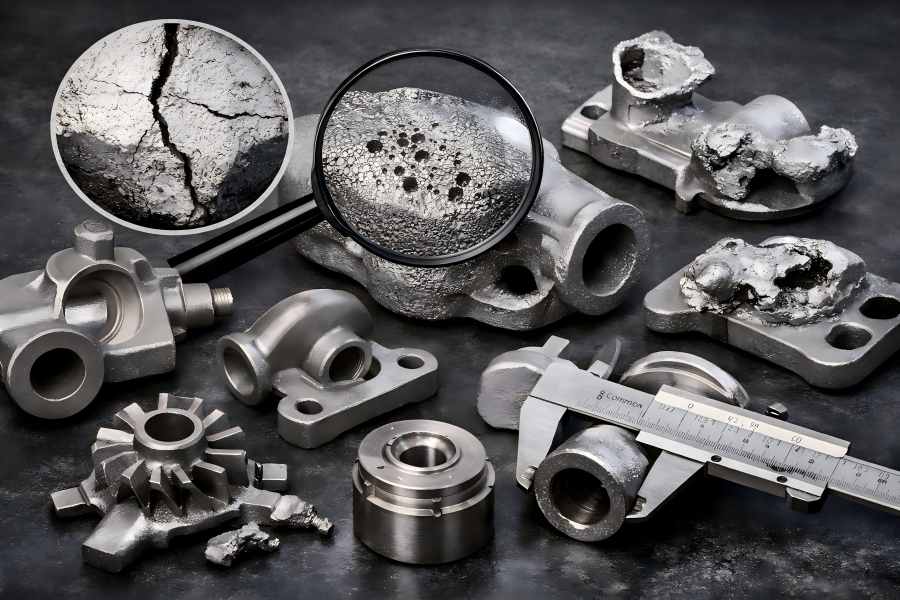
Water glass investment casting, commonly referred to as sodium silicate investment casting, is a precise manufacturing technique that enables the production of complex metal components with smooth surface quality and accurate dimensional control. However, defects can still occur, making it essential to understand their causes and solutions to improve yield and quality.
1. Porosity and Gas Holes
Porosity occurs when voids or cavities form inside the casting or on its surface. These can range from tiny pinholes to larger gas holes that weaken structural performance and reduce part life. In water glass casting, porosity is frequently tied to improper gas escape and moisture in the mold.
Causes:
- Air and gases trapped in the mold cavity or molten metal during pouring.
- Poor venting or inadequate number of vent channels, restricting gas escape.
- High moisture content in the ceramic mold or binder system, especially water glass binders. Moisture can convert to steam and expand during pour, leading to voids.
Solutions:
- Design mold and gating systems with sufficient vents and escape channels to allow trapped gas to exit before metal arrives.
- Thoroughly dry ceramic molds and control humidity during shell drying to eliminate moisture that drives steam formation.
- Use degassing techniques for the molten metal, including vacuum melting or inert gas sparging, to reduce dissolved gas content.
- Employ gentle and controlled pouring practices to minimize air entrapment and turbulence.
2. Shrinkage Cavities and Solidification Voids
Shrinkage defects appear as internal or surface cavities that develop when metal shrinks as it cools and solidifies. Because water glass investment castings are often complex, inadequate compensation for shrinkage can lead to voids that compromise strength and dimensional accuracy.
Causes:
- Insufficient molten metal supply to make up for volume loss during solidification.
- Poor feeder or riser design that fails to feed molten metal to critical areas as they cool.
- Inconsistent or low mold temperature accelerates cooling in specific areas, creating hot spots and increasing shrinkage chances.
Solutions:
- Incorporate proper feeder heads, risers, and chilled areas in mold designs to ensure directional solidification and appropriate metal flow.
- Preheat molds to a controlled and consistent temperature to slow the cooling rate and reduce shrinkage risk.
- Use simulation software during design to predict solidification patterns and adjust gating and feeding systems accordingly.
- Ensure the casting structure avoids large sudden thickness changes, which concentrate cooling stresses.
3. Surface Roughness and Mold Erosion
Surface roughness refers to an uneven, coarse texture on the casting surface that deviates from the expected finish. In water glass investment casting, surface roughness can be caused by mold material issues, poor mold preparation, or turbulent metal flow during filling.
Causes:
- Non-uniform mold material or improper mixing, resulting in inconsistent mold surface properties.
- Inadequate compacting of mold sand and binder, leading to weak shell areas that erode during pouring.
- Turbulent metal flow from poorly designed gating systems, causing mold surface erosion and uneven surfaces.
- Incorrect pouring temperature — too low leads to premature solidification; too high increases chemical reactions with mold.
Solutions:
- Use high-quality refractory sand with proper grain size distribution and uniform binder mixing.
- Compact mold materials thoroughly to ensure consistent density and strength across all shell layers.
- Optimize gating and venting design to smooth metal flow and avoid turbulence.
- Control pouring temperature and rate to match the thermal characteristics of both metal and mold, minimizing surface reaction and roughness.
4. Cold Shuts, Misruns, and Incomplete Fill
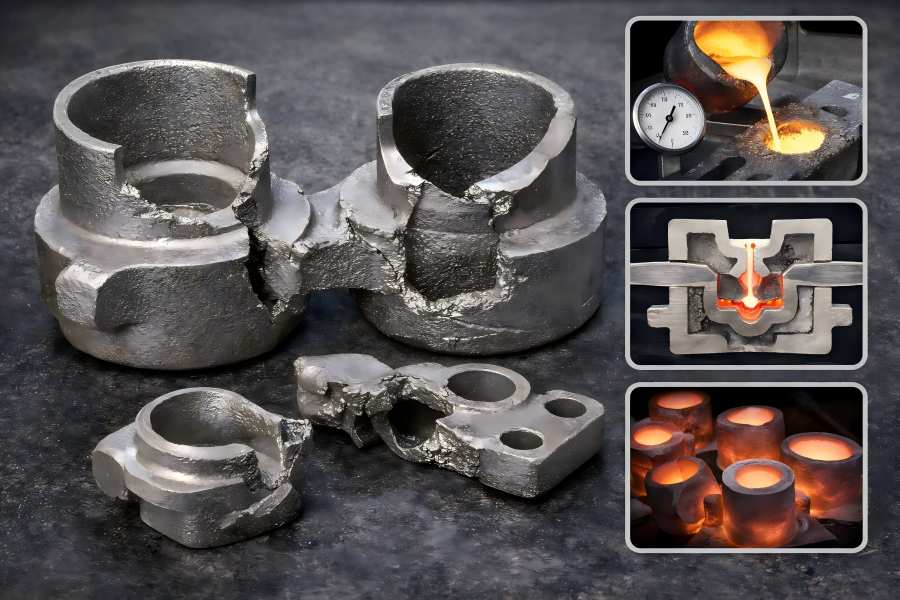
Cold shuts and misruns occur when the molten metal fails to fully fill the mold cavity before starting to solidify. These types of defects appear as incomplete features or unbonded metal fronts with visible seams, reducing part integrity.
Causes:
- Insufficient pouring temperature, reducing metal fluidity and preventing complete filling.
- Slow or irregular metal flow due to poor gating design or restricted cross-sections.
- Improper preheating of shell molds leads to rapid cooling of molten metal before filling is complete.
Solutions:
- Maintain optimal pouring temperature to ensure metal has adequate fluidity to reach all sections of the mold.
- Redesign gating and runner systems with smoother transitions and sufficient cross-sectional area to encourage full cavity fill.
- Preheat ceramic molds consistently to prevent excessive temperature gradients that hamper flow.
5. Cracks and Hot Tears
Cooling frequently causes splits or separations, such as cracks on the casting’s exterior or inside. When metal cools and solidifies unevenly, thermal stresses can exceed material strength, leading to hot tears or fissures.
Causes:
- Rapid cooling and large temperature differentials through the casting lead to high internal stresses.
- Inadequate gating or mold support, creating stress concentration areas.
- High stiffness gradient between thick and thin sections can result in differential contraction, provoking cracks.
Solutions:
- Use controlled cooling techniques to reduce thermal gradients as the casting solidifies.
- Enhance the design and support of the mold to more uniformly transfer stress across the component.
- Add design features such as fillets and transitions to minimize abrupt thickness changes.
- Perform post-casting stress-relief heat treatments when cracking risk is high.
6. Inclusions and Slag Entrapment
Inclusions are foreign materials, oxides, or slag embedded within the finished casting. These non-metallic defects reduce mechanical strength, cause stress risers, and often require costly machining or rejection.
Causes:
- Poor cleaning of molten metal before pouring allows slag, oxides, and impurities to enter the casting cavity.
- Broken refractory fragments from molds or gating channels become entrapped during filling.
- Inadequate flux or filtration during pouring, limiting removal of unwanted material.
Solutions:
- Skim and clean molten metal before pouring to remove as much slag and oxide content as possible.
- Employ ceramic filters in gating systems to trap entrained particles before they enter the mold.
- Use effective fluxing agents to combine with impurities and promote their removal.
- Periodically inspect and maintain furnaces to reduce refractory spallation.
7. Shell Reaction Defects and Veining
Shell reactions occur when molten metal interacts chemically with the mold surface, leading to veining, surface cracks, or adherent sand particles. In water glass investment casting, residual salts and silica-based components can react with metal, causing surface blemishes.
Causes:
- Contaminants or residual compounds in the ceramic shell that react with molten metal.
- Excessively high pouring temperatures increase chemical attack and diffusion.
- Moisture or unbalanced binder composition in water glass shells increases susceptibility to hot chemical interaction.
Solutions:
- Improve the quality and purity of shell materials, removing residual salts and impurities.
- Add a protective mold wash or coating compatible with the casting metal to act as a barrier.
- Reduce pouring temperature to what is necessary for good fluidity while limiting reaction potential.
- Ensure proper shell drying before casting to eliminate moisture.
8. Dimensional Inaccuracy and Warpage
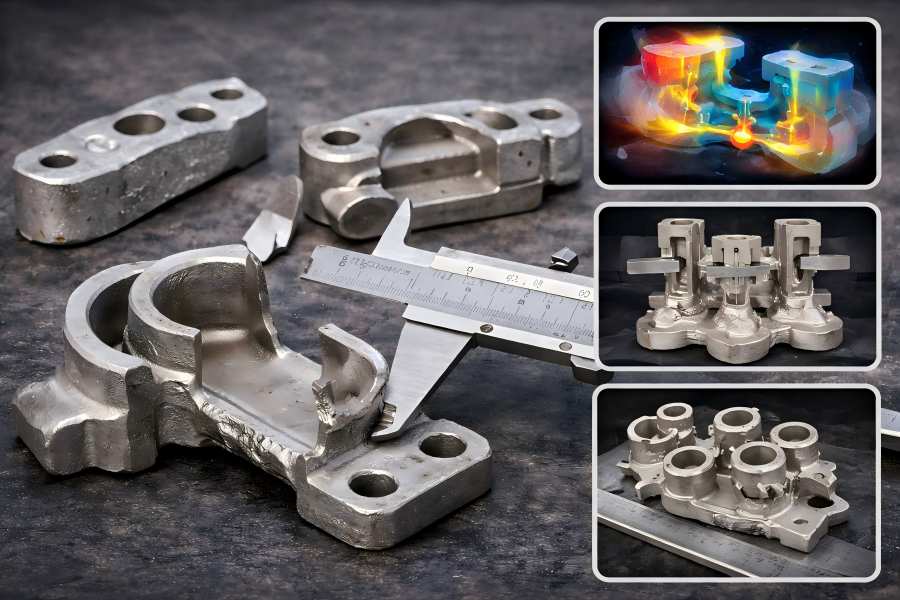
Dimensional inaccuracies occur when cast parts deviate from intended sizes or shapes, while warpage describes distortion from the original geometry. In water glass investment casting, these can originate from uneven solidification or differential shrinkage.
Causes:
- Uneven cooling rates across different part sections cause distortion.
- Poor mold support or inconsistent wall thickness leads to differential contraction effects.
- Premature part removal from the shell before complete solidification.
Solutions:
- Control cooling and solidification uniformly, especially for complex geometries.
- Enhance mold support fixtures and maintain even wall thickness where feasible.
- Allow castings to fully stabilize within the shell before removal or handling.