
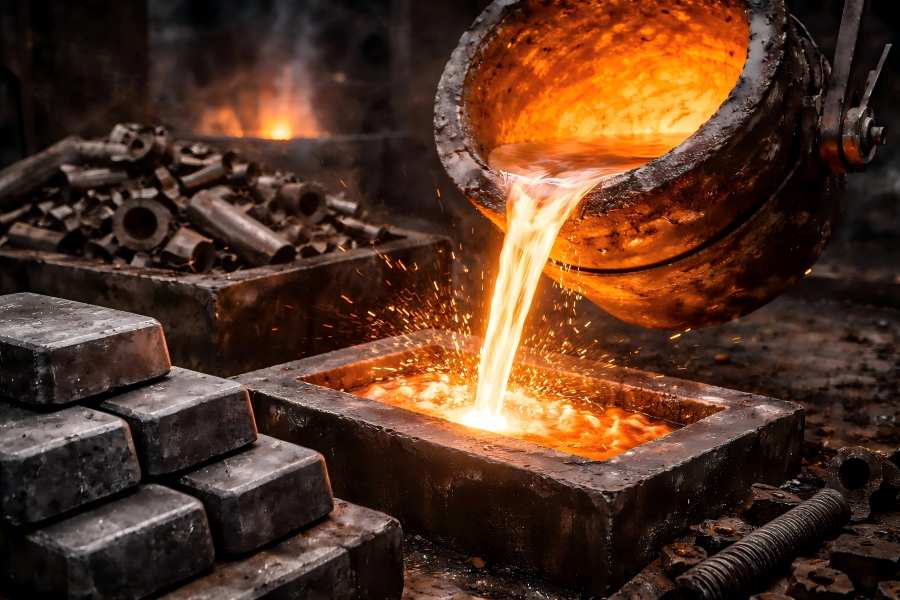
One of the most essential metals in human history and contemporary industry is iron. Its melting point, the exact temperature at which iron transitions from solid to liquid, plays a critical role in manufacturing, engineering, foundry processes, materials research, and construction technologies.
What is the temperature at which iron melts?
For pure iron, this benchmark temperature is 1538°C (which is 2800°F or 1811 Kelvin). At this temperature, iron’s rigid crystalline structure breaks down and transforms into a flowing liquid.
Standard Melting Data for Pure Iron
| Thermal Property | Value |
| Melting Point (°C) | 1538 |
| Melting Point (°F) | 2800 |
| Melting Point (K) | 1811 |
| Boiling Point (°C) | 2862 |
| Heat of Fusion (kJ/kg) | ~270 |
| Density at Melting (g/cm³) | ~7.0 |
These values form the baseline reference for industrial processing and thermal management systems involving iron.
While 1538°C is the accepted melting temperature for pure iron, real-world materials often contain impurities and alloying elements that shift this temperature up or down.
Factors Impacting Iron’s Melting Point
The melting temperature of iron is not static for all forms of iron. This crucial thermal threshold is influenced by a variety of internal and external factors.
Alloying Elements
Iron is rarely used in its pure form. It is alloyed with elements including carbon, silicon, manganese, chromium, nickel, and others in the majority of applications. These substances alter the microstructure of iron and have the ability to change its melting point.
| Alloying Element | Typical Effect on Melting Point |
| Carbon | Lowers melting range |
| Silicon | Lowers melting range |
| Manganese | Moderate influence |
| Chromium | Raises melting range |
| Nickel | Raises melting range |
| Molybdenum | Raises melting range |
Impurities and Material Defects
Uncontrolled impurities introduced during smelting or recycling processes cause melting point depression. Non metallic inclusions, sulfur, phosphorus, and oxygen can disrupt the lattice structure and lead to earlier onset of melting.
Phase and Crystal Structure
Iron exists in several crystal structures at different temperatures: ferrite, austenite, and delta iron. These different phases have distinct thermal responses. As iron heats through these transformations, latent heat absorption slightly alters effective melting behavior.
Pressure Conditions
While most industrial applications assume atmospheric pressure, extreme pressure conditions — such as found in deep earth geology or specialized research — alter the melting behavior of iron dramatically. Higher pressures generally increase the melting temperatures for crystalline solids.
Grain Size and Microstructure
Fine grain structures and specific heat treatments influence how energy is absorbed and distributed in iron, subtly affecting melting initiation.
Why is Knowing the Melting Point of Iron Crucial?
Iron’s melting point is more than a laboratory measurement. It is a cornerstone metric that impacts quality, safety, efficiency, and cost across industries.
Industrial Manufacturing and Foundries
Foundries rely on precise melting point knowledge to maintain efficient furnace operations. Overheating wastes energy and degrades material quality, while underheating leads to incomplete melting, porosity, and casting defects.
Steelmaking and Alloy Design
Steel production involves melting iron and adjusting its chemical composition. Knowing the exact melting behavior enables mill managers to optimize refining times, control carburization, and achieve targeted mechanical properties.
Welding and Fabrication
Welders work within tight thermal windows. Understanding the melting range of iron and its alloys prevents overheating, reduces warping, mitigates cracking, and ensures sound joints.
Material Research and Development
Engineers developing new iron-based materials rely on accurate melting data to model thermal processes, simulate performance, and develop next-generation alloys.
Safety and Equipment Design
Industrial furnaces, crucibles, refractory linings, thermocouples, and protective equipment are all specified based on expected thermal loads. Safety risks and early equipment failure result from misjudging the melting point.
The Comparison of Iron Melting Temperature with Other Metals
Iron’s melting temperature is higher than many common structural metals, yet lower than high-temperature refractory metals. Below is a comparative overview.
Melting Point Comparison Table
| Metal/Element | Melting Point (°C) |
| Aluminum | 660 |
| Copper | 1084 |
| Zinc | 420 |
| Lead | 327 |
| Nickel | 1455 |
| Iron | 1538 |
| Cobalt | 1495 |
| Titanium | 1668 |
| Tungsten | 3422 |
| Molybdenum | 2623 |
Key Observations:
- Iron melts at a higher temperature than structural metals like copper and aluminum.
- Compared to modern refractory metals like molybdenum and tungsten, iron has a lower melting point.
- Compared to lightweight alloys, iron requires more energy to melt, impacting energy consumption in processing.
This relative data helps engineers choose appropriate materials based on service temperatures and thermal budgets.
Melting Temperature of Different Iron Grades
Different grades and classes of iron — based on carbon content, heat treatment, and microstructure — exhibit distinct thermal behaviors.
Melting Ranges by Iron Grade
| Iron Grade | Typical Composition | Melting Range (°C) | Phase Behavior |
| Pure Iron (99.8%+) | Minimal alloying | 1535–1539 | Narrow solidus liquidus |
| Wrought Iron | Low carbon, slag inclusions | 1480–1550 | Slightly variable |
| Grey Cast Iron | 2.5–4% C, high silicon | 1150–1200 | Wide solidus liquidus |
| Ductile Iron | 3–4% C, nodular graphite | 1150–1200 | Controlled graphite |
| White Cast Iron | Low graphite, carbide present | 1200–1300 | Narrow to moderate |
| Malleable Iron | Heat-treated cast iron | 1170–1300 | Decomposed carbon clusters |
| High Carbon Iron | 1.2–2.1% C | 1300–1450 | Solidus depressed |
| Silicon Iron | 3–4% Si | 1200–1280 | Liquidus depressed |
Understanding the Ranges
- Pure and wrought iron sit near the standard melting point and display the most predictable behavior.
- Cast irons with higher carbon and silicon content melt at significantly lower temperatures, often more than 300°C below pure iron.
- The range (solidus to liquidus) indicates how long iron to begin to melt versus when it is fully liquid. Wider ranges can make casting more complex but help reduce cracking.
This table provides critical reference points for engineers and foundry technicians involved in material specification and process control.
How to Melt Iron
Melting iron in industrial and laboratory settings requires specialized furnaces, precise temperature control, and proper flux and refractory materials.
Industrial Furnaces
- Blast Furnaces:
Used primarily for primary iron production from ore. Temperatures exceed 2000°Cinternally due to chemical reactions and coke combustion. - Electric Arc Furnaces (EAF):
Electric arcs heat solid scrap iron and steel above melting temperatures. EAFs provide flexibility and quick thermal ramp-up. - Induction Furnaces:
To directly produce heat in the material, use electromagnetic induction. Induction furnaces are efficient for smaller batches and specialty melts.
Temperature Control and Thermometry
To ensure accurate melting:
- Thermocouples and optical pyrometers monitor temperatures above 1500°C.
- Programmable logic controllers (PLCs) automate heating rates and holding times.
- Calibration routines ensure that crucible zones reach uniform heat.
Flux and Slag Management
Fluxes, typically composed of limestone, silica, and other mineral additives, lower the melting point of unwanted oxides and help capture impurities. Proper slag chemistry improves melt quality and reduces energy consumption.
Crucibles and Refractory Materials
Crucibles for melting iron must resist thermal shock and chemical attack. Advanced refractories like magnesia, silica, or high alumina linings manage temperatures well above the iron melting range.
Safety Considerations
Melting iron involves dangerous conditions:
- Molten iron has high thermal energy and can cause severe burns.
- Handling slags and fluxes requires heat-resistant equipment.
- Ventilation systems remove hazardous gases.
7. How Iron’s Melting and Boiling Points Differ
The melting point and boiling point of a material represent two fundamental thermal transition thresholds:
- Melting Point marks solid to liquid.
- The boiling point marks liquid to gas.
Comparison of Iron’s Thermal Thresholds
| Thermal Transition | Approx. Temperature |
| Solid to Liquid (Melting) | 1538°C |
| Liquid to Gas (Boiling) | 2862°C |
| Liquidus vs Solidus Range | narrow for pure iron |
| Latent Heat Differences | Significant energy required for both transitions |
The boiling point of iron is nearly twice its melting temperature, indicating significant energy is required for vaporization. In most industrial and manufacturing contexts, iron is processed far below its boiling point.
Purpose of Melting Iron
Melting iron is a deliberate step in many manufacturing and fabrication workflows. The purposes fall into several categories:
Metallurgical Refining
Primary iron production involves melting ore, coke, and limestone to extract usable iron. This process removes impurities and enables alloying.
Alloy Creation
Steel and specialty alloys begin with molten iron. Controlled addition of elements like chromium and nickel occurs in liquid form for homogeneity.
Casting and Shaping
Molds are filled with molten iron to produce:
- Engine blocks
- Pipes and fittings
- Structural components
- Artistic castings
Proper control of melt temperatures ensures dimensional accuracy and mechanical performance.
Welding and Joining
Localized melting enables welding processes that join iron components. Controlled melting ensures fusion without excessive base metal dissolution.
Recycling and Reuse
Scrap iron is melted and reformed into new products. Recycling saves energy relative to primary production and reduces environmental impact.
How Iron’s Melting Point Can Be Lowered
In some applications, it is desirable to lower the effective melting point of iron to reduce energy costs, improve fluidity, or accommodate specific casting requirements. Strategies include:
Alloying with Low-Melting Elements
Adding elements such as:
- Carbon
- Silicon
- Tin
- Lead
These elements create liquid phases at lower temperatures, allowing iron mixtures to melt below the pure iron benchmark.
Flux Additives
Certain flux combinations aggressively break down solid oxides and promote earlier liquid formation. Flux design must be optimized to balance lowered melting with minimal contamination.
Grain Refinement and Thermal Treatments
Pre-processing techniques that modify microstructure can reduce energy barriers to melting initiation. Fine-grain structures absorb energy more uniformly.
Pressure Control
Under reduced pressure environments, the effective melting range can shift slightly downward, though this method is more common in research than industrial practice.
Controlled Impurity Introduction
While generally undesirable for mechanical properties, carefully managed impurity levels modify melting behavior. This must be balanced against performance requirements.