
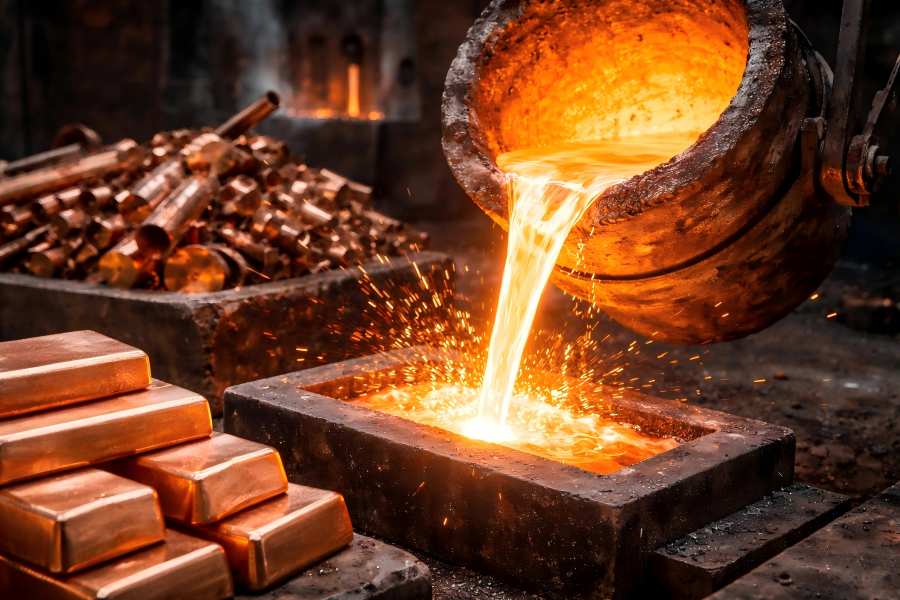
Copper is one of humanity’s oldest and most widely used metals, prized for its conductivity, ductility, and corrosion resistance. One essential physical characteristic that affects the metal’s processing, alloying, and use in industrial and manufacturing processes is its melting point.
What is the temperature at which copper melts?
The temperature at which copper changes from a solid to a liquid under standard atmospheric pressure is known as the melting point. The casting, welding, annealing, and refining processes in a variety of industries, including electronics and aerospace, are impacted by this change, which is a crucial material feature.
- Melting Point of Copper (Pure Cu): 1,084.62°C
- Melting Point in Fahrenheit: 1,984.32°F
- Melting Point in Kelvin: 1,357.77 K
Unlike some metals that display gradual softening, copper maintains a sharp solid-to-liquid transition, making its melting point highly reproducible in controlled environments.
How to Determine the Melting Point
The equilibrium temperature at which the liquid and solid phases coexist is referred to as the melting point in metallurgy and materials science. For pure metals like copper, this point is distinct and does not occur over a range. In practice, small variations can occur due to impurities, pressure changes, or measurement conditions.
Important technical terms utilized in business:
- Solidus Temperature: The temperature below which the material is completely solid.
- Liquidus Temperature: The temperature above which the material is completely liquid.
- Phase Equilibrium Point: The specific temperature at which both solid and liquid phases are in balance.
Why the Melting Point of Copper Matters
The melting point of copper is not just a number; it is central to:
- Casting and Foundry Work: Determines furnace temperatures and mold materials.
- Welding and Brazing: Guides the selection of filler metals and heat input.
- Thermal Processing: Used to optimize annealing and recrystallization schedules.
- Alloy Development: Determines how copper is alloyed with zinc, tin, nickel, and other metals
- .Electrical Component Manufacturing: Impacts processes like wire drawing and connector production.
The performance and reliability of finished products often depend on controlling thermal cycles relative to copper’s melting behavior.
Copper Basics: Composition and Structure
Understanding melting requires knowing copper’s elemental nature:
- Atomic Symbol: Cu
- Atomic Number: 29
- Crystal Structure: Face Centered Cubic (FCC)
- Density (Solid at 20°C): ~8.96 g/cm³
- Thermal Conductivity: ~401 W/m·K (very high among metals)
Copper’s FCC structure contributes to its ductility and relatively high melting point compared to metals like aluminum (660°C) but lower than refractory metals such as tungsten.
Factors That Influence Melting Behavior
Although pure copper has a known melting point, real-world conditions often involve influences that shift or broaden melting behavior:
Purity and Impurities
Trace elements such as oxygen, sulfur, and lead can lower the effective melting point by introducing lattice distortions and changing solidification behavior.
| Impurity | Typical Effect on Copper |
| Oxygen | Can form oxides; slightly lowers local melting behavior |
| Lead | Typically depresses melting point in localized regions |
| Sulfur | Promotes brittleness; marginally affects melting characteristics |
| Phosphorus | Can help remove oxygen; influences melt fluidity |
Alloying Elements
Copper forms many alloys (brasses, bronzes, cupronickel) with distinct melting points.
| Alloy Type | Primary Alloying Element(s) | Approx. Melting Range |
| Brass | Zinc | 900–940°C |
| Bronze | Tin | 950–1,050°C |
| Cupronickel | Nickel | 1,100–1,200°C |
| Beryllium Copper | Beryllium | 865–1,000°C |
Alloying broadens the melting range because mixtures do not have a single, uniform melting point.
Pressure Conditions
While standard melting point measurements are at 1 atmosphere, variations in pressure (very high or vacuum conditions) can slightly modify melting behavior.
Grain Size and Microstructure
Metallurgical conditions such as grain size, cold work, and heat history influence how heat is absorbed but do not change the fundamental melting equilibrium.
Measurement Techniques for Melting Point
Precise measurement of copper’s melting point is essential for calibration and quality control.
Differential Scanning Calorimetry (DSC)
DSC measures heat flow into a sample as temperature rises, detecting phase transitions. Melting onset is seen as an endothermic peak.
Thermocouples in Controlled Furnaces
High precision thermocouples (e.g., Type B, R, S) measure temperature at the moment of phase change.
Optical Pyrometry
Used at high temperatures, optical pyrometers measure thermal radiation emitted from a melting sample in furnaces.
Solidus/Liquidus Detection Methods
In alloy analysis, microscopic observation determines the solidus and liquidus points to define a melting range.
Typical Experimental Setup Parameters
| Parameter | Typical Setting |
| Atmosphere | Inert gas or vacuum |
| Heating Rate | 5–20°C/min |
| Sample Size | Small standard mass (~1–5 g) |
| Calibration | Standard reference metals (e.g., gold, platinum) |
Copper in Industrial Applications: Melting Point Relevance
Casting and Mold Design
Copper and copper alloys are widely cast into ingots, billets, and complex shapes.
- Furnace Temperatures: Usually set 50–150°C above melting.
- Mold Materials: Must withstand temperatures above 1,100°C.
- Cooling Rates: Influence microstructure and final properties.
Welding and Joining Processes
Processes such as TIG welding, MIG welding, and brazing depend on melt behavior:
- Heat Input Control: Critical to prevent excessive grain growth.
- Filler Selection: Matching melting ranges with parent metal.
- Preheating: Sometimes used to reduce thermal gradients.
Metal Forming and Fabrication
While forming operations occur below melting point, knowledge of thermal softening near melting helps:
- Hot Rolling: Typically performed at temperatures between 600°C and 900°C.
- Annealing: A softening process carried out below the melting point (~600–700°C).
- Recrystallization: A heat treatment process used to improve grain structure.
Electronics and Electrical Systems
Copper’s excellent conductivity makes it essential for:
- Wire Drawing: Requires controlled work and annealing cycles.
- Connector Production: Thermal profiles must avoid approaching melting thresholds.
- Soldering: Copper pads on PCBs interact with lower-melting solder alloys.
Data Table: Common Copper Alloy Melting Points
Below is a summary of melting characteristics for widely used copper alloys in industry:
Solidus and Liquidus Temperature Ranges
| Alloy Name | Composition (Primary Additives) | Solidus (°C) | Liquidus (°C) |
| C11000 Copper (99.9% Cu) | Pure Copper | 1082 | 1085 |
| C101 Brass | ~70% Cu, 30% Zn | 907 | 920 |
| C260 Brass | ~70% Cu, 30% Zn | 880 | 940 |
| C932 Bronze | ~95% Cu, 5% Sn | 1005 | 1045 |
| Beryllium Copper | Cu + 0.5–3% Be | 865 | 1,000 |
| Cupronickel 70/30 | 70% Cu, 30% Ni | 1,175 | 1,200 |
| Aluminum Bronze | Cu + 8–11% Al | 1,020 | 1,050 |
This table highlights how alloying impacts practical melting behavior and processing windows.
Thermodynamic Insights: Enthalpy and Heat Capacity
The energy required to melt copper is as important as the melting temperature itself. This property dictates how much heat must be supplied during melting and casting.
| Property | Value |
| Heat Capacity (Solid at 25°C) | ~0.385 J/g·K |
| Heat of Fusion (Copper) | ~13.05 kJ/mol |
| Thermal Expansion Coefficient | ~16.5 µm/m·K |
Understanding these values allows engineers to:
- Calculate energy requirements for melting and holding furnaces.
- Predict thermal expansion during heating and cooling.
- Model heat transfer in casting molds and dies.
Melting Behavior of Copper vs. Other Metals
A comparative overview of melting points provides context for selecting materials in thermal applications.
Comparative Melting Point Table
| Metal | Melting Point (°C) |
| Aluminum | 660 |
| Copper | 1,084 |
| Iron | 1,538 |
| Nickel | 1,455 |
| Gold | 1,064 |
| Silver | 961 |
| Titanium | 1,668 |
| Tungsten | 3,422 |
Key takeaways:
- Compared to aluminum and silver, copper melts at a higher temperature.
- Copper’s melting point is similar to gold’s, slightly higher.
- It is significantly lower than refractory metals such as tungsten and titanium.
Phase Diagram of Copper Alloys
Phase diagrams for binary systems (e.g., Cu–Zn brass, Cu–Sn bronze) are central to understanding melting ranges, solidification paths, and microstructures formed during cooling.
While the copper–copper system has a single point for pure copper, copper alloys exhibit eutectic, peritectic, or solid solution regions depending on composition.
Example: Cu–Zn Brass Diagram Insights
- Below ~35% zinc, brass forms a substitutional solid solution.
- At higher zinc contents, intermetallic phases appear, broadening the melting range.
- Eutectic points define lowest melting compositions.
These diagrams guide:
- Alloy selection based on casting temperatures.
- Cooling rate adjustments to avoid undesirable phases.
- Heat treatment strategies to improve mechanical properties.
Industrial Standards and Classification of Copper Melting
Copper grades and standards define acceptable melting behavior and impurity limits for various applications.
Standard Grade Categories
- Copper Cathode: High purity, typically used for remelting and refining.
- Electrolytic Tough Pitch (ETP): Standard electrical grade with controlled oxygen content.
- Oxygen-Free Copper: Used for high-purity electrical and vacuum applications.
- Deoxidized High Phosphorus Copper: Enhanced brazing and forging characteristics.
Grade selection affects melting behavior because:
- Oxygen and alloying elements alter thermal properties.
- Specific grades are chosen for thermal processing compatibility.
Typical Standard Specifications
| Grade | Purity | Typical Use |
| C11000 | >99.9% | Electrical wiring, high conductivity |
| C10200 | >99.95% | Lab use, high purity needs |
| C12000 | Cu-Zn alloy | Brass fittings |
| C19400 | Cu-Ni alloy | Marine hardware, corrosion resistance |
Practical Considerations in Copper Melting Operations
Furnace Selection and Operation
Different melting equipment is used depending on scale and precision needs:
- Reverberatory Furnaces: Large batch melting with controlled atmosphere.
- Induction Furnaces: Efficient, localized heating with rapid melt cycles.
- Crucible Furnaces: Small batch or specialty alloy melting.
Temperature control systems must maintain stability above the melting point while minimizing oxidation or alloy loss.
Fluxes and Atmosphere Control
Flux materials and controlled atmospheres (inert gases, reducing environments) are used to:
- Reduce oxidation of molten copper.
- Capture impurities and slag.
- Improve surface quality of castings.
Mold Materials and Heat Transfer
Mold choice is critical:
- Sand molds for large, rough castings.
- Ceramic or metal molds for high precision.
- Heat transfer characteristics influence cooling rates and microstructure.
Cooling and Solidification Control
Managing and controlling cooling is crucial to achieving the required mechanical qualities:
- Directional solidification avoids shrinkage porosity.
- Chills and fins accelerate cooling where needed.
- Controlled cooling schedules enhance toughness and grain refinement.
Common Issues and Defects Related to Melting
Certain defects originate during melting, pouring, or cooling:
| Defect | Description | Relation to Melting |
| Porosity | Gas pockets inside casting | Improper melt degassing |
| Cold Shuts | Unfused boundaries | Incomplete filling or low melt temperature |
| Inclusions | Entrapped slag or oxides | Inadequate fluxing |
| Hot Cracking | Cracks on cooling | High thermal gradients |
Understanding copper’s melting and solidification behavior helps prevent these defects.