
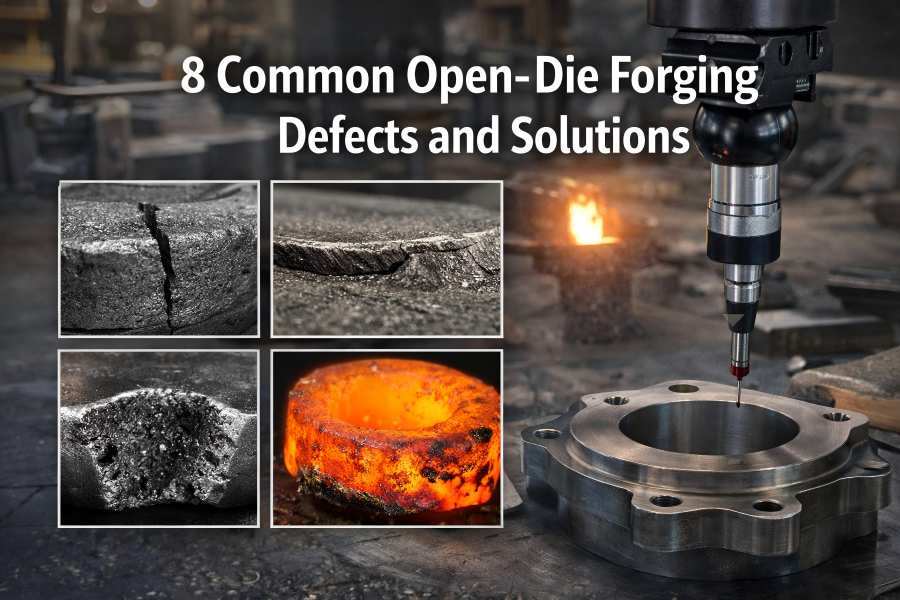
Open-die forging is a widely used metalworking process for producing high-strength components in aerospace, automotive, energy, and heavy machinery industries. Large, intricate designs can be created because it deforms metal under compressive stresses.
However, without careful control of temperature, force, material, and tooling, defects can occur, affecting part integrity, mechanical properties, and performance.
Cracking (Surface and Internal Fractures)
Cracks are visible or subsurface fractures that appear on the surface or within the internal structure of the forged part. These can significantly weaken the part, leading to failure under normal operating conditions, especially in critical stress-bearing areas.
Causes:
- Inadequate forging temperature: Metal that is not heated to the proper temperature becomes brittle, increasing susceptibility to cracking.
- Excessive deformation per pass: When large amounts of material are deformed in a single press stroke, the material may exceed its ductility limit, leading to cracks.
- Sharp corners or abrupt geometry: Sharp angles and sudden changes in cross-sectional area create stress concentration points that promote crack initiation.
- Material defects: Internal inclusions, microcracks, or prior cold work can become weak points where cracks begin during deformation.
Solutions:
- Ensure the metal is heated uniformly within the recommended temperature range for the alloy to prevent excessive brittleness.
- Reduce the amount of deformation in each press pass and use progressive reduction strategies.
- To better evenly distribute stress, avoid acute angles and use tools with rounded transitions.
- Inspect incoming billets for internal defects using techniques like ultrasonic testing to ensure the material is free of inclusions.
Laps and Folds
Laps and folds occur when the surface layers of the metal fold over themselves without proper bonding, creating weak seams or seams that are not fully fused. These can lead to lower structural integrity and potential failure under load.
Causes:
- Surface contamination: Dirt, scale, or oxide present on the billet surface during forging can cause layers of metal to fold over instead of fusing correctly.
- Inadequate metal flow: If the material does not flow properly due to improper die design or forging strategy, it can fold over instead of compressing evenly.
- Misaligned dies: When the dies are not properly aligned, the force is uneven, causing metal to fold over rather than deform evenly.
Solutions:
- Clean the surface of billets thoroughly to remove any scale, oxide, or contaminants before open-die forging.
- Optimize forging sequences to allow for more uniform material flow and reduce the likelihood of folding.
- Check and align the dies carefully to ensure that uniform compression forces are applied to the billet.
Surface Indentations and Marks
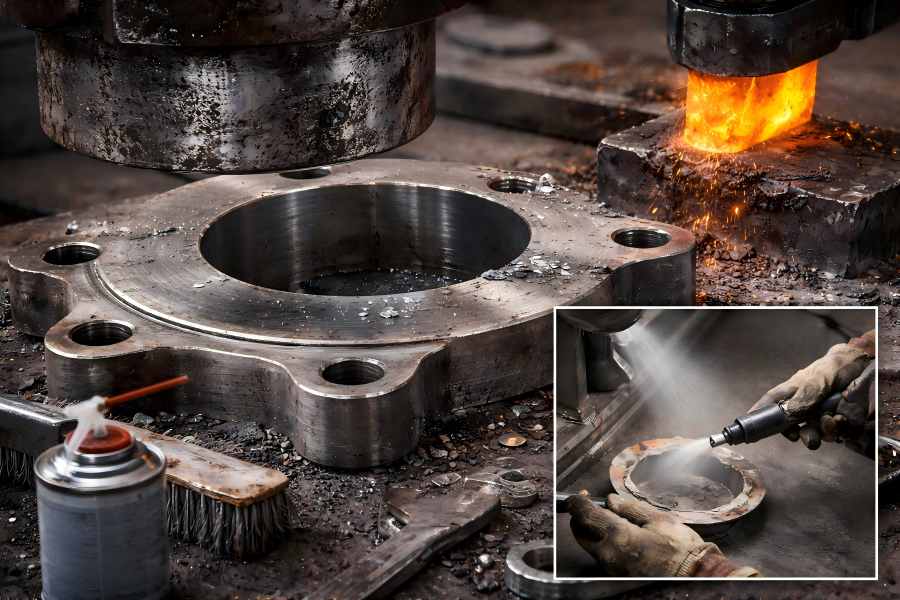
Surface indentations include any sort of dent, pit, or mark on the surface of the forged part. These imperfections can affect the visual appearance and structural integrity of the part, leading to the need for additional finishing or causing stress concentrations.
Causes:
- Dirty or rough tooling: Tooling surfaces that are worn or contaminated can leave unwanted marks on the forged part.
- Foreign debris: Scale, dirt, or other materials that are trapped between the tooling and billet can cause surface marks.
- Uncontrolled hammer or press action: An inconsistent striking action or vibration from the hammer/press can lead to indentations.
Solutions:
- Regularly clean and maintain tooling surfaces to ensure they remain smooth and free from imperfections that can be transferred to the part.
- Use cleaning techniques, such as shot blasting, to remove scale and debris before forging.
- Control the hammer or press settings to minimize vibration and ensure even application of force during forging.
Improper Grain Flow
Improper grain flow occurs when the internal grain structure of the material is not aligned in the direction of expected stresses. This leads to reduced fatigue resistance, decreased tensile strength, and other mechanical issues.
Causes:
- Inappropriate forging sequence: Forging steps that do not properly align the metal with the load-bearing direction result in poor grain alignment.
- Misaligned billet orientation: Billets that are not oriented in the correct direction of the applied loads will result in misaligned grain flow.
- Insufficient forging passes: A lack of progressive reduction leads to uneven strain and poorly aligned grain structure.
Solutions:
- Design forging sequences that ensure metal flow aligns with the expected loading directions.
- Ensure proper billet orientation to match the direction of load-bearing stresses.
- Use progressive forging passes to gradually reduce material and ensure continuous grain flow.
Oxide Scale Inclusion and Surface Oxidation
Oxide scale forms when metal is exposed to oxygen at high temperatures, causing surface oxidation. If not properly removed, oxide scale can be embedded in the forging, resulting in a decrease in mechanical properties and surface quality.
Causes:
- Extended high-temperature exposure: Long periods of exposure to high temperatures in air accelerate oxide formation.
- Reheating without descaling: Multiple reheating cycles without proper scale removal allow additional oxide layers to accumulate.
- Inadequate protective atmosphere: Lack of shielding gases or an inert atmosphere during heating can promote oxidation.
Solutions:
- Limit exposure time at high temperatures to reduce oxidation and scale buildup.
- Implement regular descaling between forging steps using mechanical methods like shot blasting or rolling.
- Use protective atmospheres or inert gases during heating to minimize oxidation.
Distortion and Warpage
Distortion and warpage occur when the forged part becomes bent, twisted, or misaligned from its intended shape. This can occur due to uneven cooling, unbalanced forging forces, or inconsistent heating. Distortion complicates downstream processes such as machining and assembly.
Causes:
- Uneven cooling: Different sections of the part may cool at different rates, causing uneven contraction and resulting in warping.
- Asymmetric forging: Uneven distribution of forces during forging causes the part to deform non-uniformly.
- Inconsistent die temperature: Uneven heating in the dies or tooling can cause thermal gradients, leading to distortion.
Solutions:
- Use controlled cooling strategies such as quenching or insulation to ensure even cooling across the part.
- Design forging sequences to apply uniform forces throughout the process, minimizing the risk of asymmetric deformation.
- Maintain consistent die temperatures by preheating the dies and using controlled temperature management systems.
Porosity and Internal Voids
Porosity and internal voids occur when gas pockets or other voids are trapped inside the metal during forging. These voids weaken the part, reduce its load-bearing capacity, and may result in product failure if not detected.
Causes:
- Trapped gases: Inadequate venting or poor gas escape during the forging process results in internal pockets.
- Low material temperatures: Cold material with low ductility prevents void closure during forging.
- Inclusions or impurities: Trapped non-metallic inclusions can create voids during deformation.
Solutions:
- Make sure there is adequate venting during forging so that gasses can escape before the material solidifies.
- Forge at temperatures that provide adequate plasticity for the material to flow and close internal voids.
- Inspect materials for impurities using ultrasonic or eddy current testing before forging.
Overheating and Burn
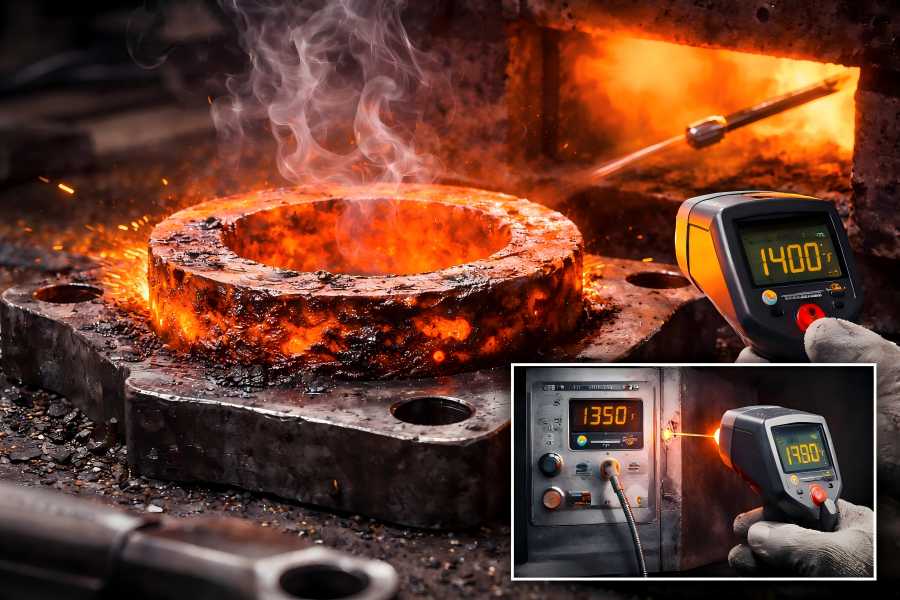
Overheating, or “burning,” occurs when the metal is exposed to temperatures above its recommended forging range. Overheating leads to oxidation, grain coarsening, or even local melting, which weakens the part and degrades its mechanical properties.
Causes:
- Excessive furnace temperature: The workpiece is exposed to temperatures higher than the alloy’s safe range.
- Prolonged soak time: Long periods at high temperatures cause grain growth and oxidation.
- Inaccurate thermal monitoring: Faulty thermocouples or pyrometers lead to overheating of the part.
Solutions:
- Follow the recommended temperature range for the alloy and minimize the time the part spends at high temperatures.
- Use accurate temperature measurement tools, such as calibrated thermocouples, to monitor and control heat levels.
- Minimize reheating cycles and ensure temperature profiles are controlled to prevent thermal damage.